By Daniel Rowles, lead trainer at Target Internet and author of Digital Branding (Kogan Page). Last updated: November 2026.
AI marketing careers are open to far more marketers than most people assume. Roles such as GEO specialist, AI content strategist, AI workflow and automation lead, marketing AI analyst and AI transformation lead are mostly being filled by experienced marketers who have added practical AI skills, not by data scientists. The fastest route is to choose the AI role closest to your current job, build skills on real projects, lead a pilot and reposition yourself with the results.
This guide is for marketers with some experience who want to move towards the AI side of the profession. It explains the roles, shows how common marketing jobs map across, and sets out a practical five-step plan. If you are earlier in your career, start with our guide to new marketing jobs created by AI.
Why are AI marketing careers worth considering now?
Because demand is rising while much of the wider jobs market is flat. PwC's 2025 Global AI Jobs Barometer found that postings for jobs requiring AI skills grew by 7.5% in a year when total postings fell by 11.3%, and that those jobs carried a 56% wage premium. PwC also found skills are changing 66% faster in AI-exposed jobs, which rewards people who move early.
Marketing reflects the same pattern. The American Marketing Association's 2026 State of Marketing Careers report found the share of marketing job postings mentioning AI doubled during 2025, and highlighted emerging roles such as GEO and AEO specialists, AI workflow designers and agentic commerce specialists. In agencies, a MarTech-reported survey found 75% of leaders were hiring AI hybrid roles.
There is a defensive reason too. A Wynter survey of B2B marketing leaders, reported by MarTech, found 47% had already reduced marketing roles because of AI. Moving towards the AI side of your function is one of the most reliable ways to make sure you are part of the team that remains.
What AI marketing careers are available?
The clearest way to think about AI marketing careers is as an evolution of roles you already know. Most AI marketing jobs are a familiar marketing discipline with AI at the centre.
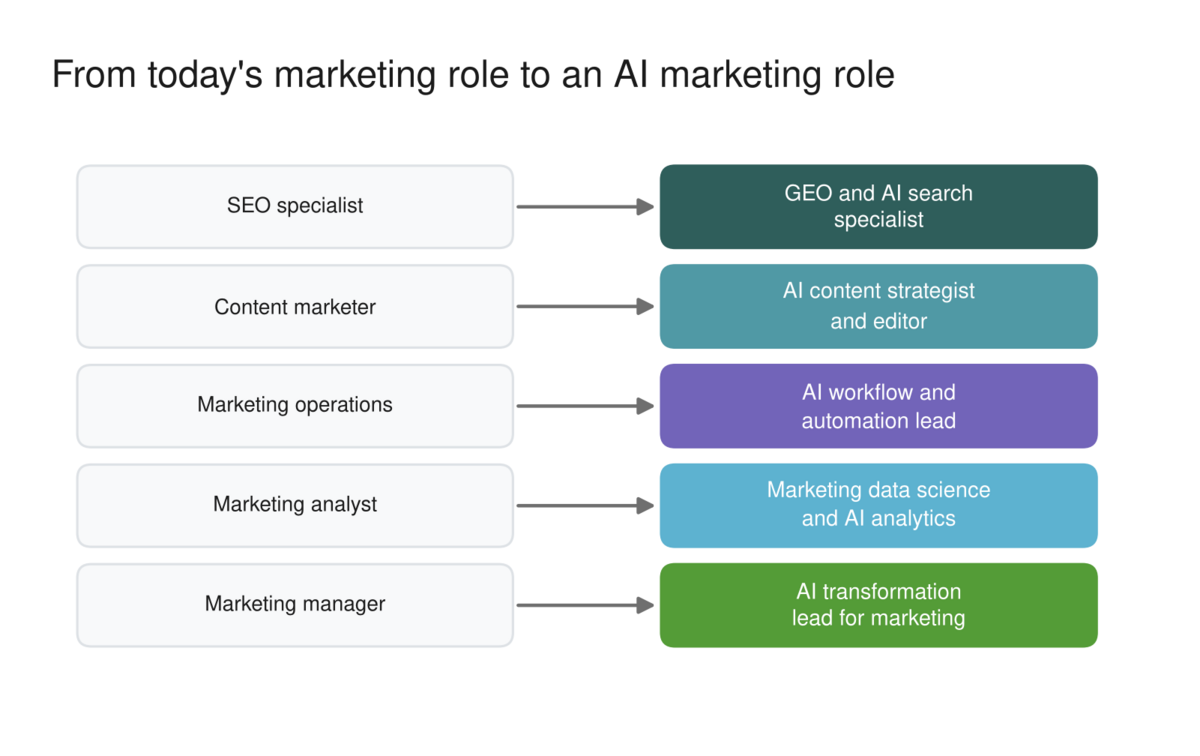
SEO specialist to GEO and AI search specialist. Visibility in AI search tools builds on technical SEO, content structure and authority. This is one of the most natural transitions, and our guide to optimising content for AI Overviews and Google AI Mode is a practical starting point.
Content marketer to AI content strategist and editor. The focus shifts from writing everything yourself to designing content systems, briefing AI, maintaining brand voice and adding original insight. The AMA data shows content marketer postings down 11%, which makes this move particularly timely.
Marketing operations to AI workflow and automation lead. People who already understand marketing platforms and processes are ideally placed to design AI-assisted workflows and agents, and to govern how they are used.
Marketing analyst to marketing data science and AI analytics. Analysts can move into predictive modelling, AI-assisted insight generation and measuring the impact of AI itself. Strong measurement foundations, such as those in our digital marketing dashboard framework, are the base to build on.
Marketing manager to AI transformation lead for marketing. Senior marketers can lead the change itself: setting AI strategy, deciding where AI should and should not be used, managing risk and bringing the team along. This connects closely with AI-assisted digital transformation.
What skills do you need for an AI marketing career?
Your marketing expertise is the foundation, and it is the part that is hardest for anyone else to acquire. On top of it you need three layers of AI capability.
The first is practical AI fluency: structured prompting, building workflows, creating custom assistants and understanding the strengths and limits of different tools. Our guide to the AI skills every marketer needs sets this out as a five-level ladder; AI marketing roles generally sit at the workflow, build or lead levels.
The second is AI literacy: a working understanding of how AI models are trained, why they make mistakes, how data privacy and intellectual property apply, and how to evaluate output quality systematically. You do not need to build models, but you do need to talk confidently with the people who do.
The third is change leadership. Most AI marketing roles involve persuading colleagues to adopt new ways of working. Skills such as stakeholder management, clear communication and measuring results so you can prove the value of change are essential. These are also among the human skills that AI cannot replace.
How do you move into an AI marketing role?
You rarely need to start again. The most successful moves follow a simple sequence that builds evidence as you go.
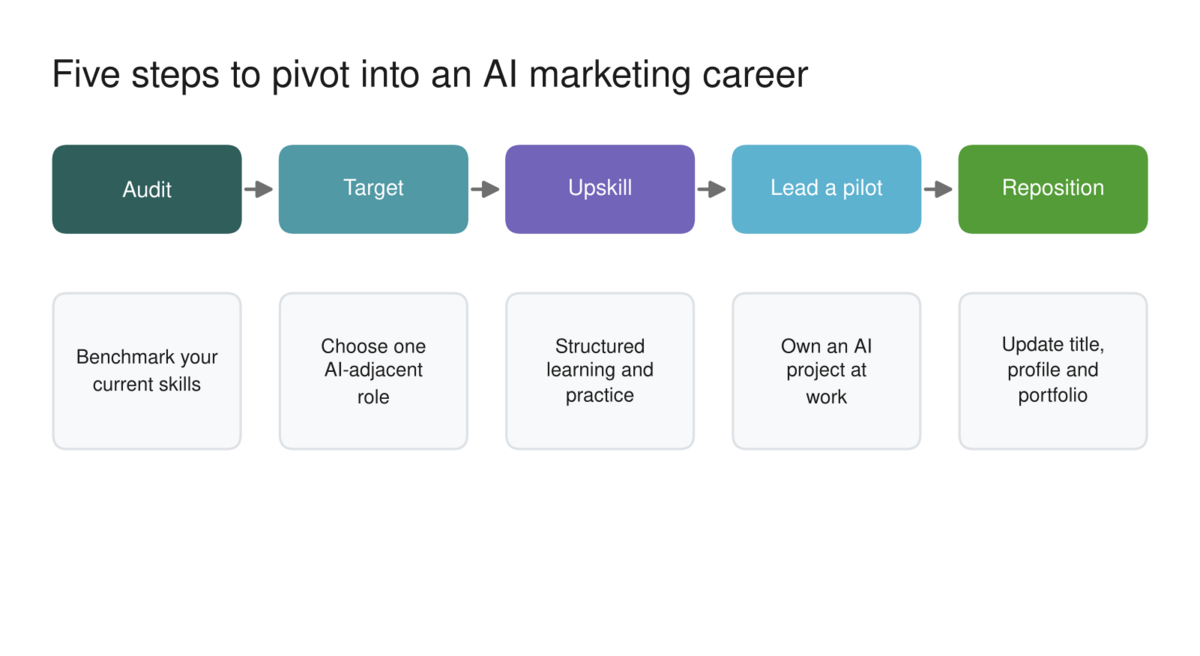
1. Audit your skills. Use our digital marketing skills benchmark to understand your strengths and gaps across marketing and AI.
2. Target one role. Choose the AI role closest to your current expertise. A focused move is easier to make and easier for employers to understand.
3. Upskill with structure. Combine structured learning with daily practice on your own work. For deeper AI skills beyond marketing, our sister platform Target AI Skills covers AI strategy, tools and workflows for business professionals.
4. Lead a pilot. Volunteer to own an AI project at work with a clear business goal, such as reducing content production time or improving visibility in AI search. Agree success measures up front, and document the process and results.
5. Reposition yourself. Update your job title where appropriate, your LinkedIn profile and your CV to reflect the AI work you are now doing, and use your pilot as the headline case study.
AI can help you plan the move, as long as you check its suggestions against your real situation.
Copy and paste prompt: "I am a [current role] with [number] years of experience in [sector]. My strongest skills are [list] and my AI experience so far is [describe]. I want to move into a role such as [target AI marketing role] within [timeframe]. Map my existing skills to that role, identify the three most important gaps, and suggest a pilot project I could propose at work to build and demonstrate those skills. Include how I should measure the pilot's success."
The Target Internet platform supports every step, with interactive courses across digital marketing and AI, skills benchmarking to show where your gaps are, accredited certification, over 400 episodes of the Digital Marketing Podcast, and monthly live masterclasses.
Frequently asked questions
Can a marketer move into AI without a technical background?
Yes. Most AI marketing roles need marketing expertise plus practical AI fluency, not a computer science degree. Prompting, workflow design, quality control and change leadership can all be learned, and your marketing knowledge is the harder part to replace.
What is the best AI marketing career to move into?
Usually the one closest to your current role. SEO specialists move most easily into GEO, content marketers into AI content strategy, operations staff into workflow and automation, analysts into AI analytics and managers into AI transformation leadership.
Do AI marketing roles pay more?
PwC found a 56% average wage premium for jobs requiring AI skills across industries. Pay varies by role, sector and location, but marketing roles that combine expertise with strong AI skills generally command higher salaries than equivalent roles without them.
How long does it take to move into an AI marketing role?
Many marketers make the move within six to twelve months by building skills on real work and leading a pilot project. The timeline depends on how far your target role is from your current one and how much opportunity you have to practise at work.
Should I move into AI or stay a marketing specialist?
The choice is becoming less binary. Most marketing specialisms now involve AI, so building AI capability within your specialism is sensible either way. A full move into an AI-focused role suits people who enjoy process design, experimentation and leading change.
If you are ready to take a structured approach to building your digital marketing skills, explore Target Internet membership options and discover how the platform's interactive courses, benchmarking tools, podcast, accredited certification and live masterclasses can help you make the move into an AI marketing career.
About the author
Daniel Rowles is lead trainer at Target Internet and the author of Digital Branding (Kogan Page). He co-hosts The Digital Marketing Podcast and delivers digital marketing and AI training for organisations around the world, including digital transformation and future skills. You can find out more on his Target Internet profile.
Bibliography
1. PwC (2025). 2025 Global AI Jobs Barometer. https://www.pwc.com/gx/en/news-room/press-releases/2025/ai-linked-to-a-fourfold-increase-in-productivity-growth.html
2. American Marketing Association (2026). 2026 State of Marketing Careers Report. https://ama.org/marketing-news/2026-career-report
3. MarTech (2025). AI is changing the hiring practices of marketing agencies. https://martech.org/ai-is-changing-the-hiring-practices-of-marketing-agencies/
4. MarTech (2026). AI is powering the loss of marketing jobs. https://martech.org/ai-is-powering-the-loss-of-marketing-jobs/