By Daniel Rowles, lead trainer at Target Internet and author of Digital Branding (Kogan Page). Last updated: November 2026.
The new AI marketing jobs emerging in 2026 include generative engine optimisation (GEO) specialists, AI workflow designers, marketing technologists, AI content strategists and agentic commerce leads, alongside fast growth in human-led roles such as influencer marketing. Most of these roles are being filled by existing marketers who have added practical AI skills, which makes them very achievable if you start building evidence now.
The headlines tend to focus on jobs that AI removes. This article looks at the other side of the ledger: the roles AI is creating, what they actually involve, and how to get one. If you want to understand the risks first, read our guide to which marketing roles are most at risk from AI.
Is AI creating new marketing jobs?
Yes, although not yet at the same pace as it is changing existing ones. Gartner research reported by Marketing Dive found that 16% of marketing leaders have already created new roles because of AI, compared with a fifth who have eliminated roles. In agencies the shift is even clearer: a survey of 225 US agency leaders reported by MarTech found that 75% were hiring AI hybrid roles that combine marketing expertise with AI skills.
The wider jobs market shows the same direction. PwC's 2025 Global AI Jobs Barometer found that postings requiring AI skills grew by 7.5% in a year when total job postings fell by 11.3%, and that those jobs carried a 56% wage premium. In other words, AI skills are one of the few areas where demand is rising while the overall market tightens.
What new marketing jobs is AI creating?
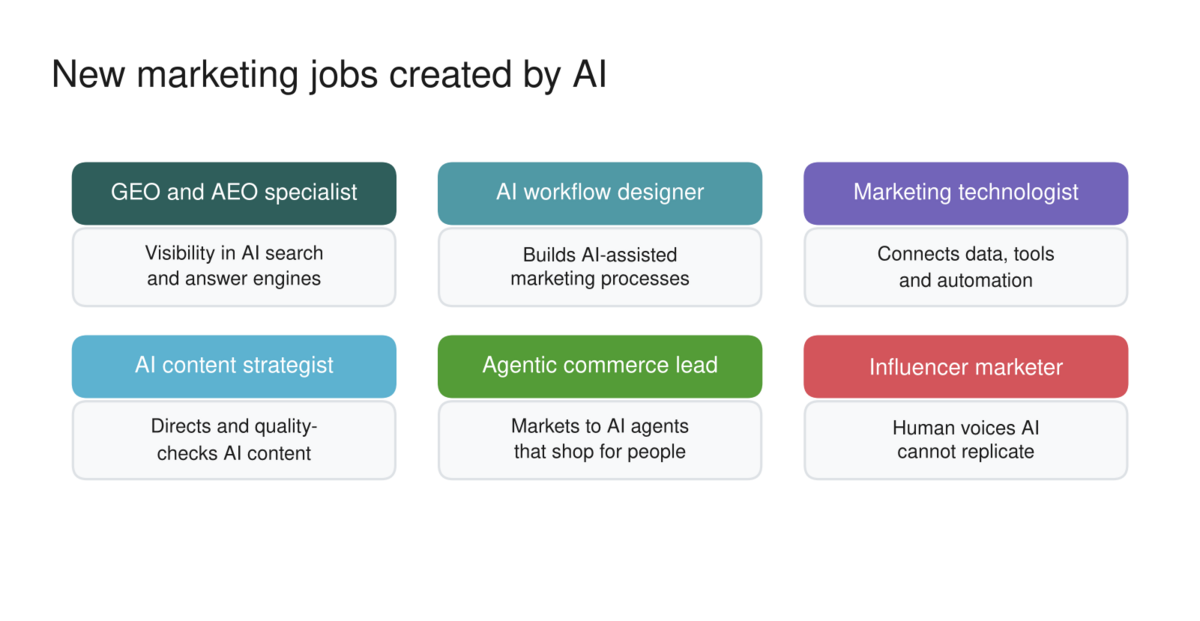
The American Marketing Association's 2026 State of Marketing Careers report highlights several emerging and growing roles. Combined with what we see in job postings, these six stand out:
- GEO and AEO specialist. Generative engine optimisation and answer engine optimisation focus on making a brand visible and accurately represented in AI search tools such as Google AI Overviews, ChatGPT and Perplexity. It builds directly on SEO skills, which is why many SEO specialists are moving into it.
- AI workflow designer. This role maps marketing processes, identifies where AI can help, and builds repeatable, quality-controlled workflows that the rest of the team can use. It blends process thinking, prompting and change management.
- Marketing technologist. Sometimes called a martech lead, this person connects data, platforms and automation so that AI tools have good inputs and outputs that can be measured. Demand rises as teams add more AI tools.
- AI content strategist. Rather than writing everything by hand, this person sets the content strategy, briefs AI tools, edits for quality and brand voice, and adds the original insight that AI cannot supply.
- Agentic commerce lead. An early-stage role focused on how brands are discovered and chosen when AI agents research and buy on behalf of customers. The AMA lists agentic commerce specialists among the roles beginning to appear.
- Influencer and creator marketer. Not an AI job as such, but growing because of AI. Influencer marketing roles grew by 10% in 2024 and 18% in 2025, according to Bloomberry data cited by the AMA, as brands look for trusted human voices.
Job titles in this area are still settling down, so you will see the same work advertised under different names. Search for the skills and responsibilities rather than an exact title, and look inside existing roles too: many "digital marketing manager" postings now describe AI workflow work without using the phrase.
What skills do new AI marketing jobs need?
Each role has its own technical skills, but they share a common core. Employers are looking for a combination of marketing fundamentals, practical AI fluency and the judgement to know when AI output is good enough. The AMA's list of future-proof skills captures this well: adaptability, comfort with ambiguity, strategic thinking, decision-making, quality control, business acumen, taste and original thinking, influence and storytelling, and AI fluency.
In practice, that breaks down like this:
- Marketing fundamentals: understanding customers, positioning and channels well enough to brief an AI tool properly and spot when its output is off-strategy.
- AI fluency: confident everyday use of AI assistants, structured prompting, and building simple automations or custom assistants.
- Data and measurement: knowing how to prove that an AI-assisted process improved results, using tools such as GA4. Our free GA4 course on key events is a good starting point.
- Change and communication skills: new AI roles often involve persuading colleagues to work differently, which makes stakeholder management a core skill rather than a nice extra.
We break down the AI part in more detail in the AI skills every marketer needs.
How do you get a new AI marketing job?
The good news is that most of these roles are being filled from inside marketing, not from computer science. Employers want people who understand marketing and can make AI useful in it. That means the fastest route is usually to grow into the role where you are, then use that evidence to move up or move on.
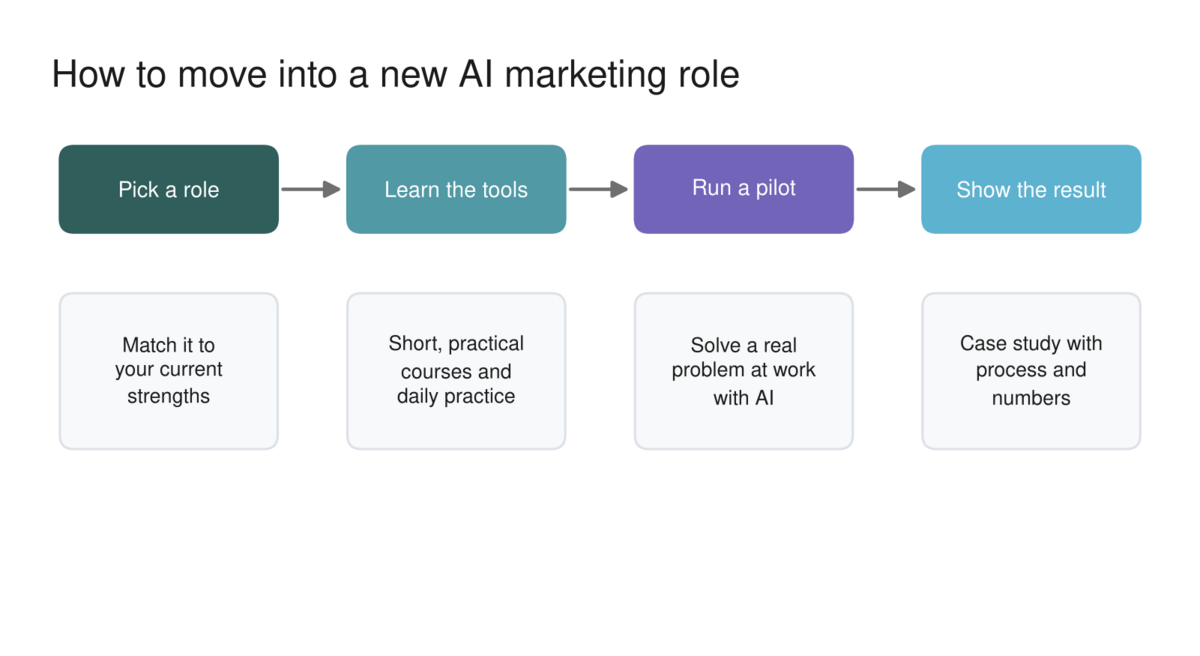
- Pick a role that matches your strengths. SEO specialists have a natural route into GEO. Content marketers suit AI content strategy. Operations and CRM people are well placed for workflow and martech roles.
- Learn the tools in context. Short, practical learning applied straight away to your own work beats long theoretical courses. Practise daily on real tasks.
- Run a pilot. Pick one real problem at work, such as speeding up campaign reporting or improving visibility in AI search, and solve it with AI. Agree with your manager what success looks like before you start.
- Show the result. Write it up as a short case study with the process you followed, what you checked and the numbers. This becomes the centrepiece of your CV, LinkedIn profile and interviews.
When you are ready to describe that experience, use AI to help you find the strongest framing, then edit it so it sounds like you.
Copy and paste prompt: "I am a [current role] applying for [target AI marketing role]. Here is a description of an AI project I led: [describe the problem, what you did, the tools you used, what you checked and the results]. Rewrite this as three CV bullet points and a 150-word LinkedIn summary that emphasise business results, my judgement and the AI skills involved. Avoid jargon and do not exaggerate anything I have not stated."
For a longer-term plan, our guide to AI careers for marketers sets out how to pivot fully into an AI marketing role. The Target Internet platform supports every stage, with interactive courses across digital marketing and AI, skills benchmarking to show where your gaps are, accredited certification, over 400 episodes of the Digital Marketing Podcast, and monthly live masterclasses.
Frequently asked questions
What is a GEO specialist?
A generative engine optimisation (GEO) specialist works to make a brand visible, accurately described and recommended in AI-powered search and answer tools. The role builds on SEO but adds work on content structure, authority signals and monitoring how AI tools describe the brand.
Do I need to know how to code to get an AI marketing job?
For most roles, no. GEO, AI content strategy and many workflow roles rely on marketing knowledge, structured prompting and no-code tools. Some marketing technologist roles benefit from basic scripting or data skills, but these can be learned alongside the job.
Are new AI marketing jobs well paid?
PwC found that jobs requiring AI skills carry a 56% wage premium on average across industries. Actual pay depends on the role, sector and location, but the direction is clear: marketing roles that combine expertise with AI skills command higher salaries.
Can I move into an AI marketing role without changing employer?
Often, yes. Many organisations create these roles for people who have already shown initiative with AI internally. Running a successful pilot and sharing the results is one of the most reliable ways to have a new role shaped around you.
Which new AI marketing job is easiest to move into?
The easiest move is usually the one closest to your current skills. SEO specialists move most naturally into GEO, content marketers into AI content strategy, and marketing operations or CRM staff into workflow and martech roles.
If you are ready to take a structured approach to building your digital marketing skills, explore Target Internet membership options and discover how the platform's interactive courses, benchmarking tools, podcast, accredited certification and live masterclasses can help you step into one of the new roles AI is creating.
About the author
Daniel Rowles is lead trainer at Target Internet and the author of Digital Branding (Kogan Page). He co-hosts The Digital Marketing Podcast and delivers digital marketing and AI training for organisations around the world, including digital transformation and future skills. You can find out more on his Target Internet profile.
Bibliography
1. Marketing Dive (2025). CMOs must rethink entry-level talent as AI alters marketing needs: Gartner. https://www.marketingdive.com/news/cmos-must-rethink-entry-level-talent-as-ai-alters-marketing-needs-gartner/831604/
2. MarTech (2025). AI is changing the hiring practices of marketing agencies. https://martech.org/ai-is-changing-the-hiring-practices-of-marketing-agencies/
3. PwC (2025). 2025 Global AI Jobs Barometer. https://www.pwc.com/gx/en/news-room/press-releases/2025/ai-linked-to-a-fourfold-increase-in-productivity-growth.html
4. American Marketing Association (2026). 2026 State of Marketing Careers Report. https://ama.org/marketing-news/2026-career-report