By Daniel Rowles, lead trainer at Target Internet and author of Digital Branding (Kogan Page). Last updated: November 2026.
The skills AI can't replace in marketing are the ones that depend on accountability, context and human connection: strategic judgement, critical thinking, ethical decision-making, original ideas, taste, empathy for customers, storytelling, leadership and stakeholder management. AI can generate options and content at remarkable speed, but it cannot take responsibility for a decision, sense what a nervous client is not saying, or earn the trust that gets a bold idea approved.
As AI takes on more of the production work in marketing, these human skills are becoming the main thing that separates one marketer from another. This guide explains why, sets out the skills in three groups, and shows how to develop them deliberately. For the full set of skills to prioritise, see our guide to AI-proof marketing skills.
Why are some marketing skills hard for AI to replace?
There are four reasons, and they apply even as AI models keep improving.
The first is accountability. Someone has to own the decision to spend the budget, launch the campaign or change the positioning. Organisations need a person who can explain the reasoning, take the consequences and adjust course. AI can recommend, but it cannot be held responsible.
The second is context. Much of what matters in marketing is not written down anywhere an AI can read it: the history behind a product decision, the politics of a leadership team, the mood of a customer community this week. Humans absorb that context through relationships and experience.
The third is originality. AI models learn from existing content, so their output tends towards the familiar. That is useful for many tasks, but brands are built on being distinctive. Recognising a genuinely fresh idea, and having the confidence to back it, is a human strength.
The fourth is trust. People buy from, work with and follow people they trust. Influencer marketing roles grew by 18% in 2025, according to Bloomberry data cited in the American Marketing Association's 2026 State of Marketing Careers report, which suggests brands are investing more in human voices as AI-generated content becomes more common.
The same AMA report lists strategy, brand management, collaboration, creativity, critical thinking, leadership, emotional intelligence, ethical decision-making and adaptability as the least disrupted marketing skills. The World Economic Forum's Future of Jobs Report 2025 reaches a similar conclusion across all industries, with analytical thinking ranked as the top core skill and creative thinking, resilience and curiosity all growing in importance.
What are the human skills AI can't replace in marketing?
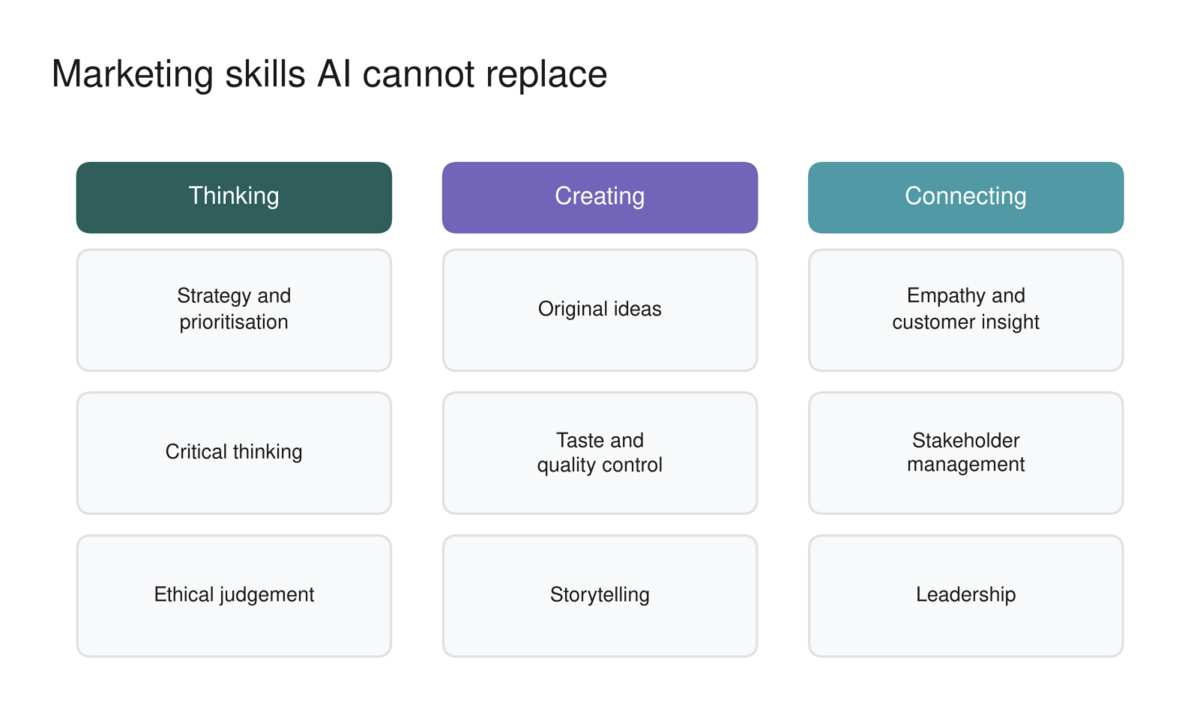
It helps to group them into three areas: thinking, creating and connecting. Most strong marketers are naturally better in one or two areas, so it is worth knowing which is your weakest.
Thinking skills
Strategy and prioritisation means choosing where to focus limited time and budget, and just as importantly what not to do. Critical thinking means questioning data, spotting weak assumptions and recognising when an AI answer sounds convincing but is wrong. Ethical judgement covers decisions about privacy, fairness, honesty in advertising and the responsible use of AI itself, where the right answer often depends on values rather than data.
Creating skills
Original ideas are the starting point for campaigns that stand out. Taste and quality control are the ability to tell good from merely competent, which becomes more important when competent output is cheap. Storytelling is the craft of turning facts and features into a narrative that makes people care, whether that audience is a customer or a board.
Connecting skills
Empathy and customer insight come from talking to real customers and noticing what they feel, not just what they click. Stakeholder management is the ability to understand what different people need, build support and handle disagreement. Leadership means setting direction, developing people and creating a team culture where AI is used well rather than feared.
Why does stakeholder management matter more in the age of AI?
Because AI is creating change, and change creates resistance. Teams are being reorganised, roles are shifting, and people are understandably anxious about what AI means for them. Marketers who can explain new ways of working, address concerns honestly and bring colleagues with them are extremely valuable.
There is also a practical reason. When AI makes it fast and cheap to produce ten versions of a campaign, the bottleneck moves to agreeing which one to run. The marketer who can align a product team, a sales director and a legal reviewer around one choice is the one who gets things launched. Our guide to stakeholder management for digital marketers covers the techniques in detail, including how to map stakeholders and tailor your message to each.
How do humans and AI work best together in marketing?
The most effective pattern we see is a loop in which humans and AI each do what they are best at. The human frames the problem, the AI generates options and drafts, the human judges and refines, and the AI then helps scale the approved work across formats and channels.
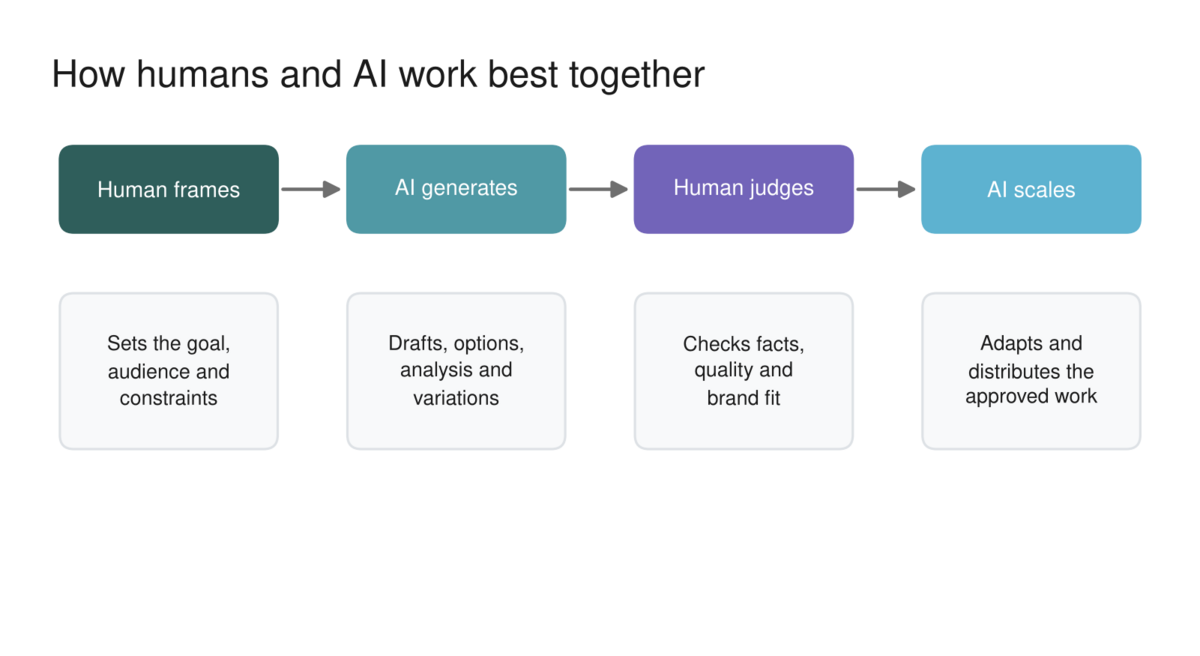
Notice that the human steps are exactly the skills described above. Framing a problem well needs strategy, customer insight and business acumen. Judging output needs critical thinking, taste and ethical judgement. Getting the result approved and adopted needs storytelling and stakeholder management. AI makes these skills more productive, not less necessary.
This is also why AI fluency and human skills should be developed together. Our guide to the AI skills every marketer needs covers the AI side of the loop.
How can you develop the skills AI can't replace?
Human skills grow through deliberate practice, feedback and reflection, and the good news is that AI can help you practise them. A few habits make a big difference:
- Talk to customers regularly. Even a few conversations a month builds insight no dataset can replace.
- Present your own work. Volunteer to explain results to senior stakeholders. Each time, ask one person for honest feedback.
- Write down your decisions. Record what you chose and why, then review the outcome a month later.
- Critique AI output. Treat every AI draft as something to improve, and notice what you change. That is your taste developing.
You can also rehearse difficult conversations with AI before having them for real.
Copy and paste prompt: "I need to persuade [stakeholder role] to approve [your proposal]. They are likely to be concerned about [known concerns]. Play the role of this stakeholder and respond realistically to my pitch, raising objections one at a time. After five exchanges, step out of the role and give me feedback on what was persuasive, what was weak and how I could adapt my message for this person."
The Target Internet platform supports both sides of your development, with interactive courses across digital marketing and AI, skills benchmarking to show where your gaps are, accredited certification, over 400 episodes of the Digital Marketing Podcast, and monthly live masterclasses.
Frequently asked questions
What skills can AI not replace in marketing?
Strategic judgement, critical thinking, ethical decision-making, original ideas, taste, empathy for customers, storytelling, leadership and stakeholder management. These depend on accountability, context and human relationships, which AI cannot provide, and the AMA's 2026 research lists them among the least disrupted marketing skills.
Will AI ever be creative enough to replace marketers?
AI can already produce creative work quickly, and it will keep improving. But marketing creativity is not just producing ideas; it is choosing the right one, adapting it to a brand and audience, and getting people to back it. Those parts remain human.
Are soft skills more important than technical skills for marketers now?
They are becoming more important relative to routine technical skills, because AI handles more of the routine work. The strongest marketers combine human skills with practical AI fluency, since each makes the other more valuable.
How can I show human skills on a CV?
Use specific examples with outcomes: a stakeholder group you aligned, a customer insight that changed a campaign, a recommendation you presented and had approved. Concrete stories are far more convincing than listing "communication skills".
Can AI help me develop human skills?
Yes. AI is a useful practice partner for rehearsing pitches, role-playing difficult conversations and getting critical feedback on your reasoning. The skill still develops through real-world practice, but AI makes rehearsal easier and more frequent.
If you are ready to take a structured approach to building your digital marketing skills, explore Target Internet membership options and discover how the platform's interactive courses, benchmarking tools, podcast, accredited certification and live masterclasses can help you combine human strengths with AI to build a lasting career.
About the author
Daniel Rowles is lead trainer at Target Internet and the author of Digital Branding (Kogan Page). He co-hosts The Digital Marketing Podcast and delivers digital marketing and AI training for organisations around the world, including digital transformation and future skills. You can find out more on his Target Internet profile.
Bibliography
1. American Marketing Association (2026). 2026 State of Marketing Careers Report. https://ama.org/marketing-news/2026-career-report
2. World Economic Forum (2025). The Future of Jobs Report 2025: Skills outlook. https://www.weforum.org/publications/the-future-of-jobs-report-2025/in-full/3-skills-outlook/