By Daniel Rowles, lead trainer at Target Internet and author of Digital Branding (Kogan Page). Last updated: November 2026.
You can build a marketing portfolio with no experience by creating your own projects around real brands, charities or local businesses, using AI to speed up research and drafting, and showing your own thinking, decisions and edits at every step. Four to six well-documented projects, such as a campaign plan, content samples, a data analysis and a website audit, will tell an employer far more than a CV ever can.
A portfolio solves the classic catch-22 of early careers: you need experience to get a job, but you need a job to get experience. This guide shows you what to include, how to create each project, how to use AI honestly and well, and gives you copy-and-paste prompts to get started. If you are just beginning, our guide to how to start a career in marketing explains where a portfolio fits in the bigger plan.
Why does a marketing portfolio matter more in the age of AI?
Because employers can no longer tell from a CV whether you can actually do the work. Almost every applicant now lists AI tools, and AI can produce a polished cover letter for anyone. What AI cannot fake is a body of work that shows how you think: the choices you made, the evidence you used and the results you achieved.
The American Marketing Association's 2026 State of Marketing Careers report advises early-career marketers to show how they have used AI on real problems, including the process and results, and to demonstrate that their AI use is becoming more sophisticated over time. A portfolio is the natural place to do that. It also fits a wider shift towards skills-based hiring: PwC found the share of AI-exposed jobs requiring a degree fell from 64% to 56%, meaning practical evidence counts for more.
There is a further benefit. With entry-level hiring slowing, as reported in a MarTech survey in which 57% of agency leaders had slowed or paused it, the candidates who succeed are those who can show they will contribute quickly. A portfolio does exactly that.
What should you put in a marketing portfolio?
Aim for variety that reflects the kind of role you want, with each project showing a clear problem, your approach and a result. Six types of project work particularly well.
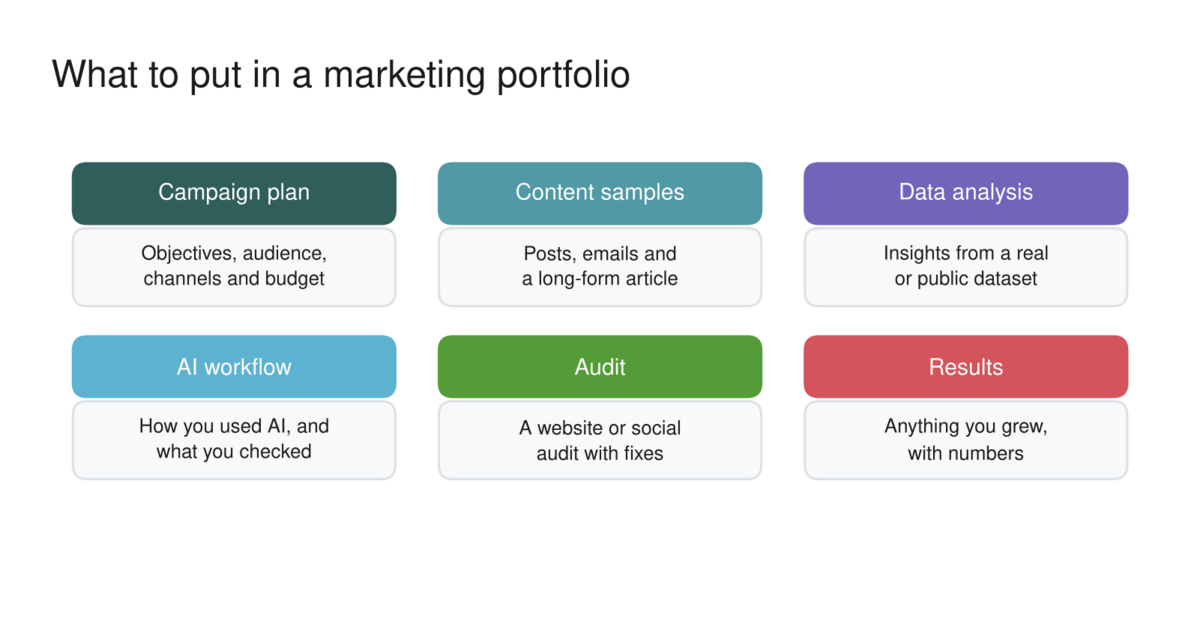
You do not need all six. Three to five strong projects are better than six weak ones. If you want a content role, weight towards content samples and an audit. If you want an analytics role, lead with data analysis. If you are not sure yet, a campaign plan, a content sample and an audit make a good, balanced starting set.
How do you create a portfolio project from scratch?
Every project should follow the same simple structure, which also makes your portfolio easy to read. Choose a real organisation, write a brief, create the work with AI as your assistant, decide how success would be measured, and write it up as a one-page case study.
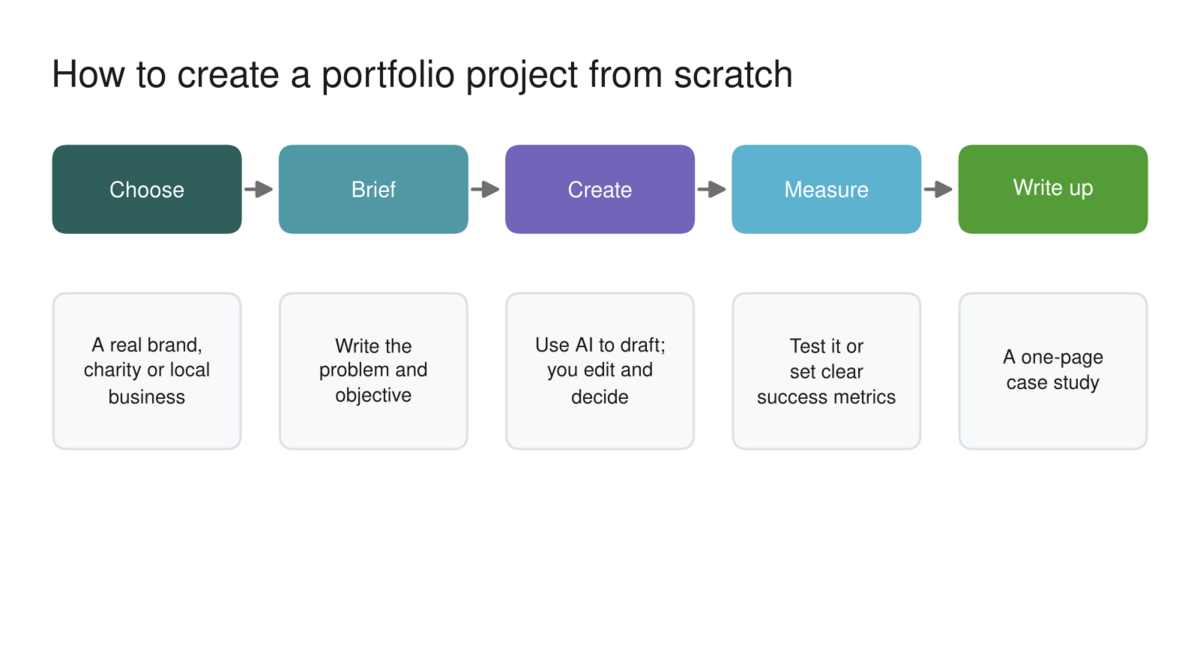
Real organisations make your work far more credible than invented ones. Local businesses, charities, clubs and societies are often happy for you to help for free, which can also give you real results and a reference. If you work on a well-known brand without its involvement, be clear that the project is speculative and use only public information.
The most important part of every write-up is your reasoning. Explain why you chose this audience, this message and these channels, and what you changed from the AI's suggestions and why. That is the evidence of judgement employers are looking for.
What portfolio projects can you create with AI?
Below are six projects, each with a copy-and-paste prompt. Treat the AI output as a first draft to challenge and improve, never as the finished piece. Keep a record of the prompts you used and what you changed, because that record is part of your evidence.
1. A campaign plan
Pick an organisation and plan a campaign around a real objective, such as increasing event sign-ups for a local charity. Build a simple persona first with our free persona template tool.
Copy and paste prompt: "Act as a marketing strategist. I am creating a speculative campaign plan for [organisation], whose objective is [objective]. The target audience is [describe persona]. Suggest three different campaign concepts, each with a core message, the channels you would use, a rough budget split for [budget] and how success would be measured. Then list the biggest risks or assumptions in each concept so I can decide which to develop."
2. Content samples
Create a small set of content for one brand: a blog article, three social posts and an email. Show the brief, the AI first draft and your final edited version side by side. Our guide to AI prompts to improve existing content has more techniques for editing.
Copy and paste prompt: "Here is a first draft of a [content type] for [brand], aimed at [audience]: [paste draft]. Critique it as a senior content editor. Identify where it sounds generic, where claims need evidence, where the tone does not fit the brand, and where the structure could be clearer. Do not rewrite it; give me numbered feedback I can act on."
3. A data analysis
Use a public dataset, a brand's public social media metrics or results from a small survey you run yourself. Show the question, the analysis and the recommendation.
Copy and paste prompt: "I have this data about [topic]: [paste or describe data]. Help me analyse it as a marketing analyst. Suggest the three most useful questions this data can answer, explain how to calculate the relevant figures, and point out any limitations in the data that would affect my conclusions. I will do the calculations and write the recommendations myself."
4. A website or social media audit
Audit a small organisation's website or social channels and recommend specific improvements. This is one of the most useful portfolio pieces, because it can be offered directly to the organisation.
Copy and paste prompt: "Act as a digital marketing consultant. I am auditing the [website or social channels] of [organisation], a [type of organisation] that wants to [goal]. Give me a structured audit checklist covering content, user experience, search visibility, calls to action and measurement. For each area, list what good looks like and the questions I should answer from my own review."
5. An AI workflow
Document a repeatable AI-assisted process you have designed, such as turning one article into a week of social content, showing each step and where a human check is needed. Our digital marketing prompt library and checklist is a good starting point.
Copy and paste prompt: "I want to design a repeatable AI-assisted workflow for [marketing task]. Map it into clear steps, show which steps AI should do and which need a human decision or check, list the quality checks at each stage, and suggest how I could measure the time saved compared with doing it manually."
6. Results
If any project led to real outcomes, such as more followers for a club, more sign-ups for an event or better email open rates, show the numbers honestly, including what did not work.
Copy and paste prompt: "Here are the details of a marketing project I completed: [describe the brief, what I did, how I used AI and the results]. Help me turn this into a one-page portfolio case study with sections for the challenge, my approach, the role AI played, what I checked or changed, the results and what I learned. Keep my wording where possible and do not add any results I have not stated."
How do you present and share your marketing portfolio?
Keep it simple and easy to scan. A free website builder, a well-organised PDF or a set of LinkedIn featured posts all work. Lead with your strongest project, keep each case study to a page, and include a short introduction about the kind of role you want. Link to it from your CV, your LinkedIn profile and every application.
Adding independent evidence strengthens a portfolio considerably. A benchmark score from our digital marketing skills benchmark and an accredited certificate both show that someone other than you has assessed your skills. The Target Internet platform offers both, alongside interactive courses across digital marketing and AI, over 400 episodes of the Digital Marketing Podcast, and monthly live masterclasses.
For more on how employers judge AI evidence, see our guide to the AI skills every marketer needs and how to prove them.
Frequently asked questions
Can I build a marketing portfolio with no experience?
Yes. Create speculative projects around real brands, offer free help to local businesses or charities, and document your process carefully. Employers care about how you think and what you can produce, not whether someone paid you for the work.
Is it acceptable to use AI in a marketing portfolio?
Yes, and it is increasingly expected, as long as you are open about it. Show what the AI produced, what you changed and why. Hiding AI use is risky; showing thoughtful AI use is a strength.
How many projects should a marketing portfolio include?
Three to five strong, well-documented projects are usually enough. Choose projects that match the roles you are applying for and show a range of skills, rather than including everything you have done.
Can I use well-known brands in my portfolio?
Yes, for speculative projects based on public information, as long as you make clear the work was not commissioned. Real projects for small organisations are even better because they can produce genuine results and references.
Where should I host my marketing portfolio?
Anywhere easy to access and share. A simple website, a PDF or LinkedIn featured posts all work. What matters is that each project is clear, concise and linked from your CV and applications.
If you are ready to take a structured approach to building your digital marketing skills, explore Target Internet membership options and discover how the platform's interactive courses, benchmarking tools, podcast, accredited certification and live masterclasses can help you build a portfolio that gets you hired.
About the author
Daniel Rowles is lead trainer at Target Internet and the author of Digital Branding (Kogan Page). He co-hosts The Digital Marketing Podcast and delivers digital marketing and AI training for organisations around the world, including digital transformation and future skills. You can find out more on his Target Internet profile.
Bibliography
1. American Marketing Association (2026). 2026 State of Marketing Careers Report. https://ama.org/marketing-news/2026-career-report
2. PwC (2025). 2025 Global AI Jobs Barometer. https://www.pwc.com/gx/en/news-room/press-releases/2025/ai-linked-to-a-fourfold-increase-in-productivity-growth.html
3. MarTech (2025). AI is changing the hiring practices of marketing agencies. https://martech.org/ai-is-changing-the-hiring-practices-of-marketing-agencies/