By Daniel Rowles, lead trainer at Target Internet and author of Digital Branding (Kogan Page). Last updated: November 2026.
Marketing graduate jobs in 2026 are fewer and more competitive than a few years ago, partly because AI now handles many traditional junior tasks and partly because of wider economic pressure. Employers who are still hiring want graduates who can use AI confidently on real marketing work, understand the commercial basics and prove it with a portfolio, not just a degree.
This guide explains what the graduate market looks like, what employers now expect, where to look and how to make your application stand out. If you are still deciding whether marketing is right for you, our guide to how to start a career in marketing covers the wider picture, including non-graduate routes.
What is the marketing graduate jobs market like in 2026?
Tough, but not closed. In the UK, the Institute of Student Employers reported that graduate hiring fell by 8% while apprentice hiring rose by 8%, suggesting some employers are shifting entry-level investment from graduate schemes to apprenticeships. Competition is intense: the Intergenerational Foundation, citing ISE data, reports around 140 applications for every graduate role.
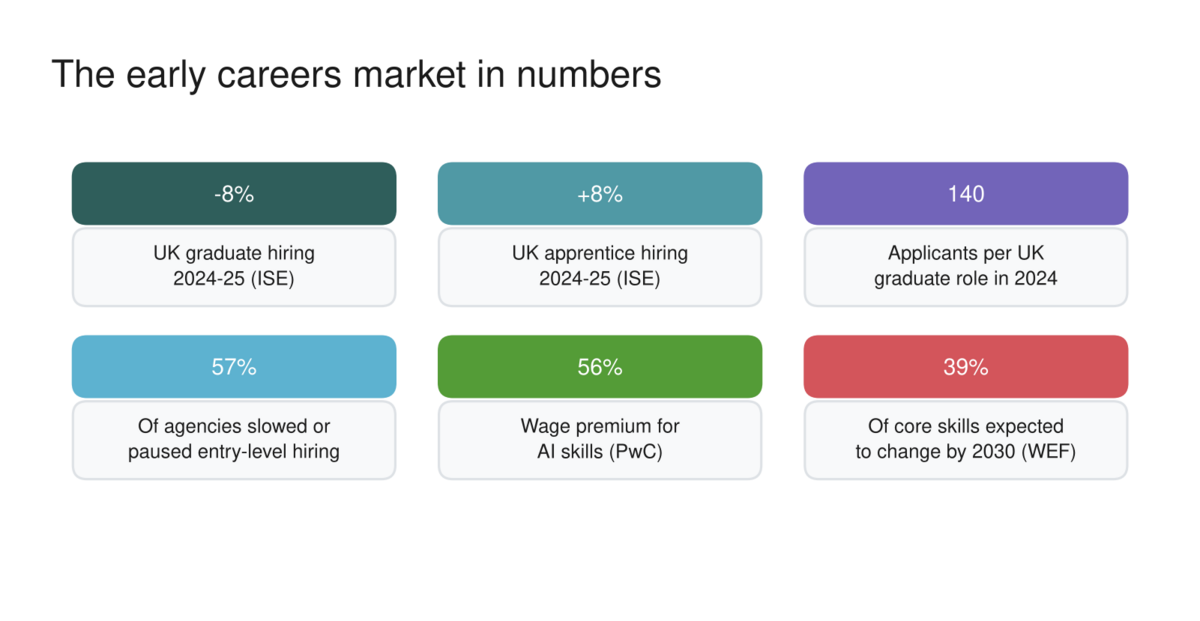
Marketing-specific data points in the same direction. A survey of 225 US agency leaders reported by MarTech found that 57% had slowed or paused entry-level hiring. Gartner, reported by Marketing Dive, predicts that most high-performing marketing teams will use AI to remove traditional entry-level roles by 2030.
It is important not to overstate the role of AI. The ISE has said that employers are not telling it AI is replacing student jobs, and that the economy and employment costs matter a great deal. The honest summary is that AI is one of several pressures, but it is the one that is changing what employers want from the graduates they do hire.
Why are there fewer graduate marketing jobs?
Traditionally, graduate marketers learned the job by doing the groundwork: researching competitors, drafting social posts, building reports, proofreading and managing campaign admin. Senior people reviewed that work and, over time, graduates absorbed the judgement behind it.
AI has disrupted that model. Much of the groundwork can now be done in minutes by an experienced marketer using AI tools, so some organisations are asking whether they need a junior role at all. That is a real risk for the profession, because without entry-level roles there is no pipeline of future leaders, and thoughtful employers are already worrying about it. For graduates, though, the practical consequence is clear: the roles that remain expect you to add value beyond the groundwork from early on.
At the same time, employers are moving towards skills-based hiring. PwC's 2025 Global AI Jobs Barometer found that the share of AI-exposed jobs requiring a degree fell from 64% to 56%. A degree still helps, but it is no longer enough on its own, and graduates are competing with apprentices and career changers who can show practical skills.
What do employers want from marketing graduates now?
Employers are looking for three things: skills they can use straight away, a mindset that will cope with constant change, and evidence that proves both.
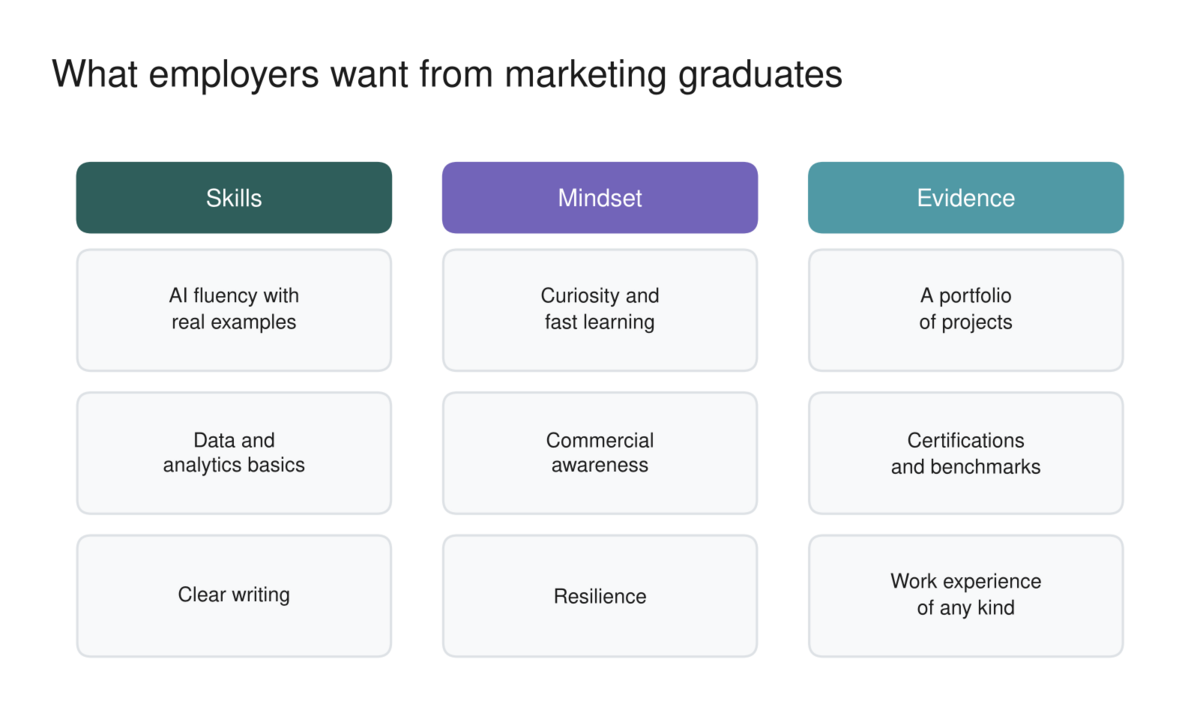
Skills. AI fluency with real examples comes first, because AI is now part of almost every marketing role. Data and analytics basics matter too; our free GA4 course on key events is a quick way to build them. Clear writing remains essential, partly because you will be judging and editing AI output rather than just producing your own.
Mindset. Curiosity and fast learning matter more than ever, because the tools will change several times during your first few years. Commercial awareness, meaning an understanding of how marketing makes money for the organisation, sets graduates apart. Resilience helps you keep going through a difficult search and a fast-moving first job.
Evidence. A portfolio of projects is the most persuasive thing you can offer. Certifications and benchmark scores add independent proof, and any work experience counts, including part-time jobs and volunteering, if you can explain what you learned. The American Marketing Association's 2026 careers report specifically advises early-career marketers to show how they have used AI on real problems, including their process and results.
How do you make a marketing graduate application stand out?
With so many applicants per role, a generic CV and cover letter will rarely get through. The most effective applications treat the employer like a marketing audience: research what they need, then show clearly how you meet it.
Start by researching the organisation's marketing in depth. Look at its website, social channels, search visibility and recent campaigns, and form a view on one thing it could do better. Then build a short piece of work around that idea, such as a one-page audit or a sample campaign plan, and reference it in your application. This shows initiative, commercial thinking and practical skill in a way a list of modules cannot.
Be specific about how you use AI. Rather than "proficient in ChatGPT", describe a project: the task, how you used AI, what you checked or corrected, and the result. Our guide to the AI skills every marketer needs explains what employers mean by AI fluency, and our guide to building a marketing portfolio with no experience shows how to create the evidence.
Finally, use AI to sharpen your application, but never to write it for you. Recruiters are increasingly good at spotting generic AI text.
Copy and paste prompt: "Here is a graduate marketing job description: [paste job description]. Here is my CV: [paste CV]. Identify the five things this employer most wants, show me where my CV provides evidence for each and where it is weak, and suggest specific projects or experiences I could highlight or create to fill the gaps. Do not rewrite my CV; give me feedback I can act on myself."
Where should graduates look for marketing jobs?
Look beyond the big-name graduate schemes. They attract the most applications and are often the first to shrink in a difficult market. Good alternatives include graduate and degree apprenticeships, junior roles in agencies, marketing executive roles in small and medium-sized businesses, and roles in adjacent functions such as customer experience, sales support or digital content, which can lead into marketing. Charities and public sector bodies also hire marketing graduates and often give early responsibility.
It also pays to understand which specialisms are growing. Influencer marketing roles grew by 18% in 2025, according to Bloomberry data cited by the AMA, and roles connected to AI search visibility are emerging fast. Our guide to new marketing jobs created by AI explains these in more detail.
The Target Internet platform can help you get ready for these roles, with interactive courses across digital marketing and AI, skills benchmarking to show where your gaps are, accredited certification, over 400 episodes of the Digital Marketing Podcast, and monthly live masterclasses. You can start with our free digital marketing skills benchmark.
Frequently asked questions
Are there still graduate marketing jobs in 2026?
Yes, although there are fewer than in previous years and competition is high. Many employers are still recruiting graduates, but they expect more practical skills from day one, particularly confident use of AI and an understanding of data and commercial results.
Is a marketing degree still worth it?
A marketing degree gives useful theory and a recognised qualification, but on its own it is no longer enough to stand out. Combine it with practical AI skills, a portfolio of real projects and, ideally, some work experience or an accredited certification.
Should I apply for a marketing apprenticeship instead of a graduate scheme?
It is worth considering both. UK apprentice hiring rose by 8% while graduate hiring fell, and apprenticeships combine paid work with structured training. Graduate and degree apprenticeships can be a strong option if graduate schemes are not responding.
What should a marketing graduate CV include?
Include a short profile, specific projects with results, examples of how you used AI and what you checked, relevant tools and certifications, and a link to your portfolio. Tailor it to each role rather than sending the same version everywhere.
How many applications should I send for graduate marketing jobs?
Quality matters more than quantity. With around 140 applicants per graduate role, a smaller number of carefully researched, tailored applications with supporting work will usually do better than a large number of generic ones.
If you are ready to take a structured approach to building your digital marketing skills, explore Target Internet membership options and discover how the platform's interactive courses, benchmarking tools, podcast, accredited certification and live masterclasses can help you stand out in a competitive graduate market.
About the author
Daniel Rowles is lead trainer at Target Internet and the author of Digital Branding (Kogan Page). He co-hosts The Digital Marketing Podcast and delivers digital marketing and AI training for organisations around the world, including digital transformation and future skills. You can find out more on his Target Internet profile.
Bibliography
1. FE News (2025). ISE: Apprenticeships rise as graduate vacancies drop 8%. https://www.fenews.co.uk/skills/ise-apprenticeships-rise-as-graduate-vacancies-drop-8-apprenticeship-hiring-increased-by-8
2. Intergenerational Foundation (2025). Will AI take your graduate job? https://if.org.uk/2025/08/26/will-ai-take-your-graduate-job/
3. MarTech (2025). AI is changing the hiring practices of marketing agencies. https://martech.org/ai-is-changing-the-hiring-practices-of-marketing-agencies/
4. Marketing Dive (2025). CMOs must rethink entry-level talent as AI alters marketing needs: Gartner. https://www.marketingdive.com/news/cmos-must-rethink-entry-level-talent-as-ai-alters-marketing-needs-gartner/831604/
5. Institute of Student Employers (2025). Have graduate jobs really nosedived? https://ise.org.uk/knowledge/insight/446/have_graduate_jobs_really_nosedived
6. PwC (2025). 2025 Global AI Jobs Barometer. https://www.pwc.com/gx/en/news-room/press-releases/2025/ai-linked-to-a-fourfold-increase-in-productivity-growth.html
7. American Marketing Association (2026). 2026 State of Marketing Careers Report. https://ama.org/marketing-news/2026-career-report