By Daniel Rowles, lead trainer at Target Internet and author of Digital Branding (Kogan Page). Last updated: November 2026.
The AI skills for marketers that matter most in 2026 are practical ones: using AI assistants confidently on everyday tasks, writing structured prompts with the right context, chaining steps into repeatable workflows, building simple custom assistants and automations, and checking every output for accuracy and brand fit. To prove you have them, you need evidence of real work: before-and-after examples, measurable results, accredited certification and an objective skills benchmark.
Almost every marketer now says they "use AI". That claim alone no longer stands out to employers. This guide sets out what genuine AI capability looks like at each level, and how to show it in a way that is credible. If you want to know where you are starting from, our digital marketing skills benchmark will show your current gaps.
Why do AI skills matter so much for marketers now?
Because the jobs market is already pricing them in. The American Marketing Association's 2026 State of Marketing Careers report found that the share of marketing job postings mentioning AI doubled during 2025, and marketers themselves ranked AI as the most important skill for the next five years. PwC's 2025 Global AI Jobs Barometer found a 56% wage premium for jobs that require AI skills, up from 25% a year earlier.
At the same time, there is a clear gap between what employers need and what most teams have. The World Economic Forum's Future of Jobs Report 2025 lists AI and big data as the fastest-growing skills of all, and found that most employers plan to reskill their workforce to work alongside AI. In other words, there is both a premium for having these skills and an opportunity for people who build them early.
It is also worth being clear about what AI skills are not. They are not a replacement for marketing knowledge. An AI tool will happily produce a confident campaign plan for the wrong audience. The marketers who get the most from AI are those who understand customers and channels well enough to brief it properly and spot when it is wrong, which is why we pair AI skills with the human skills covered in our guide to AI-proof marketing skills.
What AI skills do marketers need?
It helps to think of AI capability as a ladder. Each level builds on the one below, and most marketers in 2026 sit somewhere around the first or second rung.
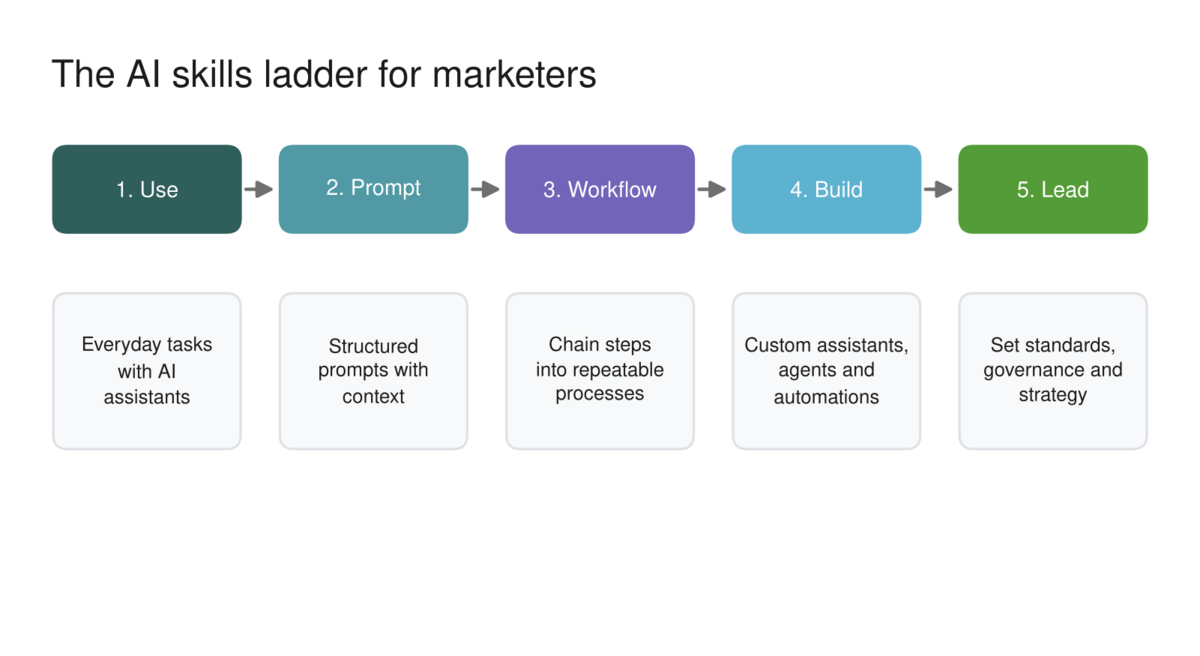
Level 1: Use
Confident, everyday use of AI assistants for tasks such as summarising research, drafting emails, brainstorming ideas and rewording copy. The key skill here is knowing what AI is good and bad at, and never publishing anything without checking it.
Level 2: Prompt
Writing structured prompts that give the AI a role, context, audience, constraints and an example of the output you want. Good prompting is really good briefing, which is a marketing skill in its own right. Our guides to AI prompts for content planning and AI prompts to improve existing content are good places to practise.
Level 3: Workflow
Chaining several steps together into a repeatable process, for example research, outline, draft, edit and repurpose, with a human check at the right points. This is where AI starts to save hours rather than minutes, and where quality control becomes critical.
Level 4: Build
Creating custom assistants, reusable prompt libraries, simple agents and no-code automations that colleagues can use. Marketers at this level make the whole team more productive, not just themselves.
Level 5: Lead
Setting standards for how the team uses AI, including governance, data privacy, brand safety and measurement, and deciding where AI should and should not be used. This overlaps with the wider change work covered in our guide to AI-assisted digital transformation.
You do not need to reach level five to be valuable. Moving one level up from where you are today is usually enough to stand out in your current team.
How do you build AI skills as a marketer?
The most effective approach is to learn on your real work rather than on generic exercises. Pick one recurring task each week, such as writing a campaign brief, analysing survey results or creating social variations, and work out how to do it better with AI. Keep a simple log of the task, the prompt you used, what you had to correct and the time saved. Within a couple of months, that log becomes both your personal prompt library and your evidence.
A good shortcut is to start from a proven set of prompts and adapt them, rather than starting from a blank page. Our digital marketing prompt library and checklist covers the most common marketing tasks. You can also ask AI to coach you directly.
Copy and paste prompt: "You are an AI skills coach for marketers. I work as a [job title] and I use AI for [describe current use]. Based on a five-level ladder of use, prompt, workflow, build and lead, tell me which level I am at and why. Then design a four-week practice plan to reach the next level using tasks from my real job, with one specific exercise per week and a way to measure progress."
How do you prove you have AI skills?
Saying you are "proficient in ChatGPT" on a CV carries very little weight now. Employers want to see what you have done with AI, how you checked it, and what difference it made. Four types of evidence work best, and they are strongest in combination.
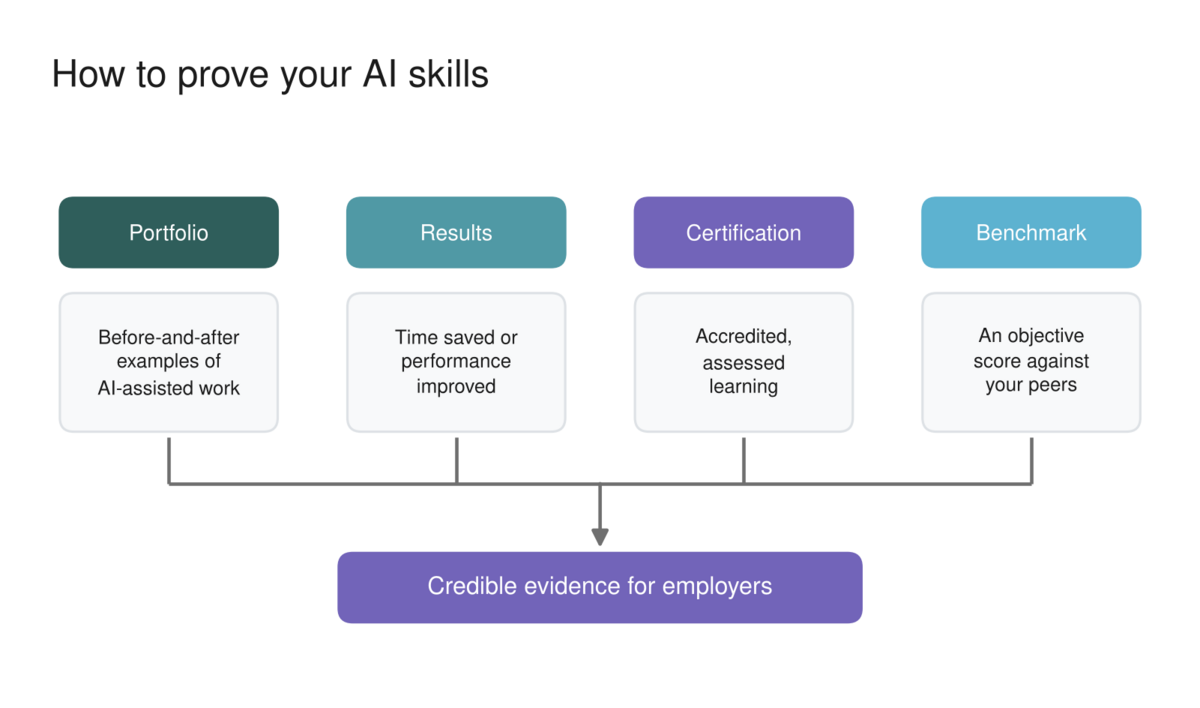
A portfolio of AI-assisted work. Show before-and-after examples: the brief, the AI output, your edits and the final version. This demonstrates both AI fluency and judgement. If you are early in your career, our guide to building a marketing portfolio with AI when you have no experience shows how.
Measurable results. Time saved, output increased, conversion rate improved or costs reduced. Even modest numbers are persuasive when they are specific and honest.
Accredited certification. An assessed, accredited certificate shows you have covered the fundamentals in a structured way, which matters to employers who cannot judge AI skills themselves.
An objective benchmark. A skills benchmark score shows where you stand against peers, and lets you track progress over time.
The AMA's advice for early-career marketers makes the same point: show how you have used AI on real problems, including your process and results, and show that your use of AI has become more sophisticated over time. The Target Internet platform can help with each part, offering interactive courses across digital marketing and AI, skills benchmarking to show where your gaps are, accredited certification, over 400 episodes of the Digital Marketing Podcast, and monthly live masterclasses.
Frequently asked questions
What is the most important AI skill for marketers?
Structured prompting, because it is really the skill of briefing well. A marketer who can give AI clear context, audience, constraints and examples gets far better output than one who types a vague request. It also underpins every higher level, from workflows to custom assistants.
Do marketers need to learn to code to use AI?
No. Most marketing AI work uses natural-language prompts and no-code tools. Basic data skills and an understanding of how automation platforms connect are helpful at the build level, but coding is not a requirement for most marketing roles.
How do I show AI skills on my CV?
Replace generic tool lists with specific achievements: the task, how you used AI, what you checked and the measurable result. Add a link to a portfolio of before-and-after examples and include any accredited certification or benchmark scores.
Which AI tools should marketers learn?
Focus on skills rather than specific tools, because tools change quickly. Learn one general AI assistant well, then the AI features inside the platforms you already use, such as your analytics, advertising, design and email tools.
How long does it take to become good at AI as a marketer?
With daily practice on real tasks, most marketers can move up one level of the ladder in four to eight weeks. Reaching the build and lead levels takes longer and usually involves leading a real project at work.
If you are ready to take a structured approach to building your digital marketing skills, explore Target Internet membership options and discover how the platform's interactive courses, benchmarking tools, podcast, accredited certification and live masterclasses can help you build AI skills and prove them with confidence.
About the author
Daniel Rowles is lead trainer at Target Internet and the author of Digital Branding (Kogan Page). He co-hosts The Digital Marketing Podcast and delivers digital marketing and AI training for organisations around the world, including digital transformation and future skills. You can find out more on his Target Internet profile.
Bibliography
1. American Marketing Association (2026). 2026 State of Marketing Careers Report. https://ama.org/marketing-news/2026-career-report
2. PwC (2025). 2025 Global AI Jobs Barometer. https://www.pwc.com/gx/en/news-room/press-releases/2025/ai-linked-to-a-fourfold-increase-in-productivity-growth.html
3. World Economic Forum (2025). The Future of Jobs Report 2025: Skills outlook. https://www.weforum.org/publications/the-future-of-jobs-report-2025/in-full/3-skills-outlook/