By Daniel Rowles, lead trainer at Target Internet and author of Digital Branding (Kogan Page). Last updated: November 2026.
Will AI replace marketing jobs? The 2026 data says AI is replacing marketing tasks much faster than it is replacing marketing people, but the impact on jobs is real and uneven. Execution-heavy roles are shrinking and entry-level hiring is slowing, while strategic, creative and AI-fluent roles are holding steady or growing.
If you want to see where you stand today, our digital marketing skills benchmark is a good place to start. This article pulls together the most credible research published in 2025 and 2026, explains what it actually means for marketing careers, and sets out what to do about it.
What does the latest research say about AI and marketing jobs?
The clearest picture comes from the American Marketing Association's 2026 State of Marketing Careers report, which surveyed 1,412 marketers. It found that marketing job postings are around 27% below pre-pandemic levels, yet more employers are hiring than a year earlier. The demand that remains has shifted: senior and strategic roles are steady while execution roles are declining. The share of job postings mentioning AI doubled during 2025, and marketers ranked AI as the single most important skill for the next five years.
Leaders are already acting on this. Gartner research reported by Marketing Dive found that a fifth of marketing leaders have already eliminated roles because of AI, while 16% have created new ones. Gartner also predicts that by 2030 AI will allow most high-performing marketing teams to remove traditional entry-level jobs altogether.
In B2B, a Wynter survey of 100 SaaS marketing leaders reported by MarTech found that 47% had reduced marketing roles because of AI, very often by simply not replacing people who left. Tellingly, 94% of the same leaders expected their own role to still exist in two years.
So will AI replace marketing jobs or just change them?
The marketers most at risk are not those whose jobs AI touches, but those who do not change how they work.
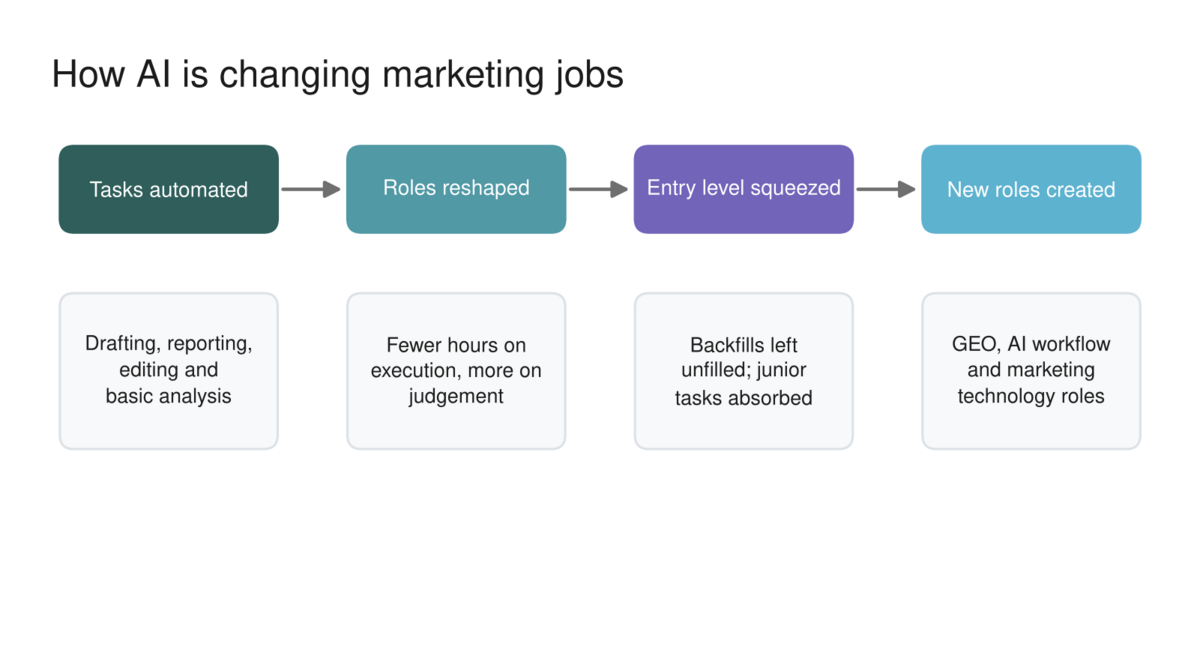
Mostly AI is changing the job, and the change shows up in headcount through the side door. Very few organisations announce that they have replaced their marketing team with AI. What happens instead is quieter: a content role is not backfilled, an agency takes on a new client without hiring, or a junior position is merged into someone else's job because drafting, reporting and resizing now take a fraction of the time.
This matters because it changes the question you should ask about your own career. The useful question is not "will AI replace my job title?" but "what share of my working week is spent on tasks AI can now do to an acceptable standard?" If that share is high and you are not the person directing the AI, your role is exposed. If most of your week is spent on judgement, relationships, strategy and quality control, AI is far more likely to make you more productive than redundant.
The wider economic data supports this. The World Economic Forum's Future of Jobs Report 2025 expects 39% of workers' core skills to change by 2030, and the WEF projects that technology will create more jobs globally than it displaces over the same period. The catch is that the new jobs need different skills from the old ones, and they do not always appear in the same teams or at the same level.
Which marketing skills is AI disrupting most?
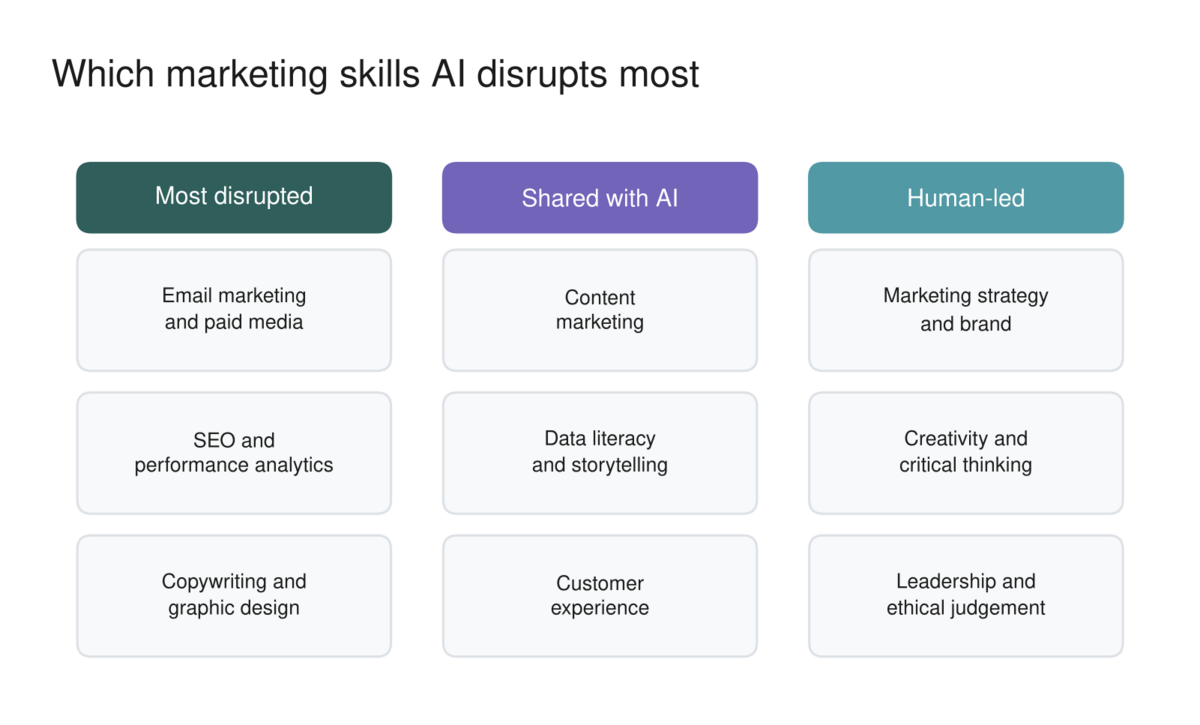
The AMA research is useful here because it breaks marketing down by skill rather than by job title. It groups skills into three tiers:
- Most disrupted: email marketing, SEO, paid media, performance analytics, copywriting, lead generation, market research and graphic design.
- Equal partnership with AI: content marketing, data literacy and storytelling, customer experience, consumer behaviour and influencer marketing.
- Least disrupted: strategy, brand management, collaboration, creativity, critical thinking, leadership, emotional intelligence, ethical decision-making and adaptability.
"Disrupted" does not mean "gone". Paid media and SEO are still essential channels; it is the manual, repeatable work inside them that is being automated. A paid media specialist who spends their day adjusting bids by hand is at risk. One who designs the measurement framework, briefs the automated bidding systems and explains the results to the board is in demand. We look at this role by role in our guide to which marketing roles are most at risk from AI.
Why is entry-level marketing hit hardest?
Entry-level roles have traditionally been built around exactly the tasks AI now does well: first drafts, social posts, report building, competitor research and campaign admin. That is why the squeeze is sharpest at the start of a career. A MarTech report on a survey of 225 US agency leaders found that 57% had slowed or paused entry-level hiring, while 75% were hiring for AI hybrid roles that combine marketing and AI skills.
In the UK, the Institute of Student Employers reported that graduate hiring fell by 8% while apprentice hiring rose by 8%. It is important to be careful here. The ISE itself has said its members are not reporting that AI is replacing student jobs; economic conditions and employment costs also play a big part. But the direction of travel for marketing specifically, as Gartner's prediction shows, is towards fewer traditional junior roles.
The answer for early careers is not to avoid marketing, but to arrive with evidence that you can do more than the tasks AI already handles. Our guide on how to start a career in marketing when AI is doing the entry-level work covers this in detail.
Which marketing jobs are growing?
The AMA report highlights several areas of growth. Influencer marketing roles grew by 10% in 2024 and 18% in 2025, according to Bloomberry data cited in the report. Marketing strategist roles are rising, as are specialists in generative engine optimisation (GEO) and answer engine optimisation (AEO), who focus on visibility in AI search tools. Newer roles such as agentic commerce specialists and AI workflow designers are also starting to appear. By contrast, the same data shows SEO specialist postings down 15% and content marketer postings down 11%.
There is also a clear financial signal. PwC's 2025 Global AI Jobs Barometer found a 56% wage premium for jobs requiring AI skills, up from 25% the year before. We explore the emerging roles, and how to get them, in new marketing jobs created by AI.
The Target Internet platform is built for exactly this kind of shift, with interactive courses across digital marketing and AI, skills benchmarking to show where your gaps are, accredited certification, over 400 episodes of the Digital Marketing Podcast, and monthly live masterclasses.
How can you protect your marketing career from AI?
The research points to a consistent set of actions. None of them are complicated, but they do require you to change how you spend your time:
- Audit your week. List the tasks you do and mark the ones AI can already handle. That share is your exposure.
- Become the person who directs the AI. Learn to brief, check and improve AI output in your own specialism, then build repeatable workflows around it. See the AI skills every marketer needs.
- Move up the value chain. Spend the time AI saves on strategy, insight and stakeholder conversations, the work AI cannot own.
- Invest in human skills. Judgement, taste, storytelling and influence are the skills least disrupted by AI. Our guide to AI-proof marketing skills breaks these down.
- Make your progress visible. Keep a record of what you have improved with AI, including the time saved and the results achieved, so you can prove it.
Start with the audit. It takes ten minutes and tells you more than any industry report.
Copy and paste prompt: "I work as a [job title] in [industry]. Here is a list of the tasks I do in a typical week, with rough hours for each: [paste list]. For each task, tell me whether current AI tools could do it fully, partly or not at all, and explain why. Then suggest which tasks I should automate first, which I should keep and develop, and which new higher-value tasks I could take on with the time I save."
Frequently asked questions
Will AI replace marketing jobs completely?
No credible research suggests marketing as a function will disappear. The evidence shows AI replacing specific tasks and reducing headcount in execution-heavy roles, often by leaving vacancies unfilled, while strategic, creative and AI-fluent roles hold steady or grow. The overall shape of marketing teams is changing more than their existence.
Which marketing jobs are safest from AI?
Roles built on strategy, brand management, leadership, creativity and relationships are the least disrupted, according to the AMA's 2026 research. Roles that combine marketing expertise with strong AI skills are also in high demand, and PwC found these attract a significant wage premium.
Is it still worth studying marketing?
Yes, but combine it with practical AI skills and real portfolio work. Employers increasingly hire on demonstrated skills rather than qualifications alone, so a portfolio of real projects matters as much as a certificate. PwC found the share of AI-exposed jobs requiring a degree fell from 64% to 56%.
How quickly is AI changing marketing roles?
Quickly. PwC found skills are changing 66% faster in jobs most exposed to AI, and the share of marketing job postings mentioning AI doubled during 2025, according to the AMA. That pace means continuous learning is now part of the job rather than an occasional extra.
What should marketers learn first to stay relevant?
Start with practical AI fluency in your own specialism, because that is where you can show results fastest. Then build the human skills AI cannot replace: strategic thinking, quality control, storytelling and stakeholder management. Finally, keep evidence of what you have achieved so employers can see it.
If you are ready to take a structured approach to building your digital marketing skills, explore Target Internet membership options and discover how the platform's interactive courses, benchmarking tools, podcast, accredited certification and live masterclasses can help you build a career that AI makes stronger rather than smaller.
About the author
Daniel Rowles is lead trainer at Target Internet and the author of Digital Branding (Kogan Page). He co-hosts The Digital Marketing Podcast and delivers digital marketing and AI training for organisations around the world, including digital transformation and future skills. You can find out more on his Target Internet profile.
Bibliography
1. American Marketing Association (2026). 2026 State of Marketing Careers Report. https://ama.org/marketing-news/2026-career-report
2. Marketing Dive (2025). CMOs must rethink entry-level talent as AI alters marketing needs: Gartner. https://www.marketingdive.com/news/cmos-must-rethink-entry-level-talent-as-ai-alters-marketing-needs-gartner/831604/
3. MarTech (2026). AI is powering the loss of marketing jobs. https://martech.org/ai-is-powering-the-loss-of-marketing-jobs/
4. MarTech (2025). AI is changing the hiring practices of marketing agencies. https://martech.org/ai-is-changing-the-hiring-practices-of-marketing-agencies/
5. World Economic Forum (2025). The Future of Jobs Report 2025: Skills outlook. https://www.weforum.org/publications/the-future-of-jobs-report-2025/in-full/3-skills-outlook/
6. PwC (2025). 2025 Global AI Jobs Barometer. https://www.pwc.com/gx/en/news-room/press-releases/2025/ai-linked-to-a-fourfold-increase-in-productivity-growth.html
7. FE News (2025). ISE: Apprenticeships rise as graduate vacancies drop 8%. https://www.fenews.co.uk/skills/ise-apprenticeships-rise-as-graduate-vacancies-drop-8-apprenticeship-hiring-increased-by-8
8. Institute of Student Employers (2025). Have graduate jobs really nosedived? https://ise.org.uk/knowledge/insight/446/have_graduate_jobs_really_nosedived