By Daniel Rowles, lead trainer at Target Internet and author of Digital Branding (Kogan Page). Last updated: November 2026.
The most AI-proof marketing skills are the ones that decide what should be done and whether it is good enough: strategic thinking, judgement, quality control, business acumen, taste, storytelling and influence, combined with the AI fluency to put the tools to work. AI is excellent at producing output. It is much weaker at choosing the right problem, understanding context and taking responsibility for the result.
This guide explains what makes a skill resistant to AI, sets out the nine skills the research points to, and gives you a practical way to prioritise your learning this year. If you want to see your current strengths and gaps first, try our digital marketing skills benchmark.
What makes a marketing skill AI-proof?
No skill is completely immune to change, so "AI-proof" really means "hard for AI to do well without a skilled human involved". The useful distinction is between producing an output and owning an outcome. Writing a social post, building a report or resizing an image is producing an output, and AI is now very good at it. Deciding which audience matters most, which message will move them, whether the evidence is strong enough and how to persuade a sceptical finance director is owning an outcome, and that still needs a person.
The World Economic Forum's Future of Jobs Report 2025 supports this view. Employers rank analytical thinking as the most important core skill, and expect creative thinking, resilience, flexibility and agility, and curiosity and lifelong learning to grow in importance alongside AI and big data skills. The WEF also expects 39% of workers' core skills to change by 2030, which means the ability to keep learning is itself one of the most valuable skills you can have.
The marketing-specific picture is similar. The American Marketing Association's 2026 State of Marketing Careers report found that strategy, brand management, collaboration, creativity, critical thinking, leadership, emotional intelligence, ethical decision-making and adaptability are the least disrupted marketing skills, while execution skills such as copywriting, paid media and routine analytics are the most disrupted.
What are the most AI-proof marketing skills?
The AMA report identifies nine future-proof skills for marketers. Together they describe someone who can direct AI, judge its output and turn it into results that matter to the business.
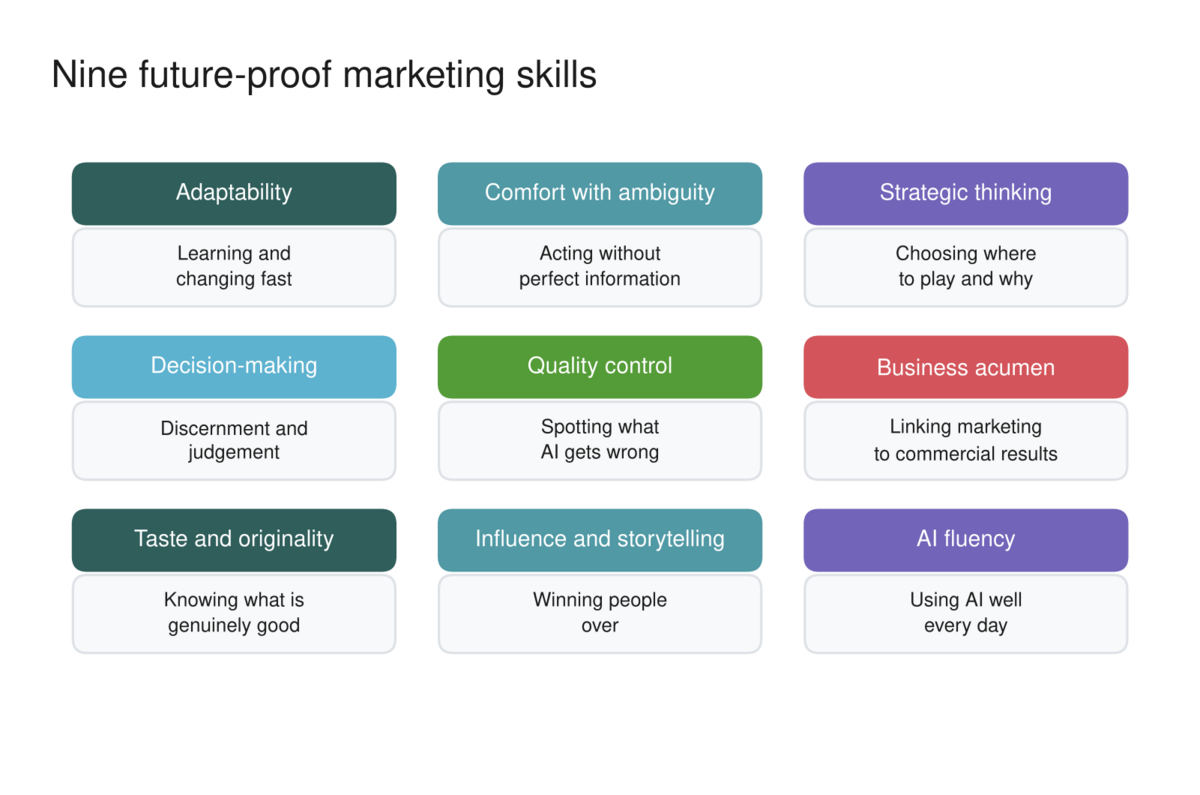
Adaptability and comfort with ambiguity. Marketing tools and platforms now change month by month. Marketers who can learn quickly and act sensibly without perfect information keep moving while others wait for certainty that never arrives.
Strategic thinking. AI can generate a dozen strategies in seconds, but choosing one requires understanding the market, the competition, the budget and the organisation's appetite for risk. Strategy is about trade-offs, and trade-offs need accountability.
Discernment and decision-making. When options are cheap to generate, the scarce skill is choosing well. This means weighing evidence, spotting weak assumptions and committing to a course of action.
Quality control. AI output can be fluent and wrong at the same time. Checking facts, spotting invented sources, catching tone that is off-brand and knowing when something is "good enough" is a skill in its own right, and one employers increasingly test for.
Big-picture business acumen. Marketers who can connect their work to revenue, margin and customer lifetime value are far harder to replace than those who report clicks. Linking channel activity to business outcomes, as in our digital marketing dashboard framework, is a practical way to build this.
Taste and original thinking. AI tends towards the average of what it has seen. Knowing what is genuinely distinctive, and having ideas that are not simply remixes of existing content, is what makes a brand stand out.
Influence and storytelling. Good ideas still need to be sold internally and externally. The ability to build a narrative, read a room and win people over remains deeply human, which is why stakeholder management for digital marketers is such a valuable skill.
AI fluency. This might seem like an odd entry on a list of AI-proof skills, but it is essential. The marketers most at risk are not those whose tasks AI can do, but those who cannot use AI to do more. We explain the specific AI skills in our guide to the AI skills every marketer needs.
Why is AI fluency on a list of AI-proof skills?
Because the human skills above only become valuable at scale when you can combine them with AI. A strategist who can test ten positioning ideas with AI in an afternoon, then apply judgement to choose the best, will outperform one who can only test two. An editor who uses AI to produce first drafts, then adds insight and quality control, can deliver far more than one who writes everything from scratch.
The market is rewarding this combination. PwC's 2025 Global AI Jobs Barometer found a 56% wage premium for jobs requiring AI skills, and that skills in AI-exposed jobs are changing 66% faster than in other jobs. In the AMA research, marketers ranked AI as the most important skill for the next five years. AI fluency is not an alternative to human skills; it is the multiplier that makes them pay.
How should you prioritise what to learn in 2026?
With so much to learn, the order matters. It helps to think of AI-proof skills as layers, each building on the one before. Fundamentals come first, because you cannot judge AI output about customers, positioning or channels you do not understand. AI fluency comes next, because it multiplies everything else. Judgement and influence sit on top, because they are what turn faster work into better outcomes.
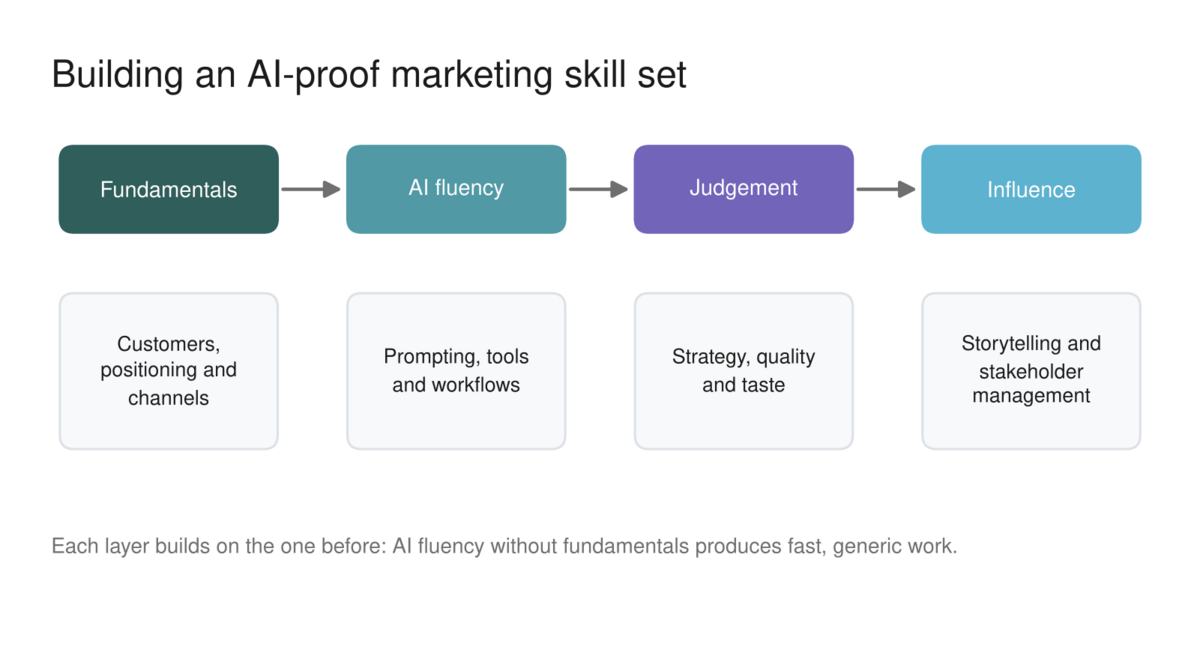
In practice, most marketers have uneven skills across these layers. Some have deep fundamentals but little AI experience. Others use AI every day but struggle to explain the commercial impact of their work. The fastest progress comes from working on your weakest layer first, rather than adding more depth where you are already strong.
If you are early in your career, the fundamentals layer deserves particular attention, because it is the part AI cannot learn for you. Our guide to starting a career in marketing explains why.
How do you build AI-proof marketing skills in practice?
Human skills are built through practice and feedback rather than reading. That means designing your work so you get regular opportunities to exercise judgement, then reflecting on the results. A simple routine looks like this:
- Benchmark yourself so you know which layer is weakest.
- Use AI on a real task every day, and keep notes on where its output needed your correction. Those corrections are your judgement at work.
- Ask for one stretch responsibility that involves strategy or influence, such as presenting results to senior stakeholders or proposing a new test.
- Review your decisions monthly: what you chose, why, and what happened. This builds discernment faster than anything else.
You can also use AI as a sparring partner to practise the very skills it cannot replace.
Copy and paste prompt: "Act as a sceptical marketing director. I am going to present a recommendation: [describe your recommendation, the evidence and the expected results]. Challenge it with the five toughest questions you would ask, point out any weak assumptions, and then tell me what additional evidence would make you approve it. Do not soften your feedback."
The Target Internet platform is designed to build exactly this blend, with interactive courses across digital marketing and AI, skills benchmarking to show where your gaps are, accredited certification, over 400 episodes of the Digital Marketing Podcast, and monthly live masterclasses.
Frequently asked questions
Which marketing skill is most AI-proof?
Strategic thinking combined with business acumen is the hardest for AI to replace, because it involves choosing between trade-offs and taking responsibility for the outcome. AI can generate options, but deciding which option fits the organisation still needs an accountable human with context.
Are creative marketing skills safe from AI?
Creative production is being heavily automated, but creative judgement is not. Original ideas, taste and the ability to recognise what is genuinely distinctive remain valuable. The AMA lists creativity among the least disrupted skills, while graphic design production is among the most disrupted.
Should I learn AI or human skills first?
Both, but in the right order for you. If you lack marketing fundamentals, start there, because you need them to judge AI output. If your fundamentals are strong, prioritise AI fluency, because it multiplies the value of everything else you know.
How long does it take to build AI-proof marketing skills?
Basic AI fluency can be built in weeks with daily practice on real tasks. Judgement, strategy and influence take longer, typically developing over months and years through experience, feedback and deliberately taking on stretch responsibilities.
Do employers really hire for soft skills over technical skills?
Increasingly they look for both, but evidence of judgement and influence is what separates candidates who can all use the same AI tools. PwC also found falling degree requirements in AI-exposed jobs, suggesting employers care more about demonstrated skills than credentials alone.
If you are ready to take a structured approach to building your digital marketing skills, explore Target Internet membership options and discover how the platform's interactive courses, benchmarking tools, podcast, accredited certification and live masterclasses can help you build the skills that keep you valuable as AI improves.
About the author
Daniel Rowles is lead trainer at Target Internet and the author of Digital Branding (Kogan Page). He co-hosts The Digital Marketing Podcast and delivers digital marketing and AI training for organisations around the world, including digital transformation and future skills. You can find out more on his Target Internet profile.
Bibliography
1. World Economic Forum (2025). The Future of Jobs Report 2025: Skills outlook. https://www.weforum.org/publications/the-future-of-jobs-report-2025/in-full/3-skills-outlook/
2. American Marketing Association (2026). 2026 State of Marketing Careers Report. https://ama.org/marketing-news/2026-career-report
3. PwC (2025). 2025 Global AI Jobs Barometer. https://www.pwc.com/gx/en/news-room/press-releases/2025/ai-linked-to-a-fourfold-increase-in-productivity-growth.html