By Daniel Rowles, lead trainer at Target Internet and author of Digital Branding (Kogan Page). Last updated: November 2026.
Hyper-personalised marketing uses real-time behavioural data, context and AI to tailor content, offers, timing and channel to each individual customer, rather than to a segment or persona. Done well it lifts relevance, loyalty and revenue. Done badly it feels intrusive, so it needs strong customer data foundations and clear consent.
What is hyper-personalised marketing?
Hyper-personalisation, also spelt hyperpersonalisation or hyper-personalization, is the use of data analysis, automation and AI to personalise each customer's experience at an individual level. It goes beyond putting a first name in an email. A hyper-personalised experience reacts to what a customer is doing right now, what they have done before, and the context they are in, such as time of day, location or device.
Common examples include product recommendations that change as you browse, emails sent at the time each recipient is most likely to open them, offers adjusted to a customer's purchase history, and website content that changes for returning visitors.
What is the difference between personalisation and hyper-personalisation?
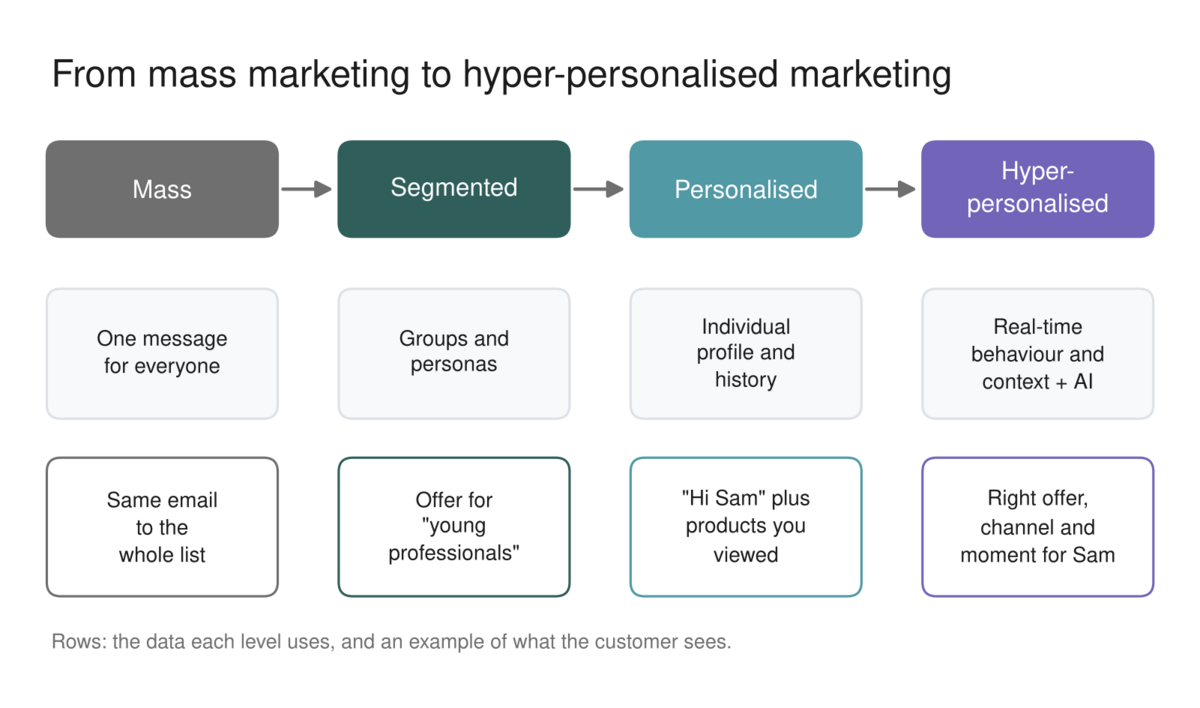
Most "personalisation" is really targeting. Customers are grouped into segments or marketing personas, and each group receives a version of the message. The individual does not get a unique experience: they get the one designed for their segment.
Hyper-personalisation tailors the experience to the individual, based on real-time knowledge of that person, while still learning from patterns across similar customers. A simple way to picture it: segmented marketing offers someone a croissant because they live in France, while hyper-personalised marketing offers it because they usually buy a pastry at this time on this day of the week.
How does hyper-personalisation work?
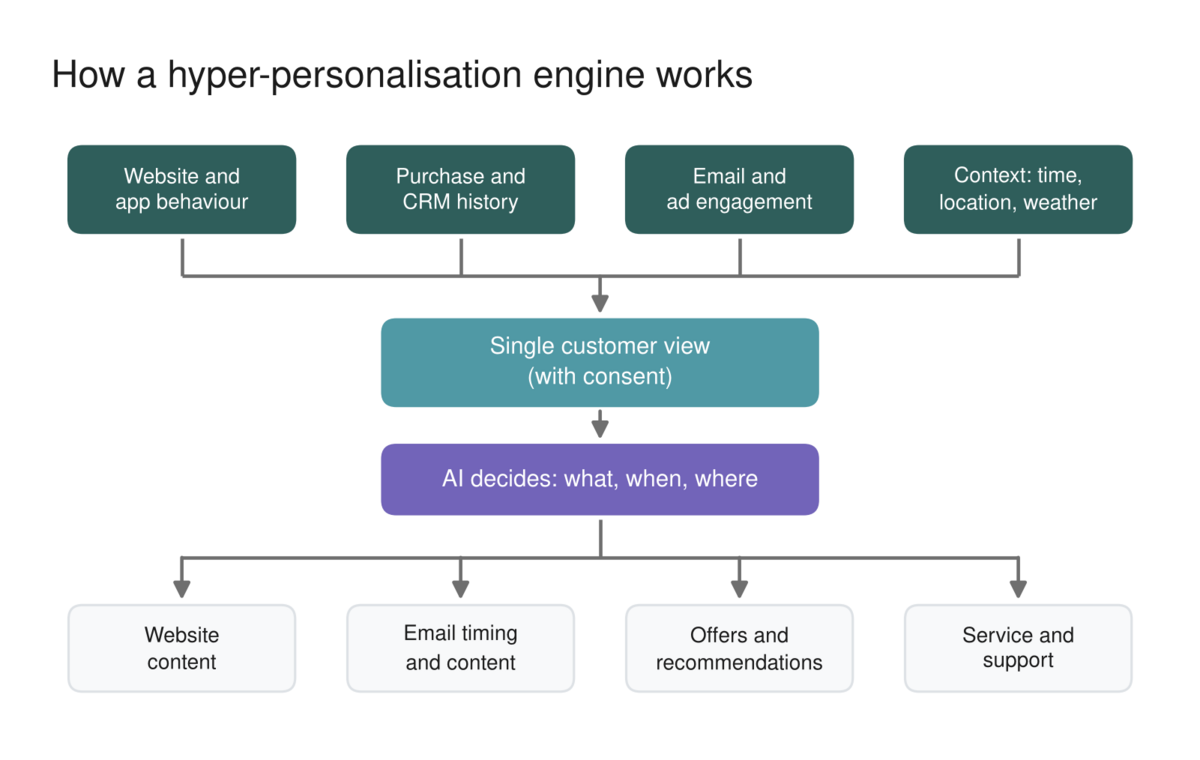
Hyper-personalisation combines three capabilities. Each depends on the one before it:
- Data: behaviour from your website and app, purchase and CRM history, email and ad engagement, and context such as location or weather are brought together, ideally into a single customer view.
- Decisioning: AI and machine learning models predict what each customer is most likely to want next, and learn from every response.
- Automation: the decision is delivered without manual work, through website content, email timing and content, offers, recommendations or service interactions.
Large organisations often build this on enterprise customer data and experience platforms. Smaller teams can start with features already built into the tools they use. Mailchimp's send time optimisation, for example, picks the best time to send to each recipient, and most e-commerce and email platforms now include AI product recommendations.
What are some examples of hyper-personalised marketing?
The best-known examples come from businesses with large numbers of logged-in customers, because they have the data and the consent to use it. Amazon's product recommendations and the feeds and ads on Instagram and TikTok are all driven by individual behaviour rather than broad segments.
Starbucks is a well-documented case outside big tech. Its Deep Brew AI platform, launched in 2019, was initially used to personalise app suggestions using order history, weather and time-of-day data. The loyalty app gives Starbucks a reason for customers to identify themselves at every visit, and that identified data is what makes hyper-personalisation possible.
Streaming services such as Netflix and Spotify work in a similar way: the artwork, playlists and recommendations each person sees are shaped by their own viewing and listening history, which is why two people in the same household can see very different home screens.
The lesson for most marketers is not to copy Starbucks' scale, but to notice the pattern: a genuine customer benefit in exchange for data, and personalisation that makes the experience faster or easier rather than simply pushing more offers.
What are the benefits of hyper-personalisation?
The case for personalisation is well supported. McKinsey research found that 71% of consumers expect companies to deliver personalised interactions, and 76% get frustrated when that does not happen. The same research found personalisation most often drives a 10 to 15% revenue lift. The main benefits are:
- Higher conversion: the right offer at the right moment is more likely to be acted on.
- Stronger loyalty and retention: customers who feel understood have a reason to keep coming back.
- Less wasted spend: fewer irrelevant messages and promotions sent to people who will ignore them.
- Lower service costs: anticipating problems, such as a delivery issue, can resolve them before a customer has to get in touch.
Personalisation at this level depends on data, analytics, automation and a clear customer experience strategy. Those are exactly the skills the Target Internet platform is built to develop, with interactive courses across digital marketing and AI, skills benchmarking to show where your gaps are, accredited certification, over 400 episodes of the Digital Marketing Podcast, and monthly live masterclasses.
What stops brands using hyper-personalisation?
Not everyone is convinced. Marketing Week columnists Peter Weinberg and Jon Lombardo have argued that personalisation at the level often promised does not work for most brands, and three obstacles explain why.
Skills and technology
Joining up data, building or buying the models, and automating delivery across channels takes skills many marketing teams do not yet have. AI tools have lowered the barrier, but someone still has to connect the data, define the rules and measure the results.
Data privacy and trust
Hyper-personalisation is data-intensive, and one person's helpful recommendation is another's surveillance.
In the UK, the GDPR allows profiling for marketing, but you need a lawful basis, you must tell people about it, and individuals have an absolute right to object to profiling for direct marketing. Stricter rules apply to solely automated decisions with legal or similarly significant effects, according to the ICO. Platform changes such as Apple's Mail Privacy Protection also limit what you can track. This is not legal advice, so involve your data protection lead early.
Stakeholder buy-in
Hyper-personalisation touches technology, data, legal and customer service, so it needs support well beyond marketing. Good stakeholder management helps, as does presenting it as the next step in an existing digital transformation programme rather than a separate initiative.
How do you get started with hyper-personalised marketing?
Whether hyper-personalisation suits your brand comes down to fit: your relationship with customers, how much first-party data they are willing to share, and your capacity to deliver. There are three sensible routes:
- Test at small scale: switch on features you already pay for, such as send time optimisation or product recommendations, and measure the uplift against a control group.
- Go all in: for brands with plenty of logged-in customers, a customer data platform and AI decisioning across channels can transform the experience, usually with a specialist partner.
- Use people-powered personalisation: for smaller or premium brands, well-informed staff supported by a good CRM can deliver a personal experience no algorithm matches.
How to measure whether it is working
Hyper-personalisation is easy to overclaim, because personalised experiences tend to be shown to your most engaged customers, who would often have bought anyway. The only reliable way to measure the effect is a holdout: keep a random group of customers on the standard experience and compare results. Measures worth tracking include:
- Incremental conversion and revenue: the difference between the personalised group and the holdout, not the raw conversion rate.
- Retention and repeat purchase: whether personalised customers come back more often over several months.
- Unsubscribes, opt-outs and complaints: early warning that personalisation has tipped into feeling intrusive.
- Cost to run: data, technology and staff time, so you can judge the return honestly.
Whichever route you choose, judge every personalised experience by three questions: is it tailored to the individual, is it delivered at the right time, and is it in the right channel?
Copy and paste prompt: "I am a marketer at [type of business] with [describe customer data: e.g. email list, purchase history, website analytics]. Suggest five small-scale hyper-personalisation tests I could run in the next 90 days using [list your tools]. For each, give the data needed, the customer benefit, the metric to measure, how to set up a control group, and any privacy or consent considerations under UK GDPR."
If you are ready to take a structured approach to building your digital marketing skills, explore Target Internet membership options and discover how the platform's interactive courses, benchmarking tools, podcast, accredited certification and live masterclasses can help you use data and AI to build better customer experiences.
Frequently asked questions
What is hyperpersonalisation in simple terms?
It is tailoring marketing to each individual customer using real-time data and AI, so the content, offer, timing and channel all reflect what that person is doing and has done, rather than which segment they belong to.
Is hyper-personalisation the same as personalisation?
No. Standard personalisation usually means tailoring to segments or adding personal details such as a name or location. Hyper-personalisation reacts to an individual's live behaviour and context, typically using machine learning, so two customers in the same segment can see entirely different content, offers and timing.
What data do you need for hyper-personalised marketing?
Typically website and app behaviour, purchase and CRM history, email and ad engagement, and contextual data such as location or time. First-party data collected with clear consent is the most reliable foundation.
Is hyper-personalisation legal under GDPR?
Profiling for marketing is allowed under UK GDPR if you have a lawful basis and are transparent about it. People can object to profiling for direct marketing at any time, and stricter rules apply to solely automated decisions with significant effects.
Can small businesses use hyper-personalisation?
Yes, at an appropriate scale. Many email, e-commerce and CRM tools include AI recommendations and send time optimisation, which let small teams test hyper-personalisation without a large technology project. Small businesses also have an advantage in people-powered personalisation, because staff often know their customers personally.
About the author
Daniel Rowles is lead trainer at Target Internet and the author of Digital Branding (Kogan Page). He co-hosts The Digital Marketing Podcast and delivers digital marketing and AI training for organisations around the world, including digital transformation and future skills. You can find out more on his Target Internet profile.
Bibliography
1. McKinsey & Company (2021). The value of getting personalization right, or wrong, is multiplying. https://www.mckinsey.com/capabilities/growth-marketing-and-sales/our-insights/the-value-of-getting-personalization-right-or-wrong-is-multiplying
2. Information Commissioner's Office (n.d.). What does the UK GDPR say about automated decision-making and profiling? https://ico.org.uk/for-organisations/uk-gdpr-guidance-and-resources/individual-rights/automated-decision-making-and-profiling/what-does-the-uk-gdpr-say-about-automated-decision-making-and-profiling/
3. WebProNews (n.d.). Starbucks' AI barista whisperer: crafting vibe-driven orders in app era. https://www.webpronews.com/starbucks-ai-barista-whisperer-crafting-vibe-driven-orders-in-app-era
4. Weinberg, P. and Lombardo, J. (n.d.). Personalisation or impersonalisation? Marketing Week. https://www.marketingweek.com/peter-weinberg-jon-lombardo-personalisation-impersonalisation/
5. Mailchimp (n.d.). Use send time optimization. https://mailchimp.com/en-gb/help/use-send-time-optimization/