By Daniel Rowles, lead trainer at Target Internet and author of Digital Branding (Kogan Page). Last updated: November 2026.
The most effective productivity tips for digital marketers are simple: start each day with one important task before anything else, check email at set times rather than constantly, plan social media in advance so it does not pull you in all day, use AI to remove routine busywork, and protect blocks of focused time from notifications. Together, these habits reduce procrastination and stress and help you spend more time on the work that actually moves results.
I first wrote this article in 2014, and the pressure on marketers has only increased since. We now juggle email, chat, video calls, social platforms and AI tools, often all at once. Microsoft's 2025 Work Trend Index found that heavily contacted workers are interrupted by meetings, emails or messages around every two minutes during core working hours. The techniques below are the ones that still work for me.
Why is productivity so hard for digital marketers?
Partly because the job never stands still. Platforms change, new tools appear every week and there is always another channel, report or post that could be improved. That creates endless task lists and a constant sense of being behind.
But the bigger problem is often procrastination and self-doubt. I wrote the original version of this article after coaching a talented young entrepreneur who had well-formed plans and clear next steps, yet had been busy for months without getting anywhere. He was caught in a loop: the more he procrastinated, the worse he felt about his abilities, and the worse he felt, the more he procrastinated. I recognised it immediately, because I am an expert procrastinator myself.
Around the same time, I read honest posts by Rand Fishkin and Tim Ferriss, both hugely successful people, describing their own struggles with self-doubt and the myth of limitless self-discipline. That was a turning point for me. Instead of relying on willpower, the answer is to design your day so that procrastination has fewer opportunities to take hold, to focus on what actually matters, and to avoid setting yourself up to fail.
1. How does the One Key Task approach work?
If your task list is longer than your arm and much of it rolls forward day after day, it is demoralising. The best task management tool in the world will not do the tasks for you, and in my experience, fiddling with task lists can become its own form of procrastination.
Instead, I choose One Key Task each day: the task that, if I complete it, means the day has been productive. It is often the biggest or most uncomfortable task, the one I would normally put off. I work on it first thing, in a protected block of around two hours, before email or anything else has a chance to distract me. If it is too big, I break it into pieces that fit into that block.
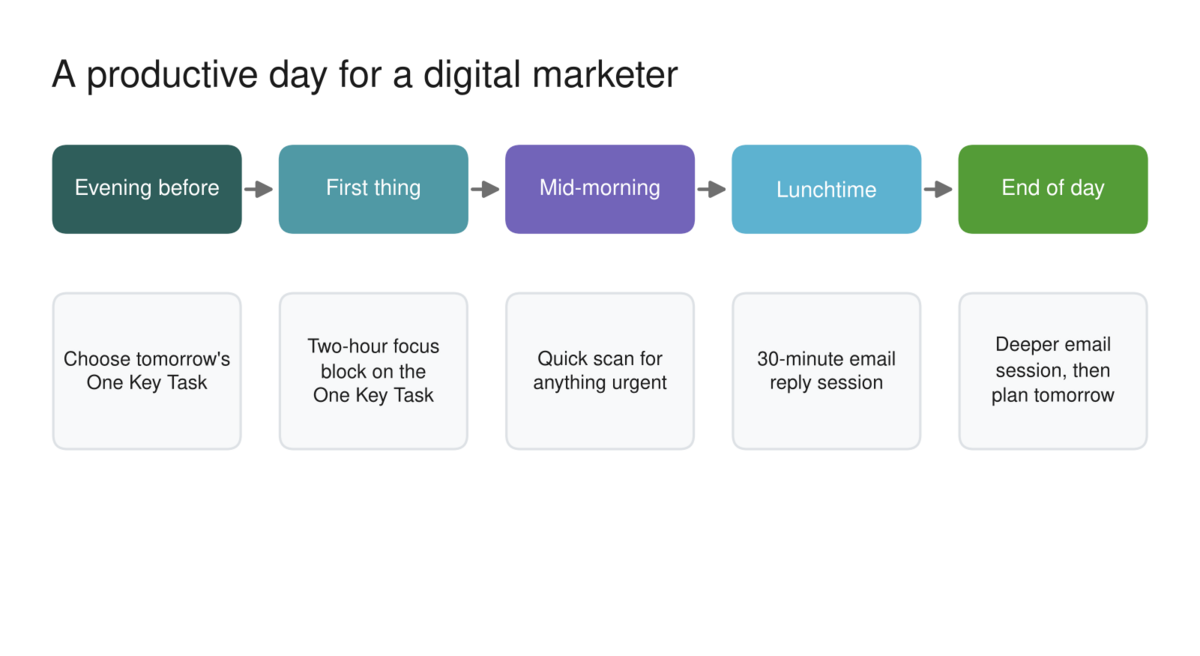
The key is to choose the task the night before, so you do not waste the morning deciding. I also spend five minutes each evening reviewing my overall task list, which gives me a sense of closure so I can switch off. Starting the day with a real achievement creates momentum that carries through everything else.
2. How should digital marketers manage email?
Email is a productivity killer because it constantly interrupts and makes it easy to feel busy while achieving very little. These rules work for me:
- Unsubscribe ruthlessly and route the newsletters you keep into a separate folder, so they never interrupt you.
- Check email at set times. I do a quick scan for anything urgent after my One Key Task, a short reply session at lunchtime and a deeper session at the end of the day.
- Switch notifications off at all other times, including the badges on your phone.
- Set expectations with an out-of-office style note explaining when you check email and asking people to call if something is genuinely urgent. Very few people actually do.
- Action it or delete it. If an email needs work, reply to set expectations, add a task and file the email, so your inbox does not become a second task list.
AI assistants built into email tools can now summarise long threads, flag what needs a response and draft replies. They are genuinely useful in these set sessions, but they work best when you still control when you look at your inbox, rather than letting it control you.
3. How do you stop social media becoming a distraction?
As marketers, we cannot simply switch social media off, but we can stop it eating the whole day. The answer is planning.
A content calendar is essential for any organisation, whatever its size. It lets you plan what you will publish and the social activity around it, focus on key topics and coordinate with colleagues. Keep it simple: a calendar that actually gets used beats a sophisticated one that does not. Then use a social media management tool to schedule posts in advance and handle responses in dedicated time slots rather than constantly. Our guide to project management for marketers covers planning tools in more detail.
Finally, be honest with yourself about the difference between monitoring for work and scrolling for distraction. Set times for both.
4. How can AI help marketers be more productive?
AI is the biggest change since this article was first written. Used well, it removes much of the routine work that used to fill a marketer's day: first drafts, summarising reports, taking meeting notes, reformatting content and pulling together data.
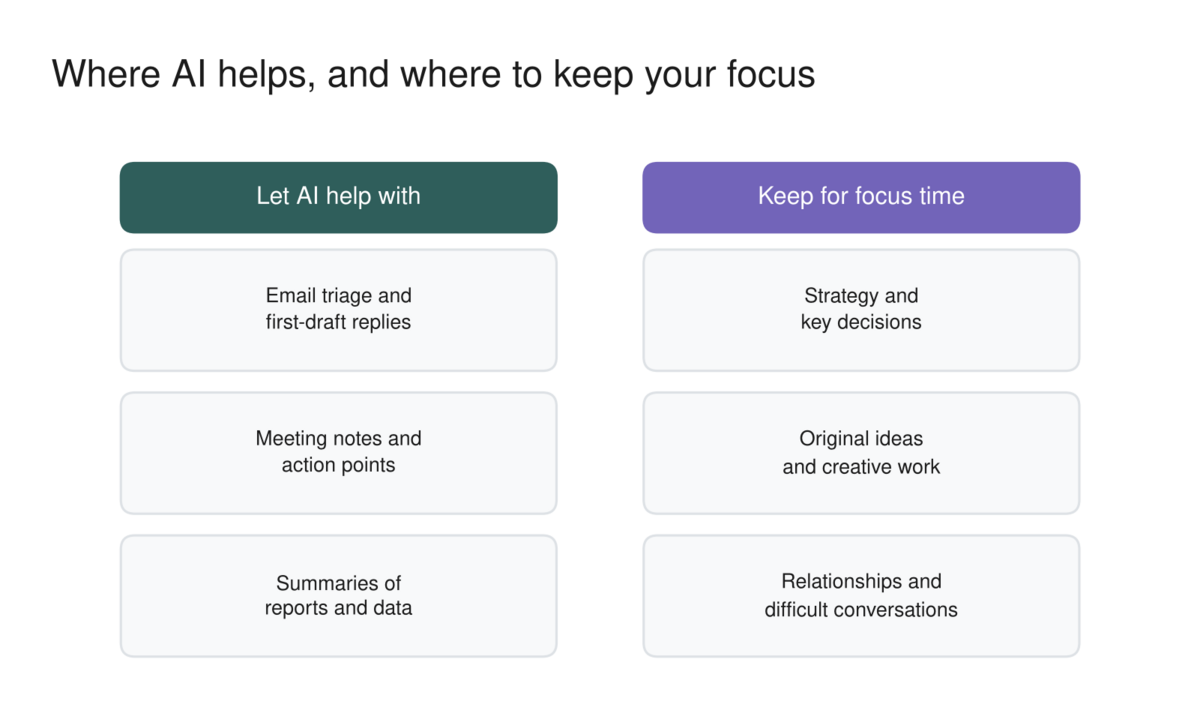
The trap is that AI can also make it easier to produce more busywork, faster. The goal is not to do more tasks; it is to free time for the work that really matters, such as strategy, creative thinking and relationships. Our guide to the AI skills every marketer needs explains how to build AI into repeatable workflows.
A good starting point is to let AI help you choose your One Key Task.
Copy and paste prompt: "Here is my task list for this week: [paste tasks]. My most important objectives this month are [objectives]. Identify the single task that would make the biggest difference to those objectives if I completed it tomorrow, explain why, and break it into steps that fit into a two-hour focus block. Then list which of the remaining tasks could be delegated, automated with AI or dropped altogether."
5. How do you protect time for deep work?
Focused, uninterrupted time is the scarcest resource most marketers have. Protect it deliberately. Block time in your calendar and treat it like a meeting. Switch off notifications, close chat apps and put your phone out of reach during focus blocks. Divide your day into segments, with different types of work in each, so you are not switching constantly between deep thinking and quick replies.
It also helps to build learning into your routine rather than squeezing it in. Short, regular learning, such as a podcast on a commute or a focused course module, keeps your skills current without derailing your week. Our guide to creating a culture of ongoing learning explains why that matters. The Target Internet platform is designed for this kind of learning, with interactive courses across digital marketing and AI, skills benchmarking to show where your gaps are, accredited certification, over 400 episodes of the Digital Marketing Podcast, and monthly live masterclasses.
Above all, be kind to yourself. Productivity systems are there to help, not to become another stick to beat yourself with. If a day goes off track, reset the next morning with a new One Key Task.
Frequently asked questions
What is the best productivity tip for digital marketers?
Start each day with one important task, chosen the night before, and work on it in a protected block before checking email or social media. It ensures the most valuable work gets done and builds momentum for the rest of the day.
How often should I check my email?
For most marketers, two or three set times a day is enough, with notifications switched off in between. Let important contacts know how to reach you if something is genuinely urgent.
Can AI make marketers more productive?
Yes, by handling routine work such as first drafts, summaries, meeting notes and data preparation. The key is to use the time saved for higher-value work, not to fill it with more low-value tasks.
How do I stop procrastinating?
Rely on structure rather than willpower. Choose one key task the night before, start it first thing, break big tasks into smaller pieces and remove distractions during focus time. Starting is usually the hardest part.
What tools help digital marketers stay organised?
A simple task manager, a content calendar, a social media scheduling tool and the AI features built into your email and productivity software cover most needs. The best tool is the one you will actually use consistently.
If you are ready to take a structured approach to building your digital marketing skills, explore Target Internet membership options and discover how the platform's interactive courses, benchmarking tools, podcast, accredited certification and live masterclasses can help you learn efficiently and focus on what matters.
About the author
Daniel Rowles is lead trainer at Target Internet and the author of Digital Branding (Kogan Page). He co-hosts The Digital Marketing Podcast and delivers digital marketing and AI training for organisations around the world, including digital transformation and future skills. You can find out more on his Target Internet profile.
Bibliography
1. Microsoft (2025). Work Trend Index Annual Report 2025: The year the Frontier Firm is born. https://www.microsoft.com/en-us/worklab/work-trend-index/2025-the-year-the-frontier-firm-is-born