By Daniel Rowles, lead trainer at Target Internet and author of Digital Branding (Kogan Page). Last updated: November 2026.
To tailor social media copywriting to platform and objective, start with what you want people to do, then write for the way each platform is used. Put the hook in the first line, because most feeds cut posts off after around 125 to 280 characters. Use a professional, insight-led voice on LinkedIn, write for the image or video on Instagram and TikTok, keep X short and timely, and match every call to action to a single objective.
Why does social media copywriting need tailoring?
The same message can succeed on one platform and disappear on another, because people use each platform in a different mood and format. LinkedIn is read in a professional frame of mind, Instagram and TikTok are led by images and video, and X rewards speed and conversation. Posting identical copy everywhere is efficient, but it usually means the copy is a poor fit for most of the places it appears.
Your objective matters just as much. A post designed to build awareness should be memorable; a post designed to drive leads needs a specific offer and a clear next step. Writing without a defined objective is the most common reason social copy feels vague. If you have not set objectives yet, our guide to five steps to a successful social media strategy is a good place to start.
How do you write for the first line?
On every major platform, most people decide whether to keep reading from the first line or two. Long posts are truncated with a "see more" or "more" link, so anything after the cut is only seen by people who were already interested. According to Hootsuite's caption preview tool, the visible text before the cut is around 125 characters on Instagram, around 140 characters on LinkedIn on desktop and around 280 on Facebook, while standard X posts are limited to 280 characters in total.
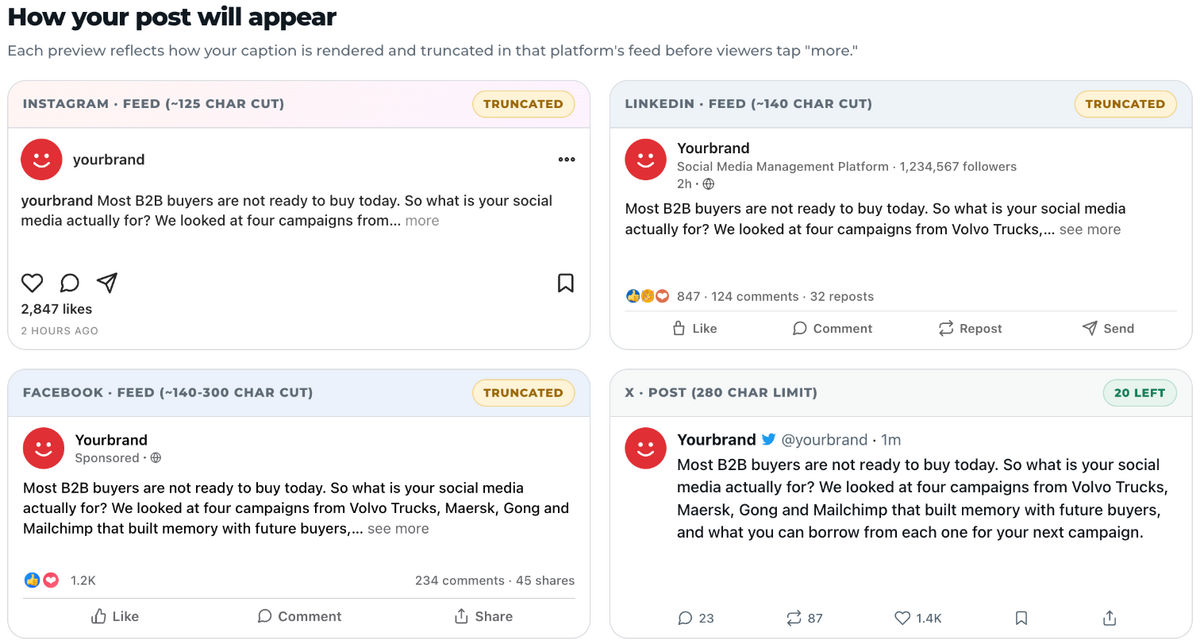
The screenshot above shows a single caption previewed across platforms. On Instagram, only the opening question survives the cut. That is why the first line needs to do the hardest work. Effective opening lines tend to:
- Make a surprising or specific claim rather than a general one.
- Ask a question the reader genuinely wants answered.
- Name the reader or their problem, so the right people recognise themselves.
- Promise a clear benefit, such as a number of tips or a result.
Avoid spending the first line on your brand name, a greeting or a hashtag. Previewing your copy before you post, with a tool like the one above or the preview in your scheduling tool, quickly shows where the cut falls.
How should you write for each social media platform?
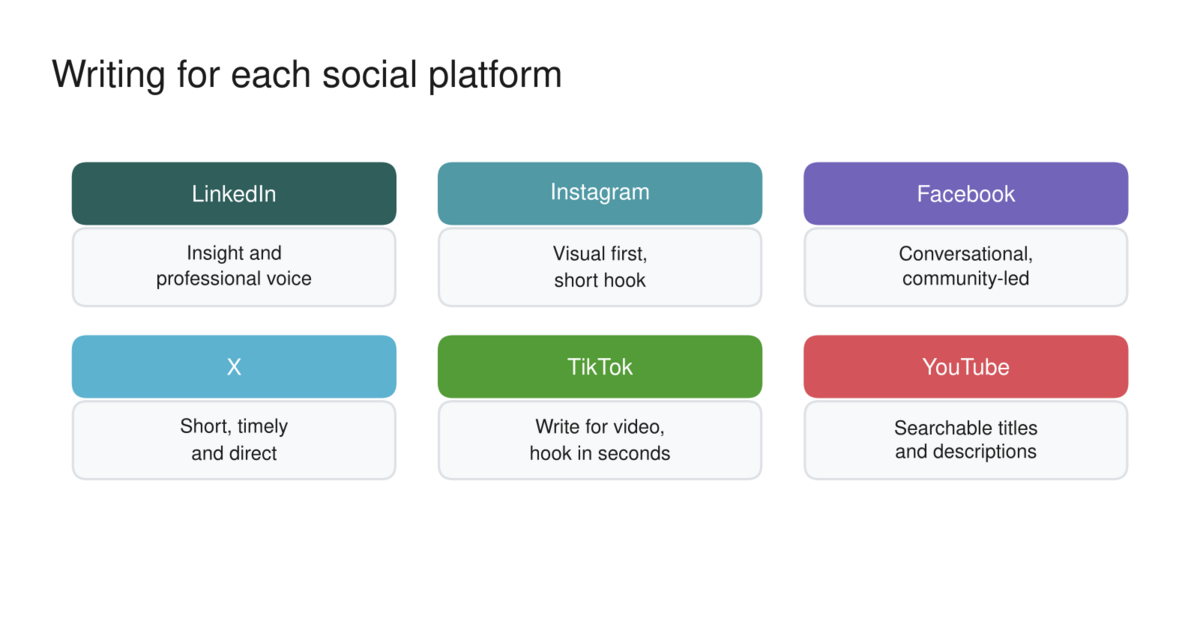
LinkedIn posts can be up to 3,000 characters, and longer, well-structured posts often do well because people are in a learning frame of mind. Lead with an insight, a lesson or a clear point of view, use short paragraphs and white space, and write in the first person where it is an individual posting. Copy from real people usually performs better than brand announcements, which is why many companies support employees to post. Our guide to personal branding on LinkedIn covers this in more detail.
Instagram is visual first, so the caption supports the image or video rather than the other way round. Captions can run to 2,200 characters, but only the opening line shows in the feed. Put the hook first, use the rest of the caption for context or a story, and keep calls to action simple, because links in captions are not clickable. Hashtags now play a smaller role than they used to; see our guide to Instagram hashtags for the current approach.
Facebook works best for conversational, community-led copy. Write as if you are talking to a group of customers, ask questions people can answer easily, and respond to comments, because the conversation underneath a post is often more valuable than the post itself.
X
X rewards brevity, timeliness and personality. Standard posts are limited to 280 characters, although X Premium subscribers can post longer. Make one point per post, tie it to what people are talking about where it fits your brand, and use threads to break up longer ideas.
TikTok and YouTube Shorts
On short-form video platforms, the most important copy is often spoken or shown on screen, not written in the caption. Write the first few seconds of the script as carefully as a headline, add on-screen text for people watching without sound, and use the caption to add keywords and context.
YouTube
YouTube is also a search engine, so titles and descriptions should use the words people search for. Put the main keyword near the start of the title, keep the most important part within the space shown in search results, and use the first lines of the description to summarise the video.
The Target Internet platform can help you build these skills, with interactive courses across digital marketing and AI, skills benchmarking to show where your gaps are, accredited certification, over 400 episodes of the Digital Marketing Podcast, and monthly live masterclasses.
How do you match copy to your objective?
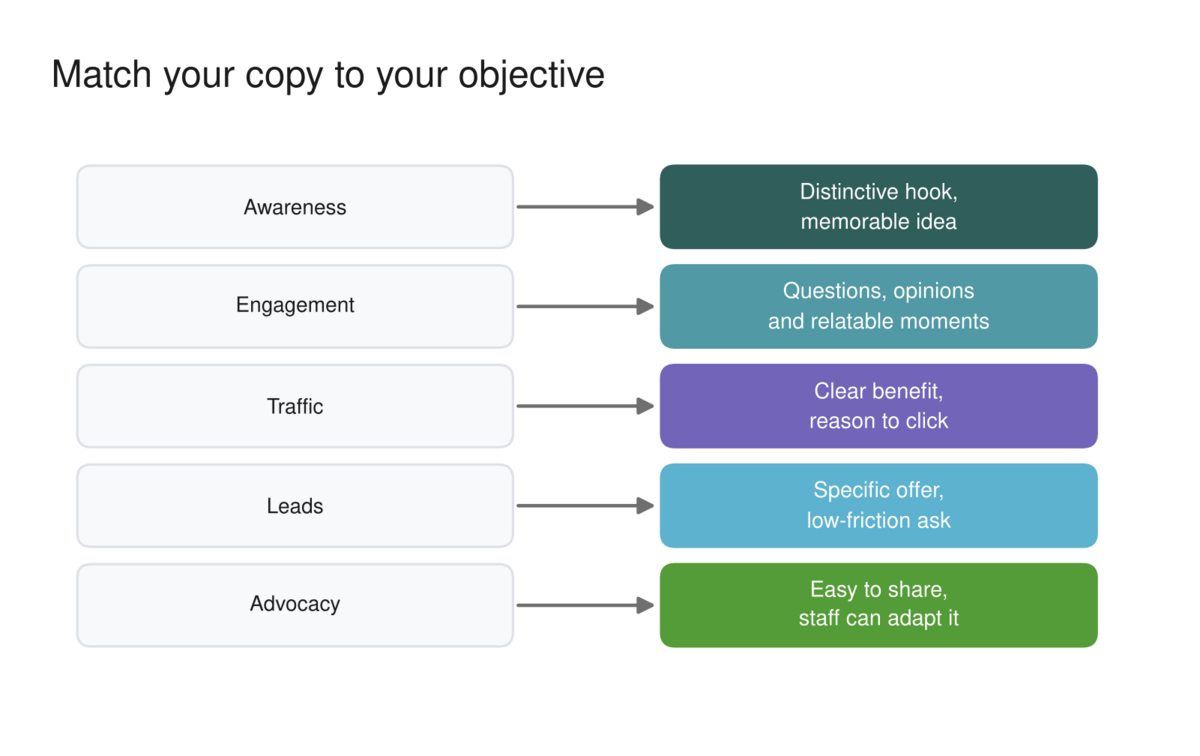
Every post should have one main objective, and the copy should be built around it:
- Awareness: make it distinctive and memorable. A strong idea, a recognisable tone of voice and consistent visual style matter more than a call to action. Our guide to establishing your brand's social media voice explains how to develop one.
- Engagement: invite a response. Ask a question, share an opinion people will want to agree or disagree with, or describe a moment your audience will recognise.
- Traffic: give a clear reason to click. State the benefit of the content you are linking to, and be specific about what people will get.
- Leads: make a specific offer, such as a guide, webinar or trial, and keep the ask small. On platforms with lead forms, the copy only needs to get the click.
- Advocacy: make it easy for staff, partners and customers to share, ideally with suggested wording they can adapt in their own voice.
For lead and traffic objectives, the headline matters as much as the post. Our guide to writing the perfect headline has techniques that work just as well in social posts.
Copy and paste prompt: "Act as a social media copywriter for [brand], which sells [product or service] to [audience]. Our tone of voice is [describe]. Write one post for each of LinkedIn, Instagram, Facebook and X promoting [content or offer], with the objective of [awareness, engagement, traffic or leads]. Put the hook in the first 125 characters, adapt the length and style to each platform, include one clear call to action that matches the objective, and explain in one sentence why each version suits its platform."
How do you know if your social media copy is working?
Measure each post against the objective you wrote it for. Impressions and reach show whether the hook stopped people scrolling, engagement shows whether the copy prompted a response, and clicks and conversions show whether it drove action. Testing two versions of the same post, with different opening lines or calls to action, is one of the fastest ways to learn what works for your audience.
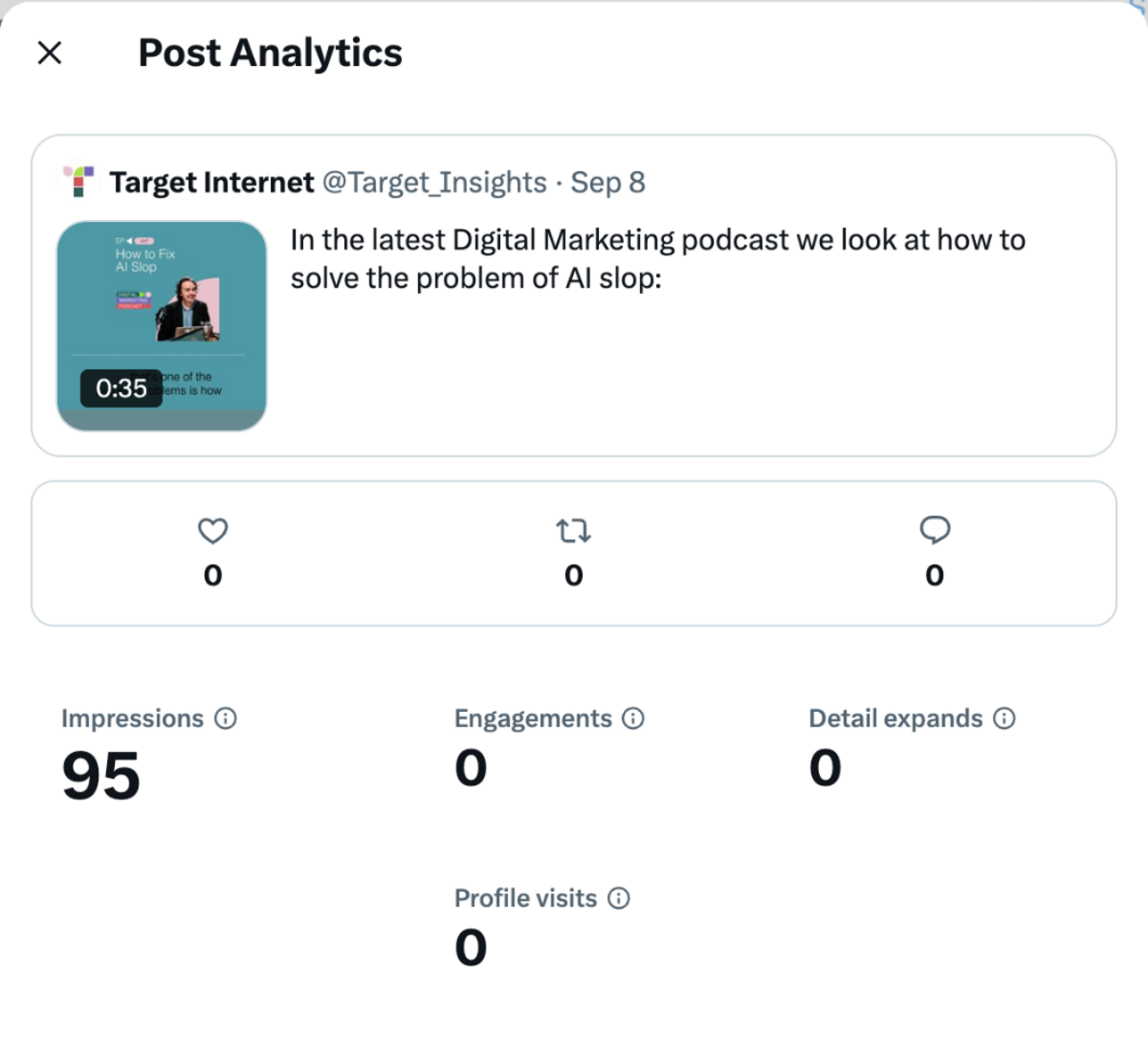
The X analytics panel above is a good example of why this matters: the post was seen, but nobody engaged. That suggests the copy or format did not give people a reason to respond, and the next version should try a stronger hook or a clearer question.
Frequently asked questions
What is social media copywriting?
It is the writing in social media posts, captions, ads and video scripts, designed to make people stop, read and take a specific action, from engaging with a post to clicking through or signing up.
How long should a social media post be?
It depends on the platform and objective, but the opening line matters most. Around 125 to 140 characters show before the cut on Instagram and LinkedIn, so put the key message there, then use the rest of the space if the content justifies it.
Should you post the same copy on every platform?
You can share the same idea everywhere, but the copy should be adapted to each platform's format, audience and character limits. A post written for LinkedIn rarely works unchanged on Instagram or X.
What is the LinkedIn character limit?
LinkedIn posts can be up to 3,000 characters, but only around the first 140 characters show on desktop before the "see more" link. Longer posts can work well on LinkedIn, as long as the opening line earns the click to read on.
Can AI write social media copy?
AI tools are useful for drafting variations, adapting copy between platforms and generating ideas, but the results need editing for your brand voice, accuracy and audience. Treat AI drafts as a starting point rather than finished copy.
If you are ready to take a structured approach to building your digital marketing skills, explore Target Internet membership options and discover how interactive courses, benchmarking tools, the podcast, accredited certification and live masterclasses can support you and your team.
About the author
Daniel Rowles is lead trainer at Target Internet, a Senior Lecturer at Imperial College and the author of several books on digital marketing published by Kogan Page, including Digital Branding. He co-hosts The Digital Marketing Podcast and delivers digital marketing and AI training for organisations around the world. You can find out more on his Target Internet profile.
Bibliography
1. Hootsuite. Free social media caption preview tool. https://www.hootsuite.com/social-media-tools/social-media-caption-preview
2. Hootsuite (2026). Ideal social media post length for every platform. https://blog.hootsuite.com/ideal-social-media-post-length/