By Daniel Rowles, lead trainer at Target Internet and author of Digital Branding (Kogan Page). Last updated: November 2026.
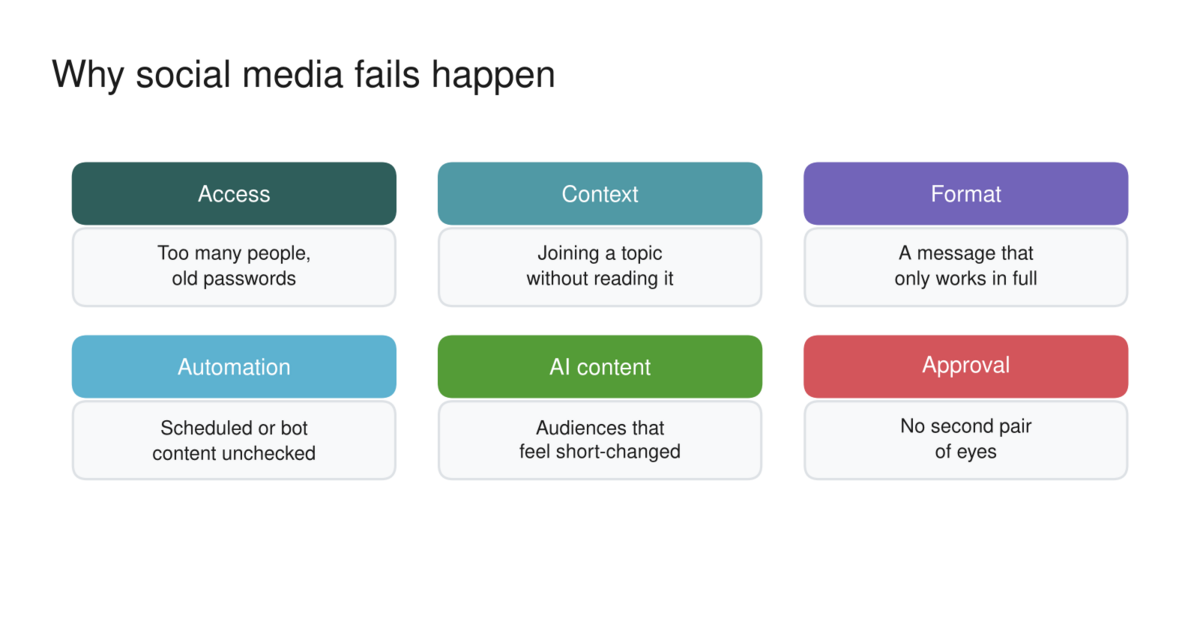
Most social media marketing fails come down to a handful of avoidable causes: the wrong people having access to an account, joining a conversation without understanding it, a message that only makes sense in full, automated or AI content that nobody checked, and the lack of a second pair of eyes before posting. The brands below learned this the hard way. The lesson from each is less about the mistake itself and more about the process that let it happen, and how quickly and honestly the brand responded.
We first published this article in 2016. This updated version keeps the classic examples that still teach something and adds more recent ones, including fails caused by automation and AI.
Why do social media fails happen?
What are some of the biggest social media marketing fails?
1. Vodafone UK: the wrong person with access (2010)
A customer service employee posted an obscene, homophobic tweet from Vodafone UK's official account. Vodafone confirmed it was not a hack, suspended the employee and apologised repeatedly to followers on Twitter.
The lesson: limit who can post from brand accounts, and respond where people are talking. Vodafone's quick, public apology was widely seen as the right response.
2. HMV: forgetting who holds the passwords (2013)
As the struggling retailer made staff redundant, employees used HMV's official Twitter account to live-tweet the sacking of around 60 colleagues, including a tweet reporting that the marketing director had asked how to shut down Twitter.
The lesson: know who controls every account, use a social media management tool with individual logins, and review access whenever people leave.
3. DiGiorno: joining a hashtag without reading it (2014)
The pizza brand jumped on the trending #WhyIStayed hashtag with a joke about pizza, without realising people were using it to share experiences of domestic abuse. DiGiorno deleted the tweet and apologised, admitting it had not read what the hashtag was about, then replied personally to many of the people it had upset.
The lesson: never join a trend until you understand why it is trending.
4. Burger King UK: a message that only works in full (2021)
On International Women's Day, Burger King UK tweeted "Women belong in the kitchen", intending the following tweets to explain a scholarship for women chefs. Most people only saw the first tweet. The brand deleted it and apologised after around 12 hours of backlash.
The lesson: every post must work on its own. A provocative line that relies on context in a thread, or an idea designed for print, rarely survives the feed.
5. KFC Germany: automation without checks (2022)
KFC sent German app users a push notification linking the anniversary of Kristallnacht to a cheese and chicken promotion. The company apologised within about an hour and blamed a semi-automated content process linked to calendars of national observances.
The lesson: automated and scheduled content needs human review, especially anything tied to dates, events or news.
6. Coca-Cola: AI content that audiences rejected (2024 and 2025)
Coca-Cola's AI-generated versions of its classic "Holidays are coming" Christmas advert drew strong criticism on social media, with many people calling them soulless. The brand faced a second backlash in 2025 after releasing another AI-made Christmas ad.
The lesson: AI can make content faster and cheaper, but audiences judge the result, not the efficiency. Be especially careful with emotional, nostalgic or creative work where people value human craft.
Bonus: Greggs: turning a fail into a win (2014)
When Google's search results showed an offensive spoof of the Greggs logo, the bakery's social team responded with humour, bartered with Google using doughnuts, and kept answering customers until it was fixed. The response was praised as a masterclass in crisis management.
The lesson: a confident, human tone of voice, built up over time, lets a brand turn an embarrassing moment into goodwill.
How should you respond to a social media fail?
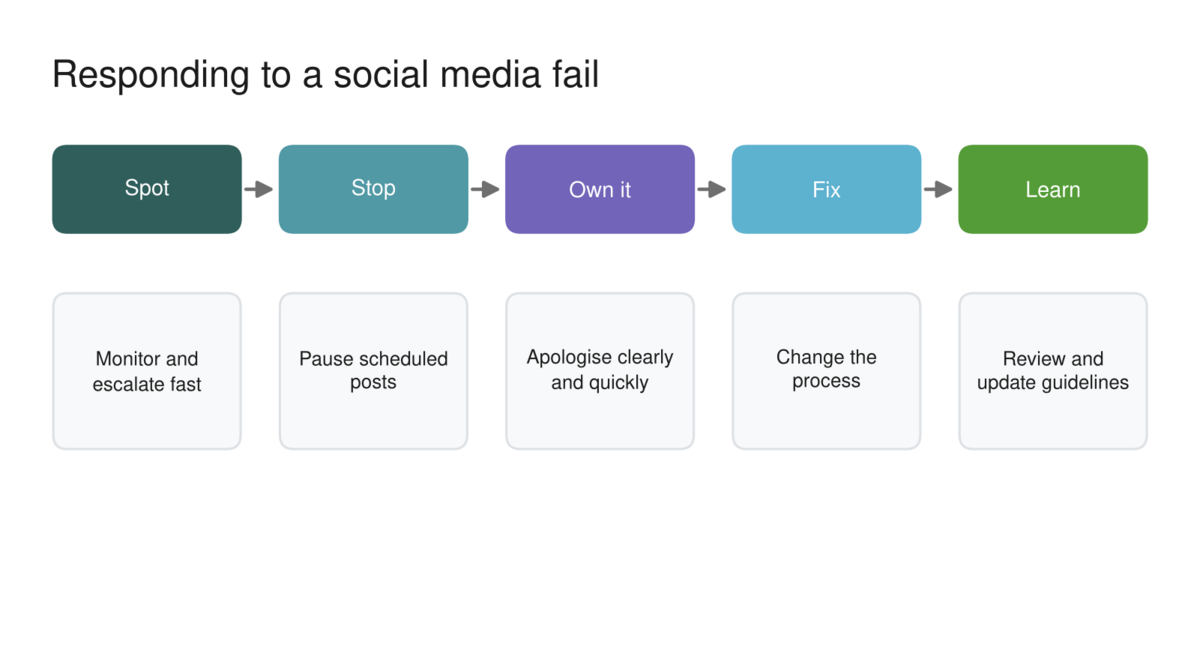
- Spot it quickly. Monitor mentions and have a clear route to escalate problems, including out of hours.
- Stop. Pause scheduled and automated posts so you do not appear tone deaf while the problem unfolds.
- Own it. Apologise clearly, in the same place the problem happened, without excuses.
- Fix the cause. Change the process that allowed it: access, approvals, automation rules or briefing.
- Learn. Review what happened and update your guidelines and training.
Our guides to social media crisis management, writing a social media policy and establishing your brand's social media voice cover each area in depth.
Copy and paste prompt: "Act as a social media risk reviewer. Here is a post we plan to publish for [brand] on [platform] on [date]: [paste post]. Our audience is [describe audience]. Check it for anything that could be misread out of context, clash with news, events or observances on or around that date, rely on a trend or hashtag we may not fully understand, or conflict with our brand voice. List each risk, how likely it is to cause a problem, and a safer alternative wording." Use this alongside human review, not instead of it, and check the date against real news on the day.
The Target Internet platform can help you build these skills, with interactive courses across digital marketing and AI, skills benchmarking to show where your gaps are, accredited certification, over 400 episodes of the Digital Marketing Podcast, and monthly live masterclasses.
Frequently asked questions
What is the most common cause of social media fails?
A lack of process: too many people with access, no approval step, or automated content that nobody checks.
Should a brand delete a post that has caused offence?
Usually yes, but acknowledge it publicly and apologise. Deleting quietly often makes things worse because screenshots spread anyway.
How can AI help prevent social media mistakes?
AI can flag risky wording and context before posting, but it can also cause mistakes. Keep a human in the loop for anything sensitive.
Can a social media fail ever be good for a brand?
Sometimes. A fast, honest and human response, like Greggs in 2014, can build goodwill.
If you are ready to take a structured approach to building your digital marketing skills, explore Target Internet membership options and discover how interactive courses, benchmarking tools, the podcast, accredited certification and live masterclasses can support you and your team.
About the author
Daniel Rowles is lead trainer at Target Internet, a Senior Lecturer at Imperial College and the author of several books on digital marketing published by Kogan Page, including Digital Branding. He co-hosts The Digital Marketing Podcast and delivers digital marketing and AI training for organisations around the world. You can find out more on his Target Internet profile.
Bibliography
1. The Next Web (2010). Vodafone UK's tweets awful language, embarrassing apologies. https://thenextweb.com/news/vodafone-uks-tweets-awful-language-embarrassing-apologies
2. The Next Web (2013). HMV staff hijack company Twitter account to live-tweet the sacking of 60 employees. https://thenextweb.com/news/hmv-employees-hijack-company-twitter-account-to-live-tweet-the-sacking-of-60-staff
3. Adweek (2021). Burger King apologizes and deletes tweet that said women belong in the kitchen. https://www.adweek.com/brand-marketing/burger-king-apologizes-and-deletes-tweet-that-said-women-belong-in-the-kitchen/
4. Fortune (2022). KFC blames bot for chicken promotion. https://fortune.com/2022/11/11/kfc-blames-kristallnacht-promotion-on-a-bot/
5. VnExpress International (2025). Coca-Cola slammed again for AI-generated Christmas ad. https://e.vnexpress.net/news/tech/enterprises/coca-cola-slammed-again-for-soulless-ai-generated-christmas-ad-4960752.html
6. Chartered Management Institute (2014). How Greggs baked up a masterclass in social media crisis management. https://www.managers.org.uk/insights/news/2014/august/how-greggs-baked-up-a-masterclass-in-social-media-crisis-management