Search results do not look the way they did two years ago. For a growing share of queries, the first thing a searcher sees is not a list of ten blue links but a generated answer: an AI Overview summarising the topic, or a full conversational response in Google's AI Mode. For marketers, this is the most significant change to search behaviour since the shift to mobile, and it raises an urgent practical question: how do you make sure your content is the content these systems read, quote and cite?
The encouraging news is that optimising for AI search is not a dark art, and it does not require throwing away everything you know about SEO. Google is explicit that there are no special technical requirements for appearing in AI Overviews or AI Mode beyond standard search optimisation. What has changed is the way content is selected, assembled and presented, and that shift rewards some habits far more than others. We explored the tools and tactics emerging around this shift in a recent episode of the Digital Marketing Podcast, Navigating AI search, ads and SEO in 2025, and this guide turns that thinking into a practical optimisation playbook.
It is worth being clear about the stakes before diving into tactics. Informational queries, the questions, comparisons and how-to searches that content marketing has always targeted, are exactly the queries most likely to trigger a generated answer. If your organic strategy depends on educational content, AI search is not a side issue: it is now the environment your most valuable pages compete in. At the same time, the brands that do earn citations report a useful compensation: visitors who click through from a generated answer arrive better informed and further along in their decision, because the AI has already handled the basics.
In this guide we will look at what AI Overviews and AI Mode actually are, how they choose their sources, how to structure content so it gets quoted, the authority and technical signals that decide whether you are eligible in the first place, and how to measure whether any of it is working.
What are AI Overviews and Google AI Mode?
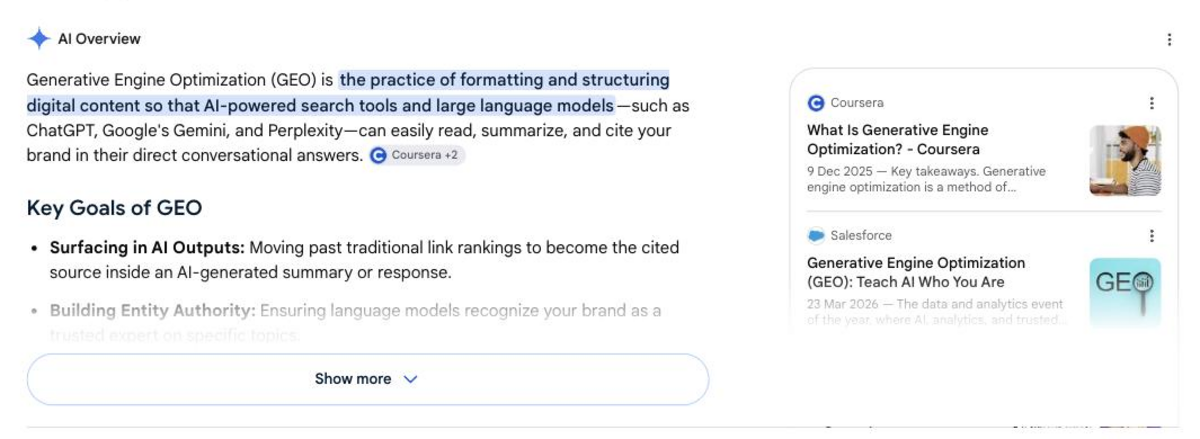
AI Overviews are the generated summaries that appear at the top of a standard Google search results page. They are triggered when Google's systems judge that a generative response would be more helpful than links alone, which in practice means informational queries, questions, comparisons and anything exploratory. The overview synthesises material from multiple sources and displays prominent citation links to the pages it drew on.
AI Mode goes further. It is a separate tab on the results page that behaves like a conversational assistant: the searcher asks a question in natural language, receives a full structured answer, often including comparison tables and follow-up suggestions, and can keep refining with further questions. Where an AI Overview condenses a topic into a paragraph or two, AI Mode can produce something closer to a short article, built in real time from retrieved web content. Google describes this as moving search beyond information retrieval towards reasoning over multiple sources at once.
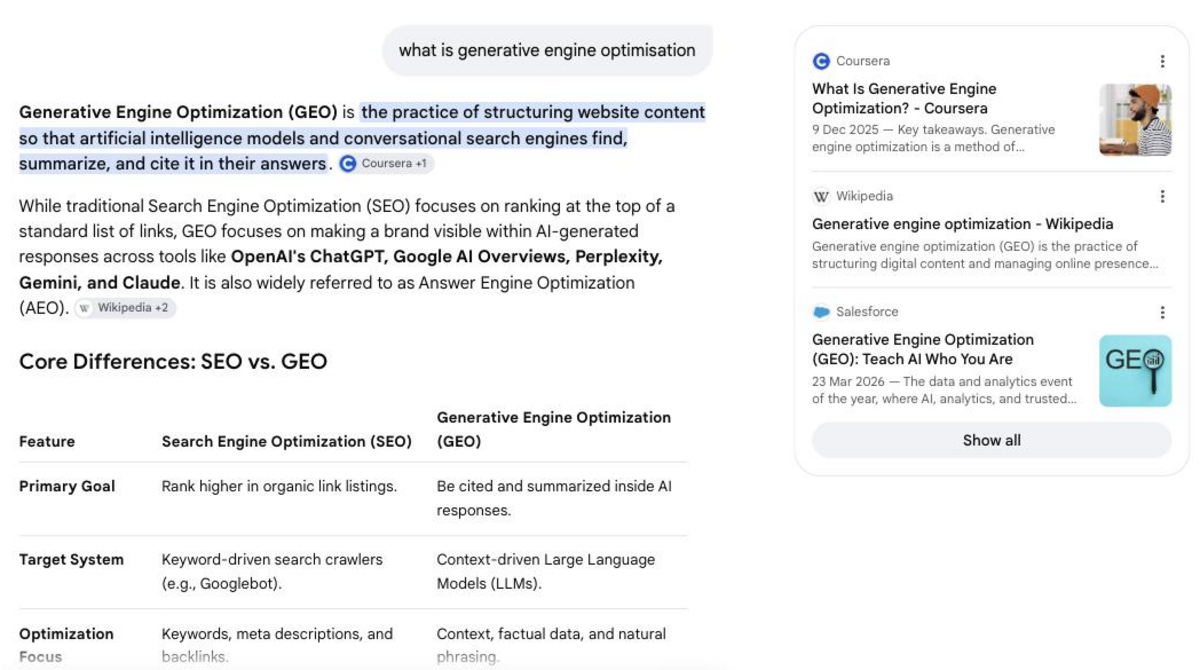
It is tempting to treat these features as bigger featured snippets, but the difference is fundamental. A featured snippet lifts one passage from one page and shows it verbatim, so winning it was a single-source competition. AI Overviews and AI Mode synthesise across many sources at once, paraphrasing rather than quoting directly, and they can cite several pages for a single answer. That changes the game from winning one box to being reliably present in a pool of trusted sources that the systems draw on again and again. It also means partial victories exist: you can be one of four citations on a valuable query even when a competitor's page outranks yours in the classic results below.
The strategic consequence of both features is the same. When an answer is assembled on the results page itself, fewer clicks are available overall, and the clicks that remain flow disproportionately to the sources that are cited. Being one of those citations, rather than a link somewhere below the fold, is now the visibility battle that matters.
How AI search actually picks its sources
To optimise for these systems you need a working mental model of how they operate, because it differs from classic ranking in one crucial way. When a searcher asks AI Mode a question, Google does not run a single search. It uses a technique known as query fan-out: the original question is broken into multiple related sub-queries, each of which is searched separately, and the most useful passages from across all of those searches are retrieved and synthesised into the final answer.
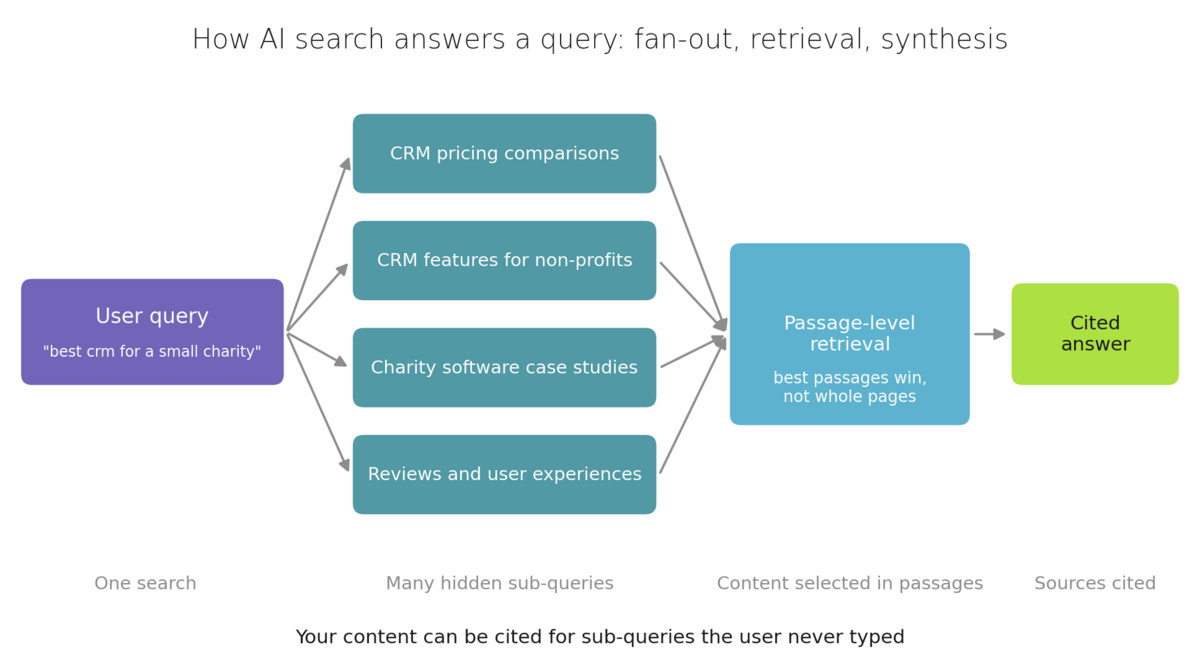
Two implications follow, and they should reshape how you plan content. First, your page can be cited for questions the searcher never actually typed. A guide to email deliverability might be pulled into an answer about why a charity's newsletter open rates have fallen, because one of the fan-out sub-queries surfaced your explanation of sender reputation. Broad, genuinely thorough coverage of your topic area therefore buys you tickets in far more draws than the keyword list you originally targeted.
AI Mode adds a further layer: conversation. Because searchers refine their question over several turns, the system carries context forward, and later retrievals are shaped by everything asked so far. A searcher might start with a broad question about CRM systems, narrow to charity pricing, then ask about data migration. Content that serves those follow-up questions, the practical second and third questions in a decision journey rather than only the obvious first one, gets retrieved at the exact moment intent is sharpest. Mapping those follow-up questions is now as important as mapping head keywords ever was.
Second, retrieval happens at the level of passages, not pages. The system is not asking whether your page is the best overall result; it is asking whether a specific paragraph of yours is the clearest, most complete answer to a specific sub-question. A mediocre page containing one superbly clear passage can win a citation over a strong page whose relevant explanation is scattered across twelve paragraphs. That is a genuinely new optimisation target, and it is the subject of the next section.
Structure your content to be quotable
If passages are the unit of competition, your job is to write passages that can be lifted out of your page and still make complete sense. The most reliable technique is answer-first writing: open each section with a direct, self-contained answer to the question the heading poses, then expand with evidence, nuance and examples underneath. Journalists call this the inverted pyramid; for AI search it is close to a design requirement.
Question-led headings help too. A heading such as "How often should a B2B brand post on LinkedIn?" followed immediately by a two-sentence answer gives a retrieval system a perfectly packaged passage. Vague headings such as "Our thoughts on posting cadence" give it nothing to match against. Keep each passage genuinely self-contained: name the subject rather than relying on pronouns that refer to earlier paragraphs, include the relevant number or recommendation inside the passage itself, and keep one idea per paragraph.
A concrete example makes the difference obvious. A typical page might say: "There are many factors to consider here, and as we discussed above, the platforms vary considerably, so it depends on your situation." Lifted out of context, that passage answers nothing. The quotable rewrite says: "Most B2B brands see the best LinkedIn engagement from three to five posts per week, with quality and consistency mattering more than volume; posting daily only pays off for teams that can sustain genuinely useful content at that pace." The second version names the subject, contains the recommendation and survives being extracted, which is precisely what retrieval systems select for.
Format supports quotability too. Genuine data belongs in clearly labelled figures rather than buried in prose, definitions belong close to the terms they define, and a short summary near the top of a long guide gives systems a reliable passage to represent the whole piece. None of this is writing for machines at the expense of people: every one of these habits also makes content easier for a busy human to scan, which is why answer-first structure has been good practice since long before generative search existed.
Schema markup reinforces all of this by making the structure of your content machine-readable. Marking up articles, FAQs, products, authors and your organisation helps systems understand what each passage is and who stands behind it. If you have not implemented structured data before, our guide on how to improve your SEO by using schema markup walks through the practicalities.
A fast way to audit an existing page is to ask an AI assistant to do the passage-level reading for you.
Copy and paste prompt: "You are an AI search retrieval system. I am going to give you the full text of a web page about [topic]. Break it into passages, then for each of the ten questions a searcher might ask about [topic], tell me which passage, if any, provides a complete self-contained answer. Flag every question where the answer exists on the page but is spread across multiple passages or depends on context from elsewhere on the page, and suggest how to rewrite it as one quotable passage. Here is the page text: [paste page text]"
Working through even one important page this way usually reveals the pattern: the knowledge is there, but it is not packaged in units an AI system can cleanly extract. If you want to build this kind of judgement systematically rather than page by page, the Target Internet platform includes interactive courses on SEO and content marketing, skills benchmarking to show you where your gaps are, over 400 episodes of the Digital Marketing Podcast, and monthly live masterclasses that cover exactly these emerging techniques.
Build the authority signals AI systems trust
Being quotable gets you considered; being trusted gets you cited. Generative systems are noticeably conservative about sourcing, because every citation is a small bet on the source's reliability made in front of the user. The signals they lean on are the familiar pillars of EEAT: experience, expertise, authoritativeness and trustworthiness. We dug into what EEAT means in practice in our podcast episode Mastering content with EEAT, and everything in it has become more important since, not less.
In practical terms, authority building for AI search looks like this. Publish under named authors with real credentials, and mark those authors up in your schema so the byline is machine-verifiable. Show first-hand experience: original data, real screenshots, documented results and honest limitations all distinguish lived expertise from paraphrased research. Keep your claims consistent with the wider evidence on the topic, because generated answers are assembled from multiple corroborating sources, and an outlier claim without support tends simply to be left out.
Entity consistency matters as well. AI systems build a picture of who your organisation is from every mention across the web, so consistent naming, a well-maintained organisation schema, active profiles and third-party coverage all sharpen that picture. This is also where the terminology conversation comes in: whether you call the discipline generative engine optimisation, answer engine optimisation or simply modern SEO, the underlying work is establishing your brand as an entity that machines can recognise and vouch for. We unpacked those overlapping terms, and what is genuinely new versus rebadged, in SEO, GEO and AEO: what you need to know.
Do not neglect the authority you build away from your own site. Because generated answers draw on the whole corroborating web, mentions of your brand in industry publications, podcasts, conference write-ups, reviews and community discussions all feed the entity picture, even where they carry no link. Classic digital PR, getting your experts quoted and your research referenced by publications the systems already trust, is arguably more valuable in AI search than it ever was for link building, because a brand that third parties consistently describe as an authority is exactly what a cautious citation engine is looking for.
None of this is fast, which is precisely why it is defensible. A competitor can copy your content structure in an afternoon; they cannot copy three years of consistent, expert, well-attributed publishing.
Technical foundations that still decide visibility
Everything above assumes that AI systems can actually reach, read and understand your content. Google is clear that AI features draw on the same index as classic search, which means the unglamorous technical layer still gates everything else. If a page cannot be crawled, rendered and understood, no amount of quotable writing will save it.
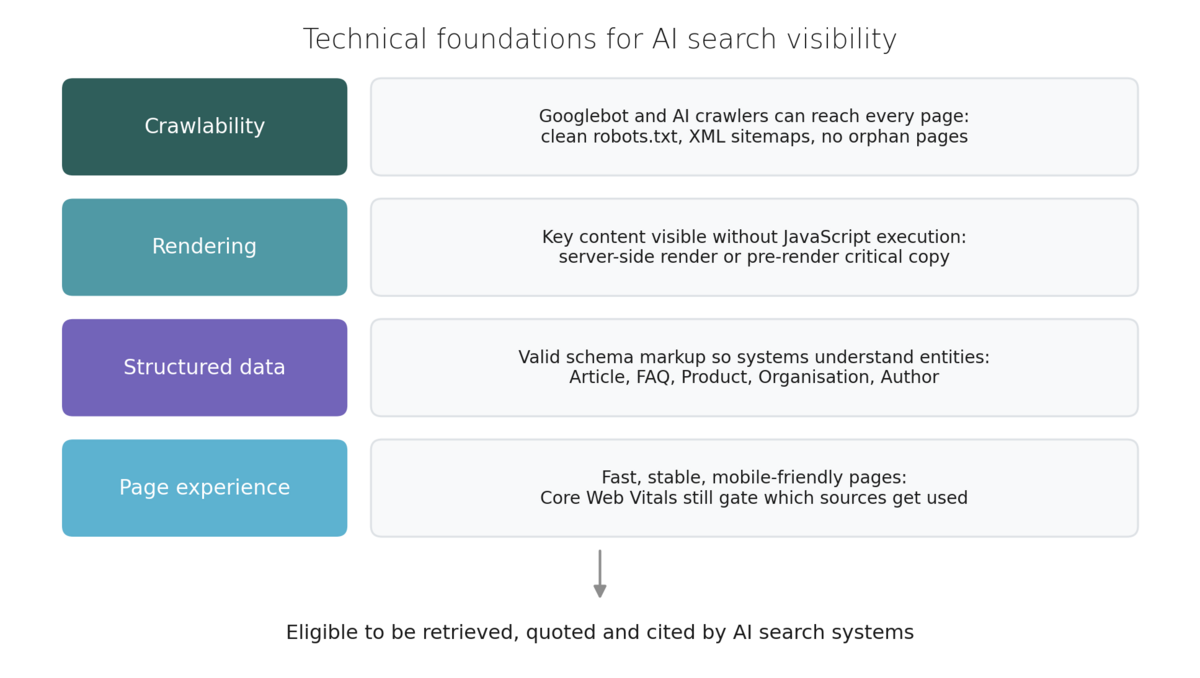
Four checks cover most of the risk. Crawlability first: your robots.txt should not be blocking the crawlers you want, your XML sitemap should be current, and important pages should be reachable through internal links rather than orphaned. Rendering second: if your key content only appears after heavy JavaScript execution, verify that it survives into the rendered HTML that crawlers actually index, and consider server-side rendering for anything critical. Structured data third: validate your schema rather than assuming it works, because malformed markup is worse than none. Page experience fourth: fast, stable, mobile-friendly pages remain part of how Google decides which sources are worth using.
The URL inspection tool in Search Console remains the quickest way to see your pages as Google sees them: it shows the rendered HTML after JavaScript execution, confirms whether the page is indexed and reports the structured data it found. Spot-checking your five most important pages there takes minutes and regularly surfaces problems that dashboards miss, such as a cookie banner blocking rendered content or a template change that silently dropped your article schema.
A sensible discipline is to fold these checks into a quarterly technical review rather than treating them as a one-off project. The audit process itself has not fundamentally changed with AI search; what has changed is the cost of failure, because an unreadable page is now invisible in two surfaces at once: the classic results and the generated answer above them.
How to measure your AI search visibility
For the first year or two of AI Overviews, measurement was the weakest part of every optimisation programme: you could see total impressions moving but not why. That changed in June 2026, when Google introduced dedicated Search generative AI performance reports in Search Console, giving site owners a specific view of impressions and visibility within AI Overviews, AI Mode and generative features in Discover.
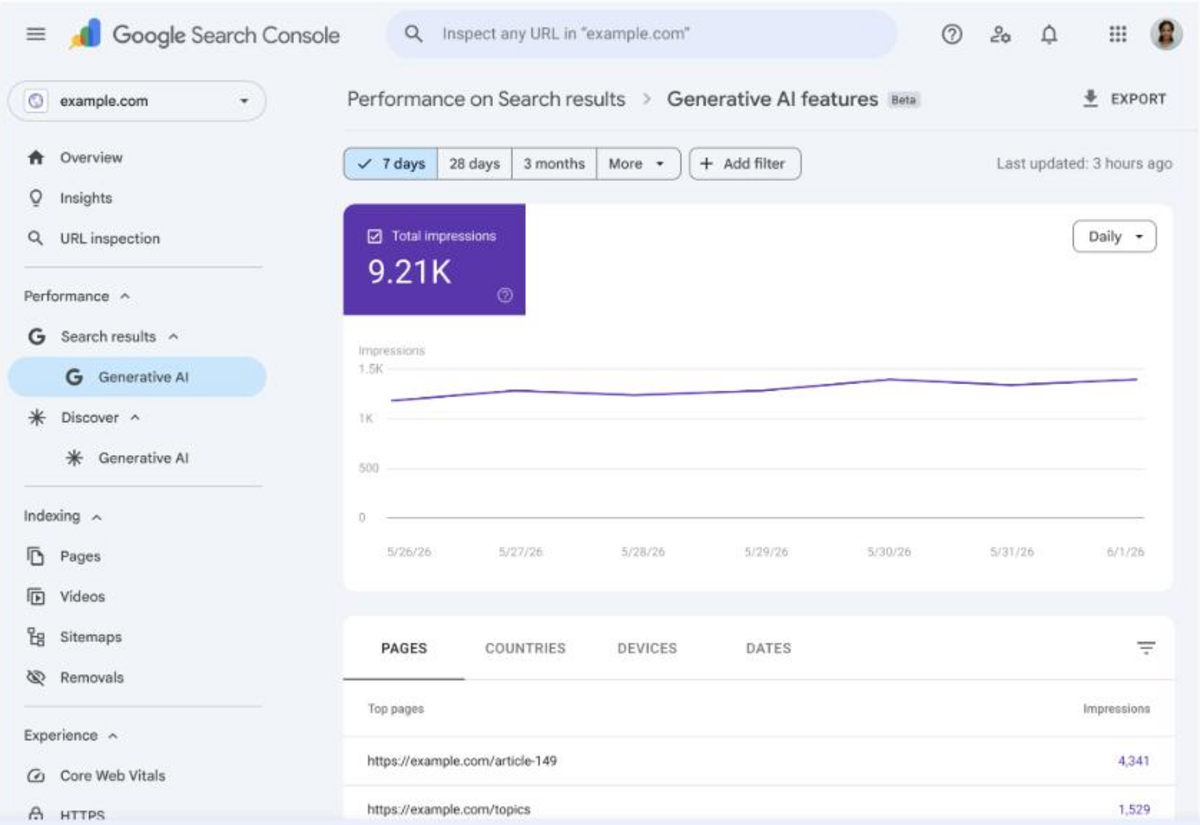
Build your measurement around three layers. The first is the Search Console data itself: track generative AI impressions alongside your classic search impressions, and watch which pages earn AI visibility, because those pages tell you which of your content patterns the systems favour. The second is behavioural: monitor click-through rates on your top informational queries over time, since a falling CTR with stable impressions is the signature of answers being resolved on the results page. The third is presence testing: regularly run your most commercially important questions through AI Overviews, AI Mode and other assistants, and record whether you are cited, who is cited instead, and what those sources do differently.
Copy and paste prompt: "I want to audit my brand's visibility in AI search. My brand is [brand name] and my website is [domain]. Here are the ten questions my customers most often ask: [list questions]. For each question, tell me how you would answer it, which sources you would consider most authoritative on this topic, and whether [brand name] appears among them. Where my brand is absent, analyse what the cited sources offer that my site currently does not."
Run that exercise monthly and the output becomes a prioritised content backlog: every question where you are absent is a gap, and the cited competitors are a specification for what closing the gap requires.
Finally, set expectations inside your organisation before the numbers force the conversation. Total organic clicks on informational content are likely to decline as generated answers absorb simple questions, and reporting that only shows falling clicks will read as failure even when visibility is improving. Add generative AI impressions, citation presence on priority questions and the quality of AI-referred sessions to your regular reporting now, so that the story you tell is about where demand is moving rather than a single shrinking metric. In your analytics, watch for referral traffic from AI assistants as a small but fast-growing segment, and judge it on engagement and conversion rather than volume.
What to do this quarter
Pulled together, the playbook is manageable. In the first month, establish your baseline: set up or locate the generative AI performance view in Search Console, run the visibility audit prompt above on your ten most valuable questions, and fix any crawling, rendering or schema failures the technical checks reveal. In the second month, rework your five most commercially important pages for quotability: answer-first sections, question-led headings, self-contained passages and complete schema. In the third month, turn to authority: get named, marked-up authors on your key content, publish at least one piece of original first-hand insight, and tidy the entity signals that describe your organisation across the web. Then re-run the audit and compare it with your baseline.
The marketers who win in AI search will not be the ones chasing each algorithm update, but the ones who build the underlying skills: structured writing, evidence-led authority, technical fluency and disciplined measurement. That is exactly what Target Internet membership is built for. Members get access to interactive online courses covering SEO, content marketing and AI, skills benchmarking to pinpoint where to focus, accredited certification, over 400 episodes of the Digital Marketing Podcast, and monthly live online masterclasses, including our dedicated SEO and AEO Masterclasses that go deeper into the techniques in this guide with working practitioners. If you want your team ready for the AI search era rather than reacting to it, that is the place to start.
Bibliography
1. Google Search Central. AI features and your website. https://developers.google.com/search/docs/appearance/ai-features
2. Google Search Central Blog. Introducing Search generative AI performance reports in Search Console. https://developers.google.com/search/blog/2026/06/gen-ai-performance-reports
3. Google. AI in Search: going beyond information to intelligence. https://blog.google/products/search/google-search-ai-mode-update/
4. Google Search Central. Creating helpful, reliable, people-first content. https://developers.google.com/search/docs/fundamentals/creating-helpful-content
5. Target Internet. The Digital Marketing Podcast. https://targetinternet.com/resources/podcast/