Before any marketing strategy or tactical plan can be put into action, you need a clear picture of the environment your organisation operates in. A PESTEL analysis is the most widely used framework for building that picture. It gives you a structured way to scan the external forces acting on your business, spot opportunities before your competitors do, and identify threats while there is still time to respond.
This guide explains what a PESTEL analysis is, what each of the six categories covers in 2026, and exactly how to run one with your team, including a ready-to-use AI prompt to accelerate the first draft. It finishes by showing you how to turn your findings into strategic decisions rather than a document that sits in a drawer.
What is a PESTEL analysis?
PESTEL (sometimes written PESTLE) is an acronym framework for assessing the key features of a business's external environment. Each factor you identify is filed under one of six headings: Political, Economic, Social, Technological, Environmental and Legal. The goal is to identify opportunities, such as a government initiative promoting your industry, and threats, such as a regulatory change that will restrict how you target advertising.
You may also see references to PEST, an older and shorter version of the same process that drops the Environmental and Legal categories. In practice the full six-category version is worth the extra effort: environmental expectations and fast-moving digital regulation are now two of the most significant sources of both risk and opportunity for marketers.
PESTEL is a situational analysis tool. Because situations change constantly, it is not a one-off exercise: the analysis should be revisited at regular intervals, typically quarterly or at each planning cycle, so that changes in the macro environment are caught early. Organisations that monitor and respond to these changes systematically are able to differentiate themselves and build genuine competitive advantage.
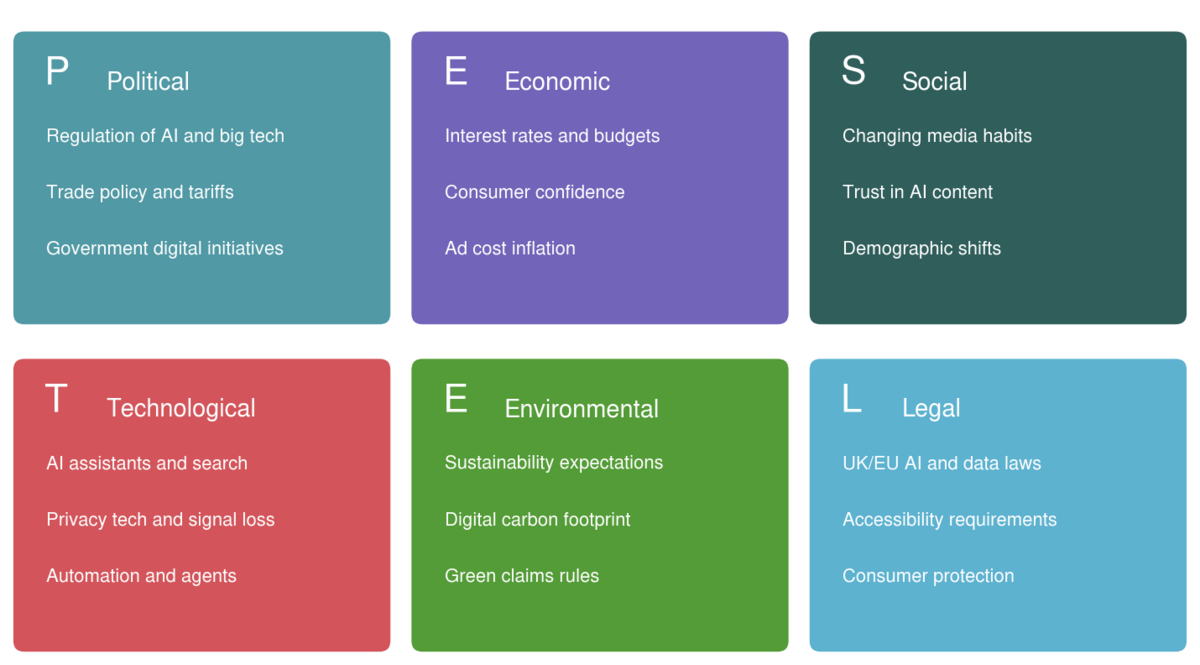
What each PESTEL category covers
Political
Political factors are about government action and direction of travel: regulation of competition, industry regulation, fiscal policy, business incentives, grants and apprenticeship schemes, and the uncertainty that comes with elections. For digital marketers in 2026, the most consequential political theme is the regulation of AI and large technology platforms. Government positions on AI safety, competition action against dominant platforms, and trade policy that affects advertising and e-commerce costs all belong here. A change of government or a new digital strategy can reshape budgets, procurement and consumer confidence within a single planning cycle.
Economic
Economic factors include interest rates, inflation, consumer confidence, exchange rates, GDP growth and employment levels. For marketing teams these translate directly into budget pressure and changing customer behaviour: when consumer confidence dips, consideration cycles lengthen and price sensitivity rises. Media cost inflation matters too. If the cost per click in your category is rising faster than your budget, that is an economic factor with immediate strategic consequences. Also watch the emergence of new commercial models in your sector, such as subscription, freemium or usage-based pricing, which can change what customers expect to pay for.
Social
Social factors cover changing demographics, consumer trends, behavioural change and shifting public opinion. Current examples include the steady migration of attention towards short-form video and creator content, generational differences in how people search for information (younger audiences increasingly discover brands through social platforms and AI assistants rather than traditional search), declining trust in undisclosed AI-generated content, and rising expectations around inclusion and accessibility. The question to keep asking is: how are the people we serve changing, and is our marketing changing with them?
Technological
Technological factors are often the fastest moving category for marketers. In 2026 the dominant force is AI: generative AI in content production, AI assistants changing how people find information, AI Overviews reshaping search results, and agentic tools automating tasks that once required whole teams. Alongside AI, consider privacy technology and signal loss (the decline of third-party tracking), changes in device and platform use, and new technology-led business processes such as dynamic pricing and hyper-personalisation. Every item in this category is a double-edged sword: an opportunity if you move early and a threat if a competitor does.
Environmental
Environmental factors include sustainability expectations, ethical sourcing, carbon emissions and, increasingly, the environmental footprint of digital activity itself, from data centre energy use to the carbon cost of programmatic advertising. Green claims are now heavily scrutinised: regulators in the UK and EU have tightened the rules on environmental marketing claims, so sustainability communication carries both reputational opportunity and compliance risk. Data handling and responsible technology practices also sit naturally in this category for digital businesses.
Legal
Legal factors include employment law, health and safety, consumer protection, and the expanding body of digital regulation: data protection law such as UK GDPR, the EU AI Act with its phased obligations, online safety legislation, accessibility requirements such as the European Accessibility Act, and advertising standards. The line between Political and Legal can feel blurry: a useful rule of thumb is that Political covers direction and intent, while Legal covers rules that are enacted or scheduled, with dates you can plan against.
How to do a PESTEL analysis, step by step
Step 1: define the scope
Decide exactly what you are analysing. A PESTEL for an entire organisation will look different from one for a single product launch, a market entry decision or a digital marketing team's annual plan. Write the scope at the top of the document. A tight scope is what separates a useful analysis from a vague list of world events.
Step 2: gather perspectives
Identify the external factors affecting your project and list each one under the appropriate heading. Involve a range of stakeholders to build a balanced picture: team members from different functions, subject experts such as lawyers, technology consultants and researchers, and customers themselves. Sourcing ideas from stakeholders catalyses insight, but back it up by working through a checklist of common factors in each category, like the examples above, to reduce the risk of missing something important.
Step 3: use AI to accelerate the first draft
A large language model is genuinely useful here, both for generating a starting list of factors and for challenging your team's blind spots afterwards. Treat its output as raw material for discussion, not a finished analysis, and verify anything that will drive a significant decision.
Copy and paste prompt: "Act as a strategy consultant. Conduct a PESTEL analysis for [organisation type] operating in [industry] in [country/market], focused on [scope, e.g. our digital marketing plan for the next 12 months]. For each of the six categories, list the five most significant current factors and the three most significant emerging factors likely to matter within two years. For each factor, state whether it is an opportunity or a threat, rate its likely impact as high, medium or low, and explain the impact in one sentence. Present the results as six clearly labelled sections. Then list the five factors from the whole analysis that deserve immediate attention, with your reasoning."
Step 4: assess impact, not just existence
A common failure is to identify factors without assessing them. For each factor, agree a simple rating of likely impact (high, medium, low) and likelihood. Split your findings into current factors and scheduled or predicted future ones. If a regulation comes into force on a known date, that is an easy win for your analysis; harder-to-predict factors such as social trends can be handled by noting two or three plausible outcomes rather than a single guess.
Step 5: turn findings into decisions
The analysis is only complete when it changes something. Feed the highest-impact factors into your planning: technological factors into your website and channel decisions, social factors into your creative and audience strategy, legal factors into your compliance roadmap. The classic next step is to carry your PESTEL findings into a SWOT or TOWS analysis, where external opportunities and threats meet an honest view of your internal strengths and weaknesses and become strategic options.
Step 6: schedule the next review
Put a review date in the diary before you close the document. Quarterly works well for most marketing teams, with a lightweight monthly scan of the fastest-moving categories, which for most digital teams currently means Technological and Legal.
A worked example: a digital marketing team in 2026
Imagine the marketing team of a mid-sized UK e-learning company running its annual PESTEL. Under Political it notes growing government focus on AI skills funding, an opportunity for its course catalogue. Under Economic it records squeezed training budgets in client organisations, a threat, alongside rising demand for demonstrable return on investment. Under Social it identifies that younger professionals increasingly learn through short video and expect AI-assisted study tools. Under Technological it flags AI assistants answering questions its articles used to answer, reducing website traffic but creating a new channel to appear in. Under Environmental it notes client procurement teams now asking about sustainability credentials. Under Legal it lists the EU AI Act's transparency obligations and accessibility requirements for its learning platform, each with compliance dates.
The team scores each factor, takes the five highest-impact items into a TOWS session, and leaves with concrete moves: an AI-skills course line, an answer-engine optimisation programme for its content, and an accessibility audit with a deadline. That is what a good PESTEL analysis produces: not a poster, but decisions.
Common mistakes to avoid
The mistakes we see most often are treating the analysis as a one-off document rather than a repeated process, listing factors without assessing their impact, letting one loud voice in the room dominate the picture, filing everything under Technological because it involves a computer, and stopping at the analysis without connecting it to strategy. A shorter, well-assessed PESTEL that leads to three real decisions beats an exhaustive one that leads to none.
Keeping your analysis current
There is no better source of PESTEL intelligence than your own ongoing monitoring of whatever affects your business most. Useful habits include following the government departments relevant to your sector (for UK digital businesses, the Department for Science, Innovation and Technology), tracking financial news for the territories you operate in, watching platform and technology announcements, and monitoring regulator activity from bodies such as the ICO, CMA and ASA. A news aggregator or AI research assistant makes this manageable: set up standing searches for your key factors and review them as a team each month. For data-led depth, the World Economic Forum's Global Risks Report, Ofcom's Online Nation study, and the major consultancies' annual technology and consumer trend reports are all reliable, free inputs.
Build the skills to act on your analysis
A PESTEL analysis tells you where the ground is moving. Acting on it takes skills across strategy, AI, content, data and the full digital marketing mix. Target Internet's e-learning platform gives you and your team structured courses, skills benchmarking and certification across every one of those areas, so the threats in your analysis become someone else's problem and the opportunities become yours. See our membership options and start building those skills today.
Sources and further reading
World Economic Forum, Global Risks Report: weforum.org/publications. Ofcom, Online Nation: ofcom.org.uk. Information Commissioner's Office guidance on data protection: ico.org.uk. European Commission overview of the AI Act: digital-strategy.ec.europa.eu. Competition and Markets Authority guidance on environmental claims: gov.uk. Office for National Statistics economic data: ons.gov.uk.