n this episode of The Digital Marketing Podcast, Daniel Rowles explores how artificial intelligence is making it possible to automate entire marketing workflows, and why this could fundamentally change the way we structure marketing teams.
We're moving beyond simply using AI to write content, generate ideas or analyse data. With the combination of AI agents, Skills, Model Context Protocol (MCP) and new AI work environments, marketers can now connect their tools, automate complex processes and build systems that carry out multiple tasks with minimal manual intervention.
But does this mean we no longer need marketing executives? Not quite.
Daniel explains why the real opportunity isn't about replacing marketers with AI. It's about reimagining marketing roles, removing repetitive administrative tasks and freeing up time for the things humans do best: creativity, strategy, empathy and understanding what really motivates an audience.
Drawing on practical examples from Target Internet's most popular AI masterclass, Daniel demonstrates how a single prompt can connect analytics, research, content creation, publishing and social media scheduling into one automated workflow.
In This Episode:
-
Can you really replace a marketing executive with three prompts?
Daniel revisits a controversial LinkedIn post that sparked a huge debate about AI and marketing jobs. He explains why the point isn't to eliminate marketing roles, but to rethink which tasks genuinely require human expertise. -
Building an automated marketing workflow with one prompt
Discover how Daniel connected Google Analytics, Google Search Console, a content management system and social media scheduling tools to research, create, publish and promote an article. The demonstration shows how AI can handle much of the operational work traditionally carried out by marketing teams. -
Understanding Model Context Protocol (MCP)
MCP is one of the most important developments in practical AI adoption. Daniel explains how it acts like a universal connector between AI and business software, allowing AI systems to retrieve information and, where permitted, take action across different platforms. -
The tools making AI automation possible
Learn how tools including Windsor.ai, Metricool and content management systems can be connected to AI. Daniel also explores how platforms such as Copilot Studio can trigger automated workflows based on events, rather than waiting for someone to enter a prompt. -
Why AI Skills are essential for consistent marketing
AI Skills provide reusable instructions for carrying out tasks in a particular way. Daniel demonstrates how a Target Internet brand skill can ensure that AI-generated articles, diagrams and social media content follow established brand guidelines, and how those instructions can be improved over time. -
The five stages of AI maturity
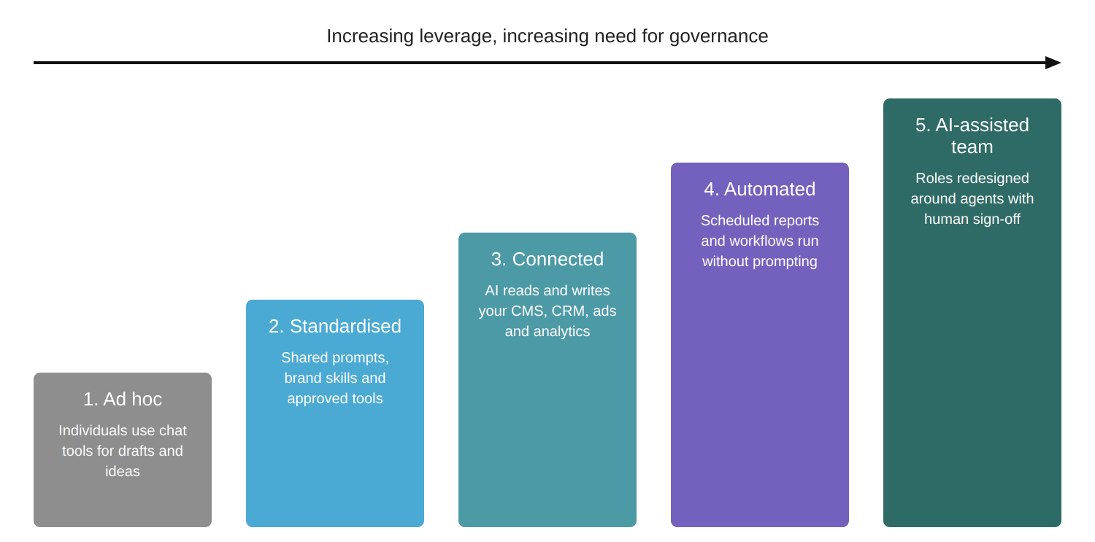
Daniel introduces a practical maturity model to help organisations understand where they are in their AI adoption journey. From ad hoc experimentation and standardised processes through to connected systems, automation and fully AI-assisted teams, the model provides a roadmap for developing more sophisticated AI capabilities. -
A practical framework for deciding what to automate
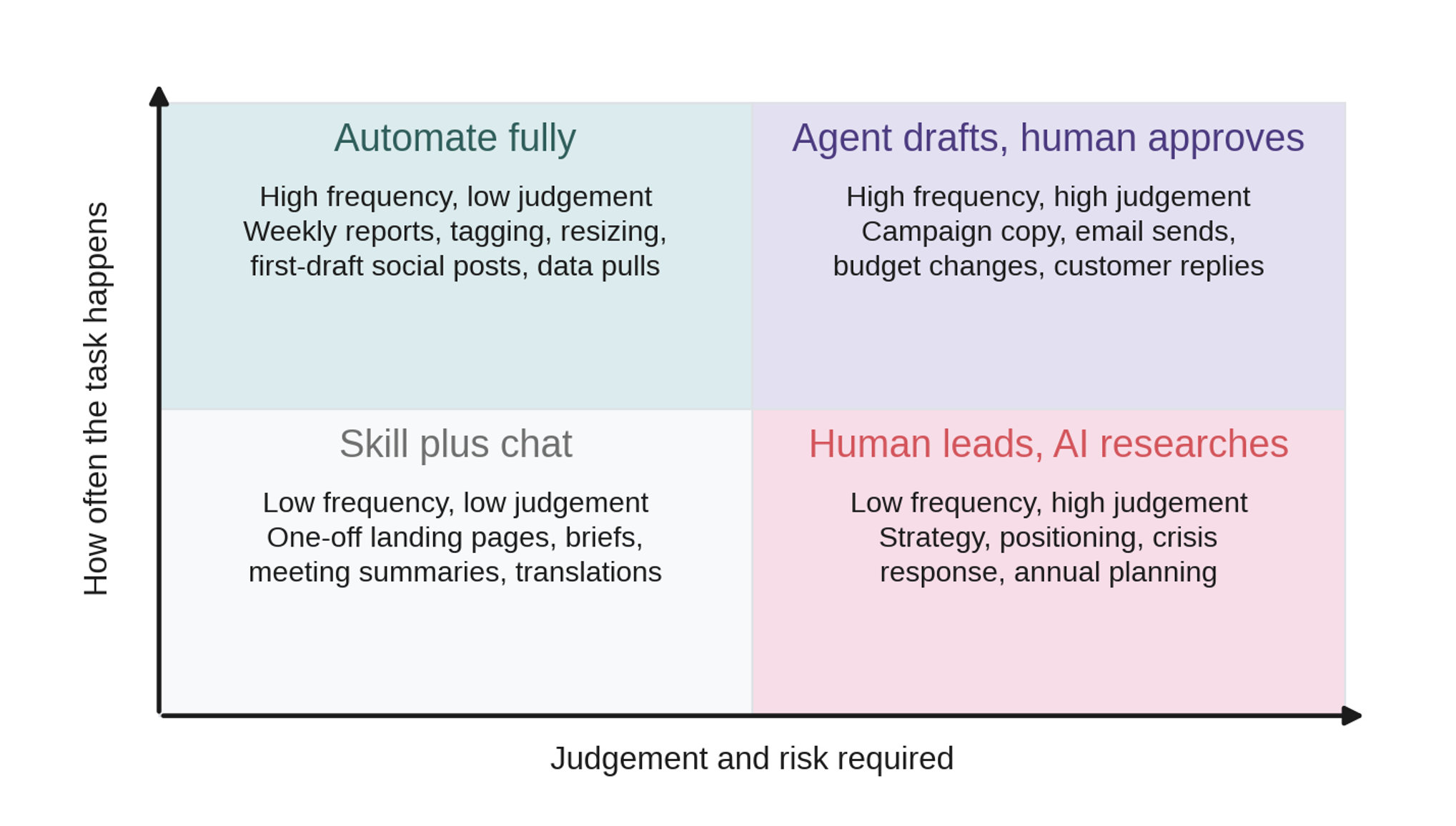
Not every marketing task should be automated. Daniel introduces a simple four-quadrant framework that evaluates activities based on how frequently they occur and the level of judgement or risk involved. It helps marketers identify which tasks to automate completely, which need human approval and which should remain human-led. -
Why human oversight still matters
Just because AI can create and publish content doesn't mean it should do so without review. Daniel explores the importance of checking accuracy, maintaining quality, understanding data sources and ensuring that humans remain accountable for important decisions. -
Rethinking the structure of marketing departments
As AI takes on more routine work, traditional channel-based roles may begin to evolve. Daniel considers how marketing teams could increasingly organise themselves around strategy, judgement, automation design and creative value rather than simply managing individual channels. -
The four technologies driving the next wave of AI adoption
AI agents, reusable Skills, MCP connections and AI work environments are coming together to make increasingly sophisticated automation possible. Daniel explains why this combination represents a significant turning point for marketing productivity and innovation.
Key Takeaways:
-
Automate tasks, not necessarily jobs. The greatest opportunity is to remove repetitive work while preserving the human expertise that makes marketing effective.
-
MCP changes what's possible. Connecting AI directly to analytics, content management, CRM and social media platforms enables complete workflows rather than isolated tasks.
-
Skills make automation repeatable. Documenting brand guidelines, processes and quality standards allows AI to deliver more consistent results.
-
Start with high-frequency, low-risk activities. Regular reporting, data collection, image resizing and other repetitive tasks are sensible starting points for automation.
-
Keep humans involved where judgement matters. Campaign strategy, positioning, sensitive communications and important business decisions still require human expertise and accountability.
-
AI adoption is a maturity journey. Organisations should progress from experimentation to connected and automated workflows in a structured, iterative way.
-
Use the time saved to create more value. The objective shouldn't simply be to produce more content faster. It should be to conduct better research, develop more creative campaigns and explore opportunities that weren't previously practical.
From Automation to Reinvention
One of the most important questions Daniel raises is whether marketers should use AI simply to do what they've always done, only faster.
By automating lower-value tasks, marketing teams can create space for deeper audience research, more original content, interactive experiences and more ambitious strategies.
But this also requires a change in mindset. Marketers need to understand how AI works, how to assess its outputs and how to design processes that combine automation with human expertise.
Rather than asking which marketing jobs AI will replace, perhaps the better question is what should a marketing department look like when AI can handle so much of the routine work?
Whether you're a marketing executive looking to improve your productivity, a marketing manager exploring automation or a business leader planning your organisation's AI strategy, this episode offers practical frameworks and real-world examples to help you take the next step.
Useful Links:
-
Windsor.ai: Connect marketing data sources, including Google Analytics and Google Search Console, to AI workflows.
-
Metricool: Social media management, scheduling and analytics platform used in Daniel's automated content workflow.
Free Resources from This Episode
Daniel also shares two practical frameworks to help you start implementing AI automation in your own organisation.
1. AI Marketing Maturity Model
2. Marketing Automation Prioritisation Framework