Search is changing fast. With AI overviews now appearing in the majority of Google results, the rules of visibility are being rewritten in real time. In this episode, Daniel Rowles explores what answer engine optimisation actually means in practice, and how marketers can adapt without chasing myths, hacks, or constantly shifting theories.
Drawing on real testing from Target Internet over the past year, this episode cuts through the noise around GEO, AEO, and SEO to focus on what genuinely works. The result is a practical framework for improving visibility both in traditional organic search and within AI-powered results, particularly Google’s AI overviews. If you are worried about falling click-through rates, changing user behaviour, or how large language models decide what to reference, this episode provides clear, grounded guidance.
Rather than treating AI search as a black box to be cracked, Daniel reframes it as a probability system influenced by clarity, credibility, and consistency. The five techniques covered here are designed to future-proof your content strategy while still delivering value to real users today.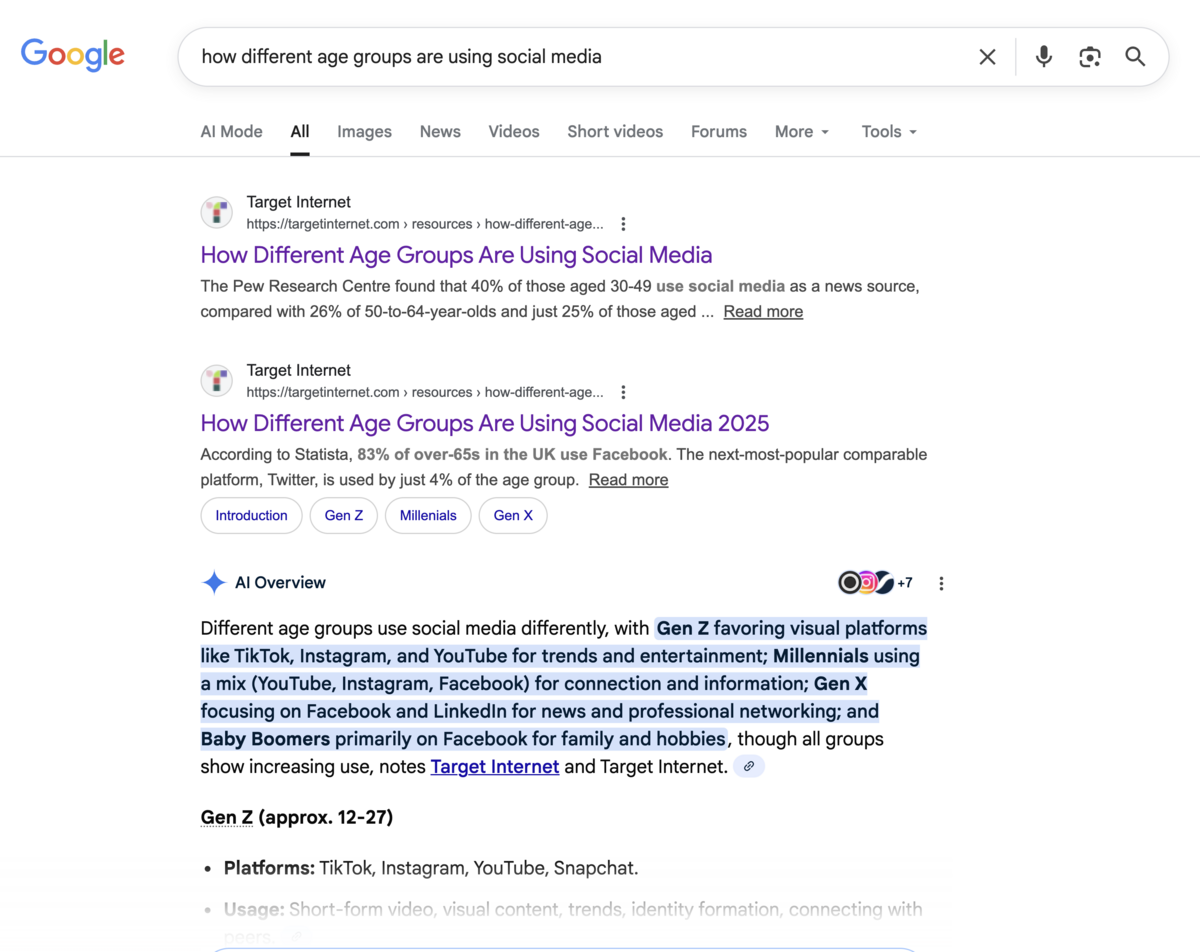
Screenshot showing AI Overview in position 3
In This Episode
Why the industry cannot agree on GEO vs AEO, and why the distinction matters less than you think
What current data tells us about AI overviews, click-through rates, and changing search behaviour
How question-led content aligns with the way people now search using AI
Why inverted pyramid writing is suddenly more important than ever
How digital PR and brand mentions influence entity reputation in AI systems
The growing role of advocacy, reviews, and online sentiment in visibility
Why multimodal content is becoming a core ranking signal, not a nice-to-have
How schema markup removes ambiguity for search engines and large language models
Where to focus your effort while Google’s AI results are still evolving rapidly
Key Takeaways
Answer engine optimisation overlaps heavily with traditional SEO, so doubling down on fundamentals is still smart
Clear, direct answers to specific questions improve your chances of being referenced by AI
Brand visibility is no longer just about links, but about being mentioned in the right contexts
Positive sentiment and third-party validation increasingly influence AI recommendations
Publishing content in multiple formats strengthens your overall search footprint
Structured data helps machines understand your content, and humans engage with it more easily