This review is part of our SEO tools comparison report. This article has been updated for 2026 and replaces the older review of SEO PowerSuite.
Index
- Introducing the Tool
- Setup and Security
- Rank Tracker
- LinkAssistant
- WebSite Auditor
- SEO SpyGlass
- Pricing
- The Verdict
- Frequently Asked Questions (FAQs)
Introducing the Tool
SEO PowerSuite has been around since 2004. It's one of the oldest SEO platforms still in active development.
Unlike every other tool in this report, SEO PowerSuite is not a cloud-based platform. It's four separate desktop applications that you download and install individually: Rank Tracker for keyword tracking and research, WebSite Auditor for site audits and content optimisation, LinkAssistant for link prospecting and outreach, and SEO SpyGlass for backlink analysis.
Each of these tools runs as its own desktop application with its own interface and project files. This is a bit of an overkill as you need to individually download and install all 4 tools, host them locally on your desktop, and give multiple permissions to each of them. No other SEO software makes you do this, at least none of the major ones (Semrush, Ahrefs, Moz Pro, etc.) that we've come across.
SEO PowerSuite makes you install four separate applications to cover the same ground that cloud tools handle in one interface. While writing this review, we were curious to see if there was any special reason behind this, but it turns out that SEO PowerSuite does not offer a single differentiating feature that explains why it needs to be run locally.
For the purposes of this review, we ran all four tools using targetinternet.com (as a test project) on a MacBook Pro M5 with 16GB RAM. You will understand why we're talking about RAM and the make of the computer in an SEO review as you continue reading.
Setup and Security
Before we get into the individual tools, we need to talk about what happens when you install them.
This is a special section that we had to write for this tool. If you don't read the rest of the article, we highly recommend reading this bit as it's the most important piece. Because if you're reading this, it means that you're considering downloading SEO PowerSuite.
To start, SEO PowerSuite runs locally on your machine and asks for a level of system access that cloud-based tools don't need.
During installation on macOS, each application will request permissions for file access, downloads, desktop files, and finding devices on your local network. That's a lot of access for SEO software. On a Mac, you can review and decline these individually, which we did. On Windows, you can't see what the tool is getting access to behind the scenes, at least not on a PC where the safety settings are turned off.
These levels of permissions are not required, especially for SEO software.
Apart from the safety issue, there's the performance side.
Rank Tracker alone consumed 2.2GB of RAM during our test, which is just 1 out of the 4 tools. Each of the other three tools used between 1.5GB and 2GB of RAM. When we were doing very basic keyword research, the fan noise kicked in, which meant the laptop needed to cool down. This is something that only happens during intensive video rendering or heavy code compilation, so it was a bit odd to see this happen while doing basic SEO tasks.
If you have all four tools open together, you're looking at 6 to 8GB of RAM being used up. Semrush, Ahrefs, and all other cloud-based tools run in a browser tab and use a fraction of those resources (less than 1GB in total).
There's also a persistent "Enter PageSpeed Insights API Key" prompt that appears in the WebSite Auditor with no context whatsoever. No explanation of what it is, why you'd need it, or where to find one. It just sits there.
Lastly, there's a serious security issue with Google login. It shows a login prompt that asks for your password in plain text. We explain this in the Rank Tracker section below, under "Autocomplete Tools." Skip ahead to that part if you want to read the warning first.
Rank Tracker (SEO PowerSuite)
Rank Tracker is the first of the four tools, and it's where you'll spend most of your time if keyword research is central to your workflow. Overall, it handles rank tracking, keyword research, SERP analysis, competitor research, and domain analysis.
Domain Analysis
This is the first thing you see after setting up a project.
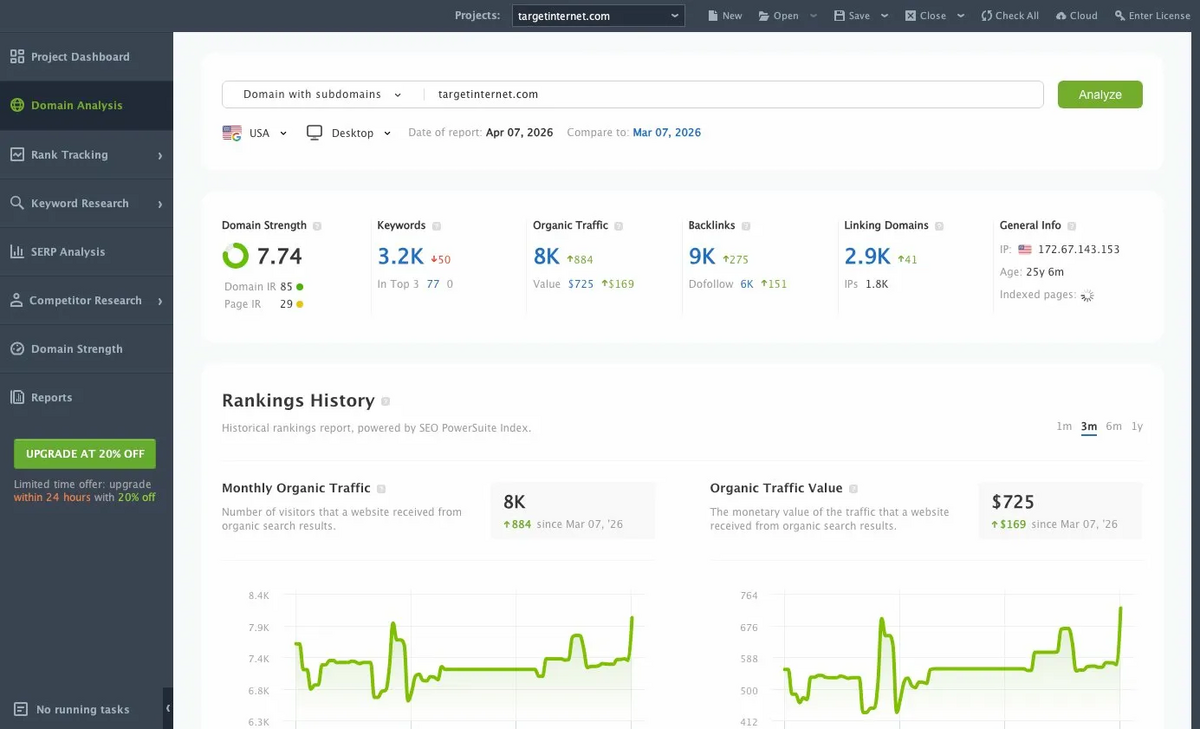
You get a top-level snapshot of your domain with metrics like Domain Strength, Keywords, Organic Traffic, Backlinks, Linking Domains, and General Info, including domain age and indexed pages. It's clean, well presented and tells you the health of your domain at a glance.
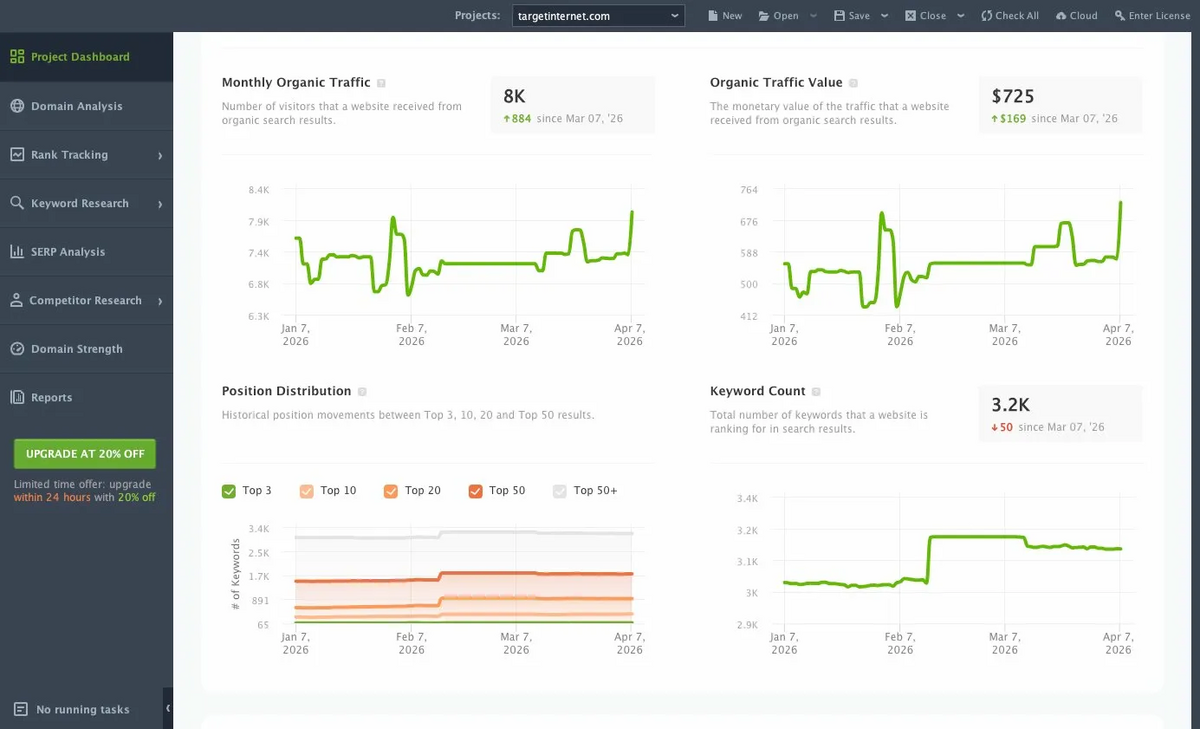
Below that, four charts cover other trends like Monthly Organic Traffic, Organic Traffic Value, and Position Distribution.
As they say, "trends are your friends"; it's always helpful to visually see whether performance is improving or declining.
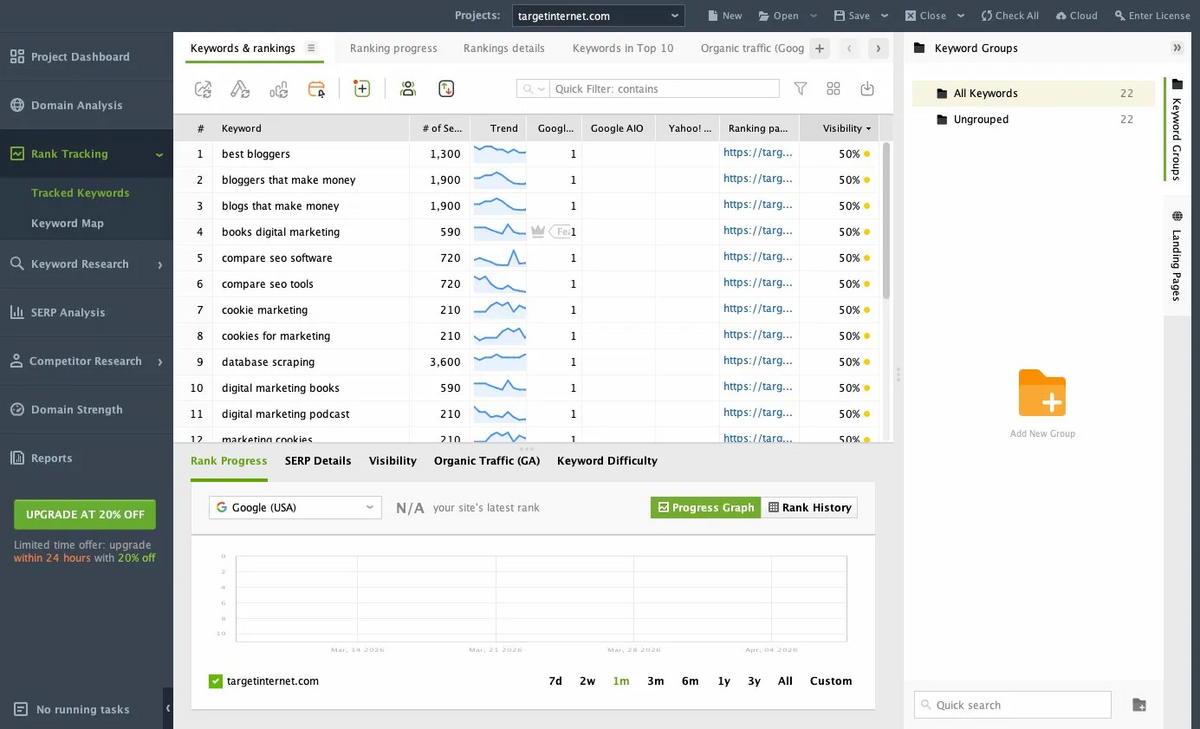
Rank Tracking
The Tracked Keywords view shows your project keywords with Search Volume, Trend sparklines, Google position, Google AIO position, Yahoo position, Ranking Page, and Visibility. What stands out is that AI Overview positions sit directly alongside traditional Google rankings. This is the same approach AWR takes, and it's the right one. Most tools that are catching up to AI search still treat it as a separate section or a separate product entirely. Having it in the same table means you can immediately see whether your AI visibility matches your organic visibility, without switching views.
Keyword Research
Rank Tracker bundles a set of keyword research sub-tools: Ranking Keywords, Keyword Gap, Autocomplete Tools, Related Searches, Related Questions, TF-IDF Explorer, and several more.
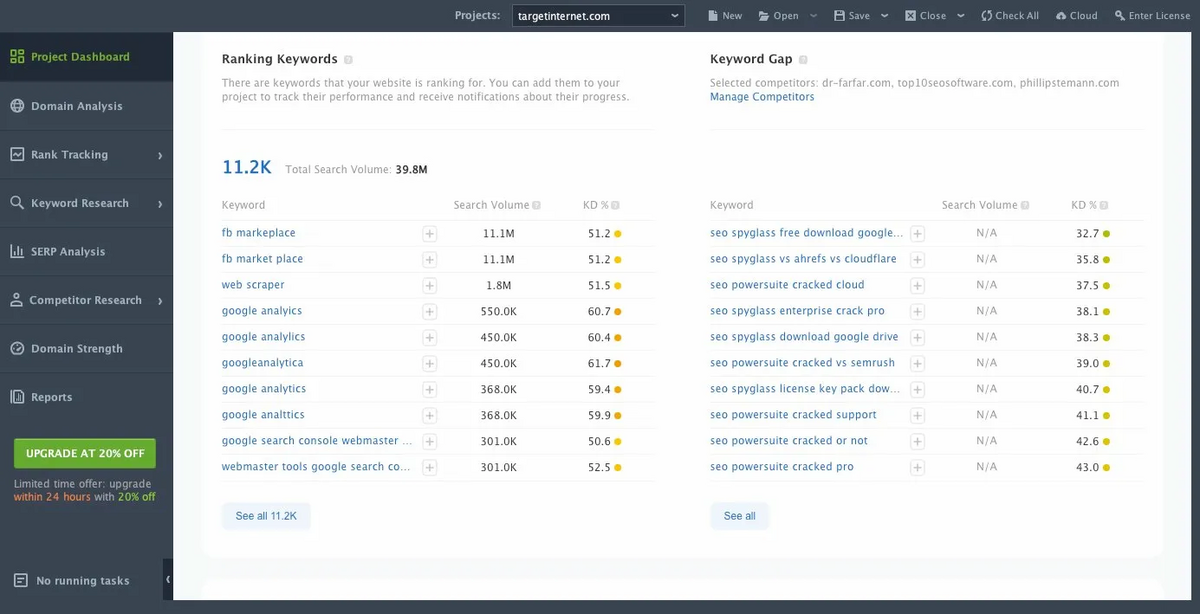
It shows you what your site is ranking for, with search volume and difficulty alongside each keyword. The layout is clean, and the data is easy to scan. Just remember that this data is also available in Google's Keyword Planner for free, and you can save your custom views on the Planner via keyword lists, so this does not add a lot of value.
The useful bit here is the Keyword Gap section, which lets you add your competitors' URLs and compares what keywords they're ranking for that you're not.
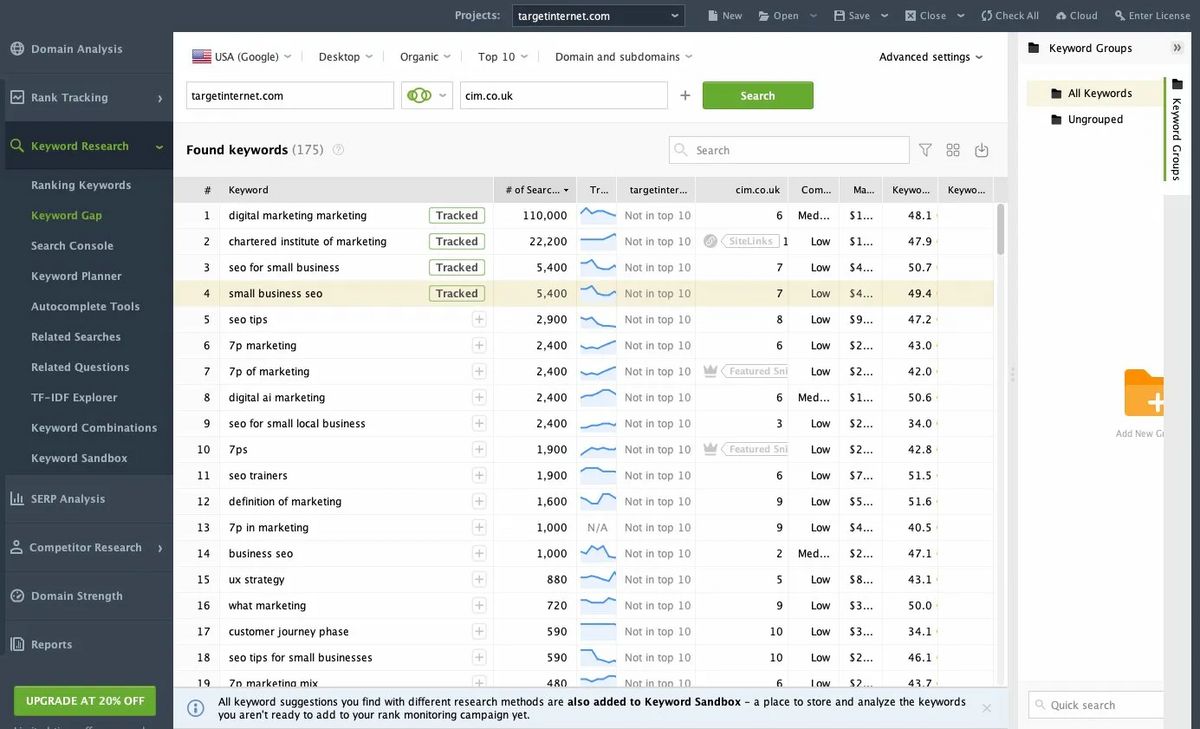
You can see search volume, competition, SERP features, and CPC for each keyword in the gap.
However, the limitation is significant: you can't see which specific pages are ranking for those keywords on the competitor's side. You can only see the keywords. It's not hard to find this data with a few manual searches, but again, it's just a waste of time when that data is already layered below this. The whole point of a competitor keyword tool is to tell you what they're doing and where. Half that answer is not enough.
Autocomplete Tools
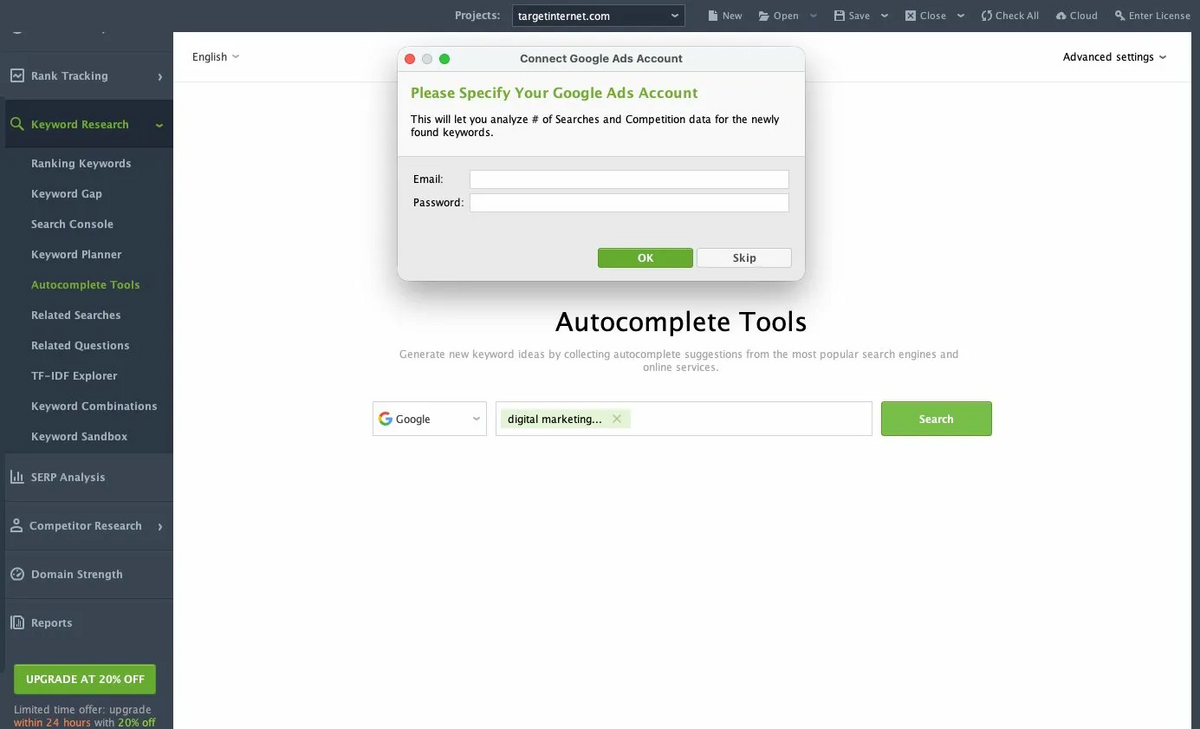
We need to be very direct here.
When you open Autocomplete Tools, a dialogue box asks you to "Connect Google Ads Account" by entering your email and password directly into the tool's own input field. Not through a Google OAuth popup. Not through a secure redirect to Google's login page, but through a plain-text email and password field inside the application itself.
We strongly advise against using this feature.
In 2026, no legitimate tool asks for your Google password this way. Semrush, Ahrefs, Moz, and every major SEO platform uses OAuth.
They handle the authentication on Google, so the tool never sees your credentials. SEO PowerSuite's approach bypasses this entirely. Your Google Ads email and password go directly into their desktop application with no secure handshake, no redirect, and no indication that credentials are encrypted in transit or at rest.
Data breaches happen to companies of all sizes. If SEO PowerSuite were ever hacked, your Google login details would be exposed.
Do not enter your Google password into this prompt. You can skip it, and the tool will still work. But the fact that this is the default behaviour is a red flag. It's not just bad design - it's a security risk.
This is not something to ignore in 2026. Never share your login details with third-party tools, especially ones that are installed locally on your device.
SERP Analysis
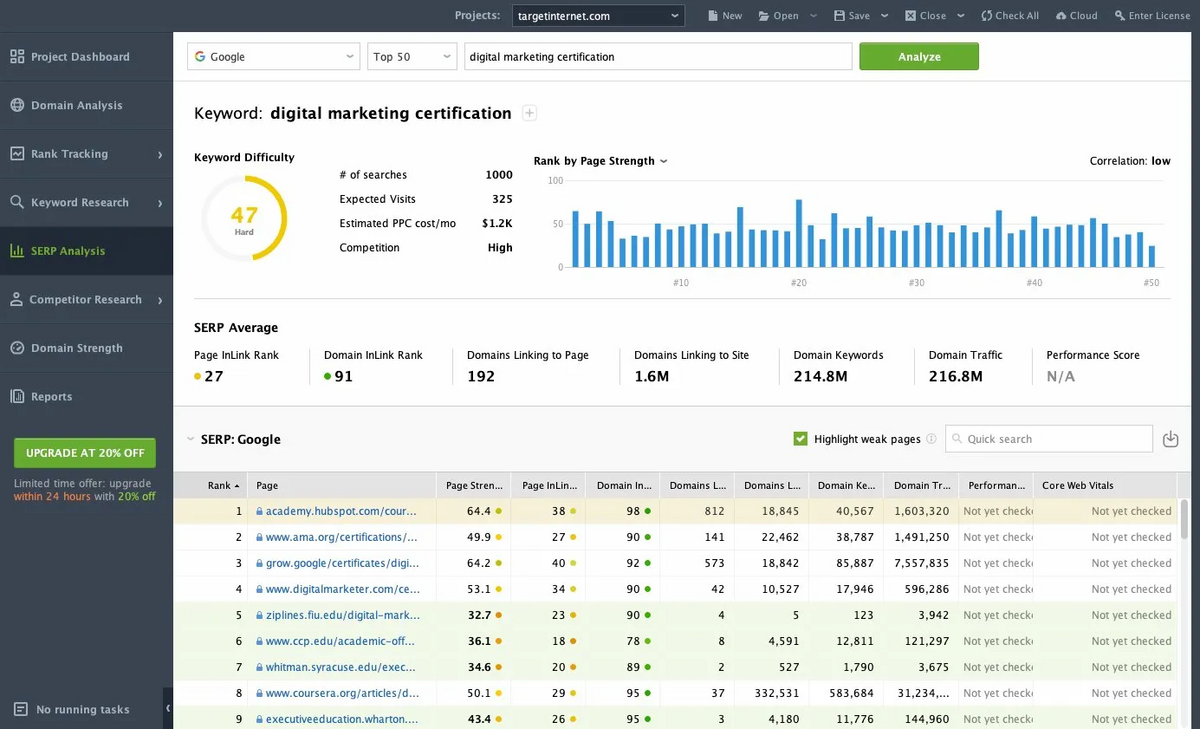
The SERP Analysis view shows key metrics like keyword difficulty, monthly searches, expected visits, and competition level. It also includes a bar chart showing how top results rank by page strength.
The data is decent. But the presentation doesn't come close to what's available in other tools. Advanced Web Ranking, for example, gives you pixel position data, click share, and visual SERP feature mapping. It tells you where your result actually sits on the page and how much real estate AI Overview blocks are stealing from your organic listing. The short version is that the SERP analysis is extremely outdated compared to what the competition offers.
Competitor Research
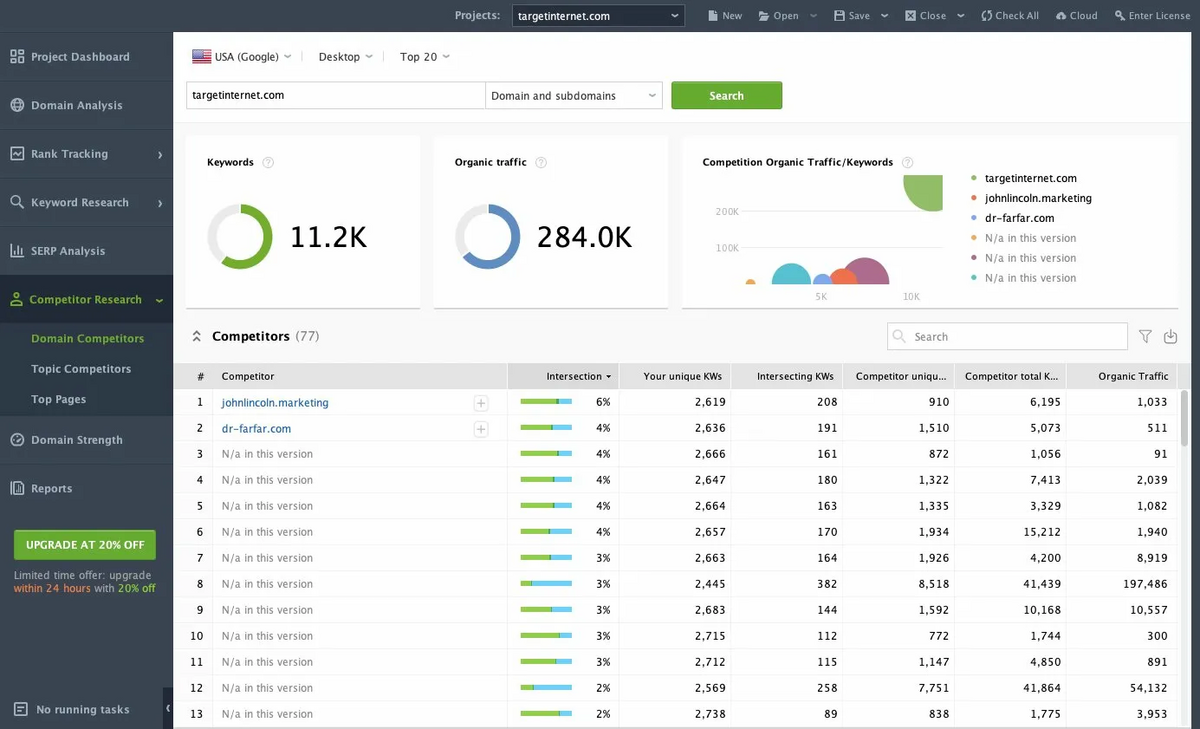
Domain Competitors maps your competing domains on a scatter plot by organic traffic against keyword count. This is very basic compared to what other tools offer because Semrush and Ahrefs both let you filter competitor maps by keyword intent, traffic trend direction, and domain authority.
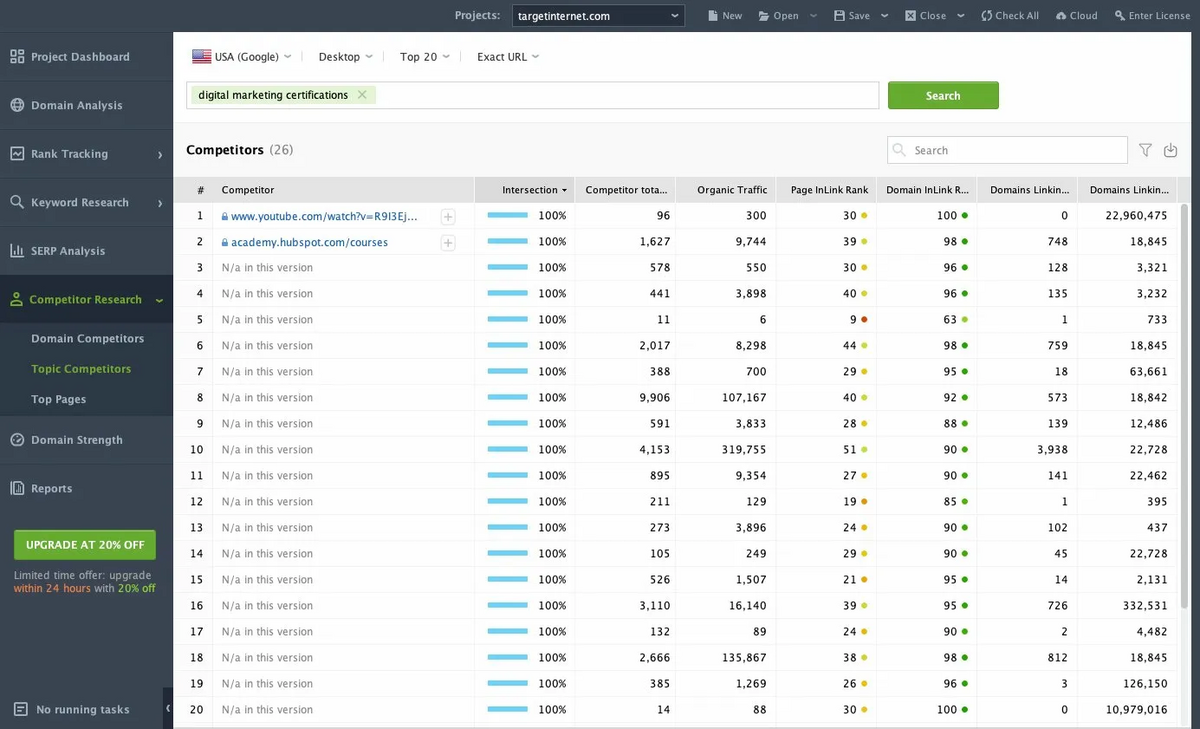
Topic Competitors is a more useful view. Instead of domain-level overlap, it shows who ranks for a specific keyword along with the authority metrics that explain why they're there. This is the view you'd use to understand what you're actually up against for a target keyword.
LinkAssistant (SEO PowerSuite)
This is the 2nd tool under SEO PowerSuite, and to reiterate, a different desktop application altogether.
Link building is one of the hardest parts of SEO. You need to find sites that might link to you, figure out who to contact, and manage the outreach process. It takes a team to do link-building successfully and regularly, so it's imperative that SEO tools provide you with features that easily integrate into your existing workflow.
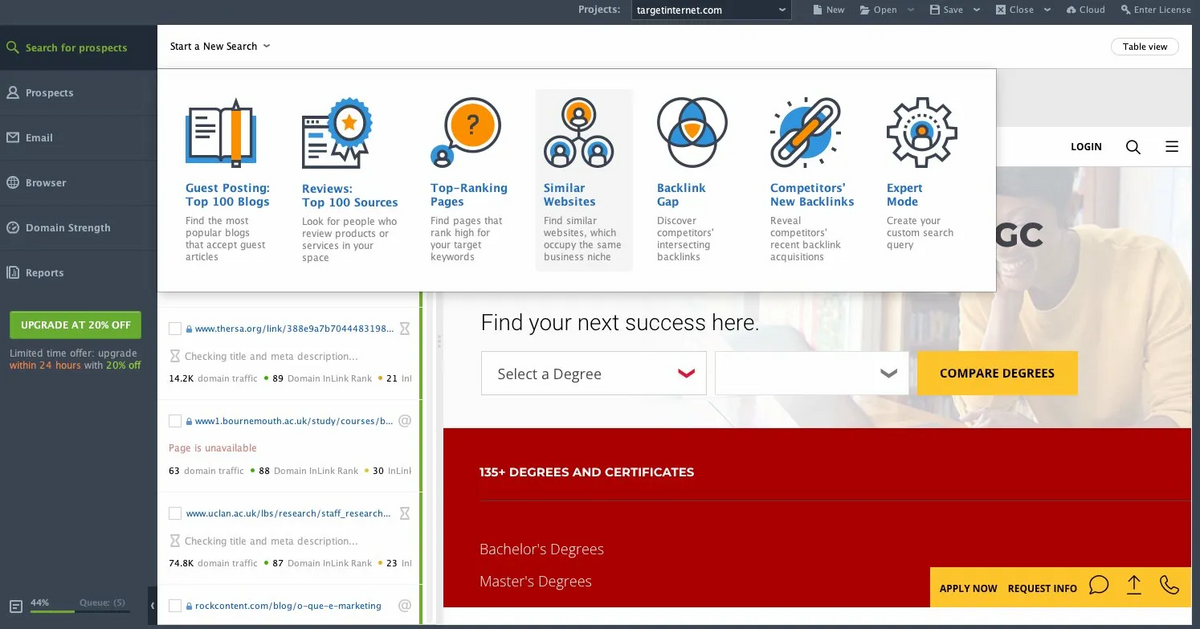
Finding Prospects
You start here by "finding prospects".
Prospects are simply other websites that you intend to reach out to, and ask to link back to your website. LinkAssistant offers several research methods here: Guest Posting, Reviews, Top-Ranking Pages, Similar Websites, Backlink Gap, Competitors' New Backlinks, and Expert Mode. You pick a method, enter your keywords or domain, and the tool queues a task.
Because everything runs locally, each task takes 5 to 10 minutes or more to complete. On Semrush or Ahrefs, these searches return in seconds.
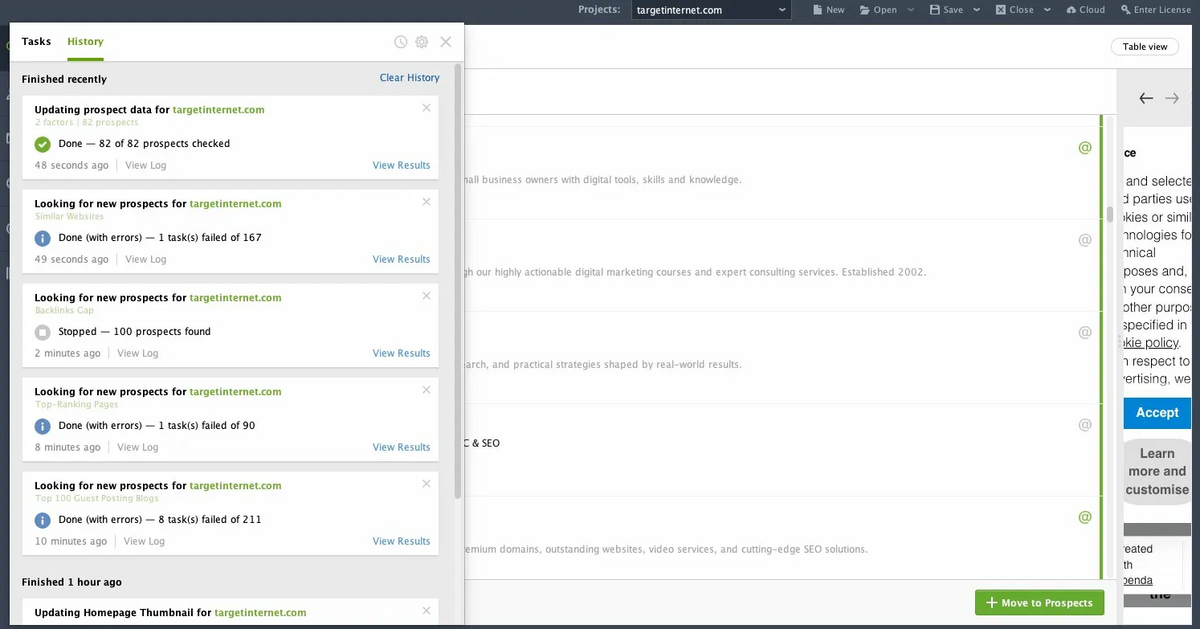
The task history shows the status for each search.
When we ran tasks, some worked, and some failed. A dialogue box shows something like "8 errors out of 211" - but that's it. No explanation of what went wrong, no advice on how to fix it, and no way to retry just the failed ones.
Once a task is completed, all results are dumped into a spreadsheet-style table in the Results tab.
Reviewing Results
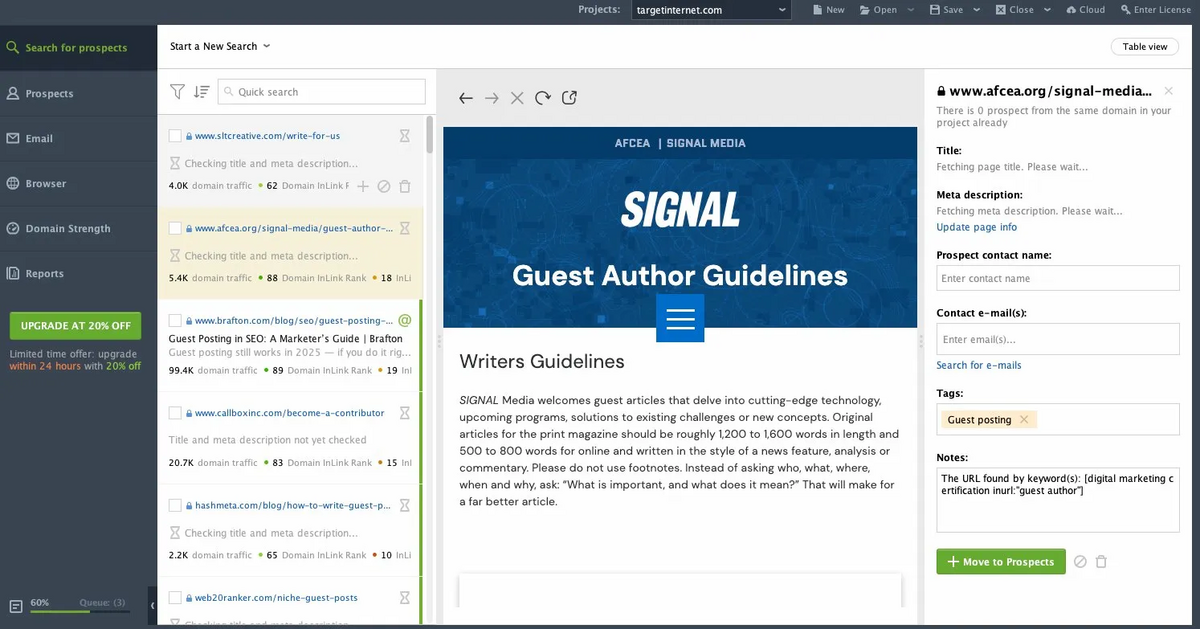
These results appear as URLs in the left sidebar.
You can preview any page in a built-in browser without leaving the tool, which is a nice touch. The right panel shows contact details and tags, and you can move prospects to a dedicated list with one click. Some backlink tools still don't offer an outreach workflow, so LinkAssistant wins some points here.
Why the Results Tab Could Be Better
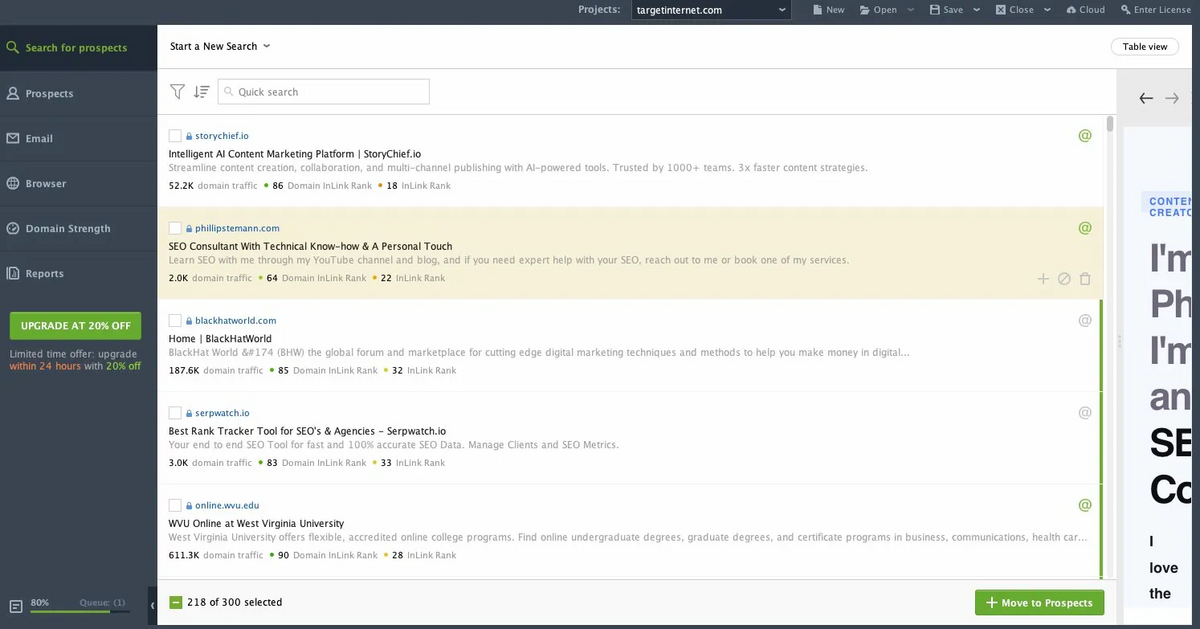
When you run multiple search methods to find your 'prospects', all your results get dumped into one single list. There's no way to tell which came from Guest Posting, which from Backlink Gap, which from Similar Websites, etc.
They're all mixed together with no grouping, no labels, and no filtering abilities.
There are no bulk edit options either, so you can't bulk delete a list if it was added by accident. You're scrolling through hundreds of URLs one by one, deciding individually whether each is worth pursuing.
The data is already there. Adding basic filters and sorting would be a simple fix. The fact that it's missing suggests this feature wasn't thought through properly during development.
WebSite Auditor (SEO PowerSuite)
Moving to the 3rd desktop application, let's talk about the WebSite Auditor.
Out of all 4 apps, this one is the most competent.
It covers site audits, content optimisation, site structure visualisation, and a set of built-in utilities that are on par with the competition.
Site Audit
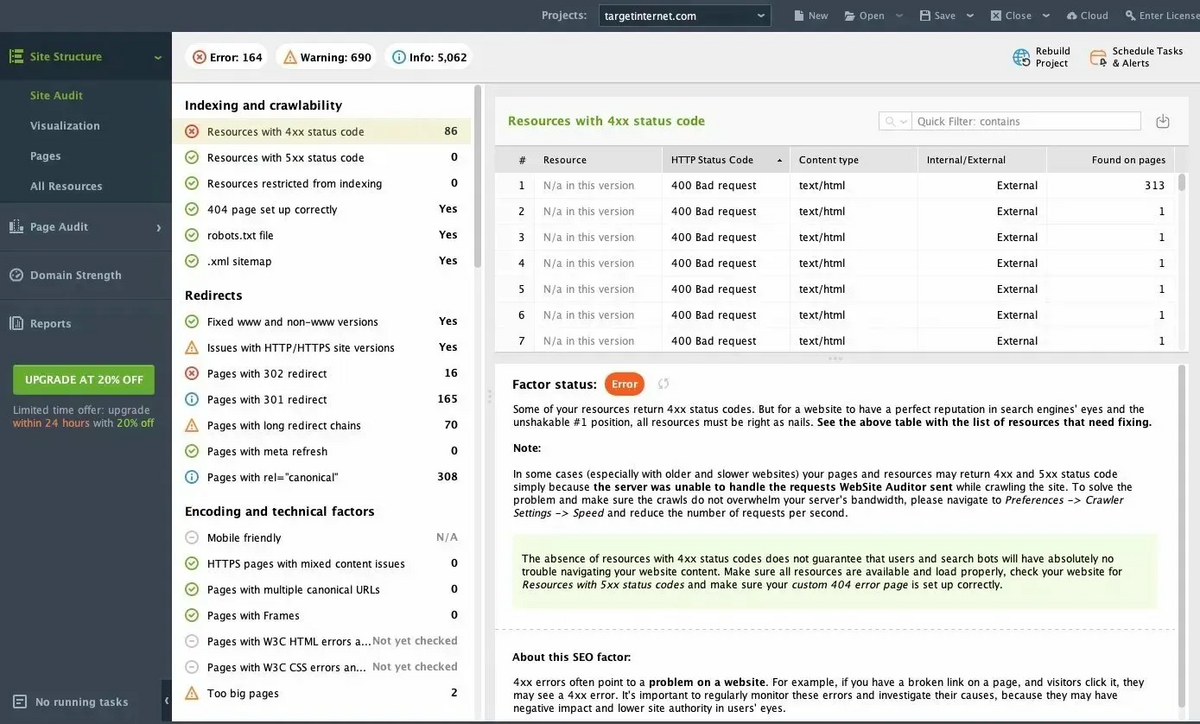
The Site Audit view organises findings into multiple categories: Indexing and crawlability, Redirects, Encoding & Technical factors, etc.
Each item shows you a count and a status icon. All the errors being flagged come with a detailed panel that opens on the right side, showing the affected URLs, their HTTP status codes, and an explanation of why that specific issue matters.
Rather than vague flags like "this page has issues," you're getting concrete problems with clear counts. Semrush and Ahrefs show similar data with colour-coded severity charts and trend tracking over time. But in terms of audit depth, WebSite Auditor holds its own.
Visualisation
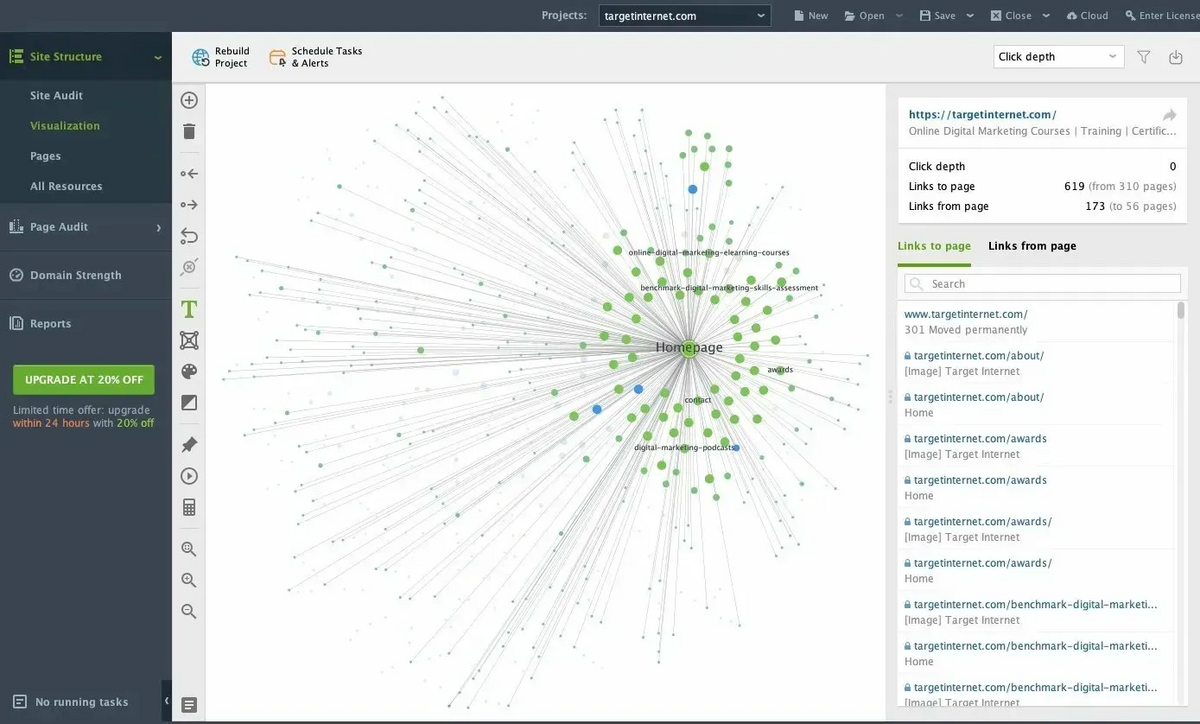
There is a very helpful Visualisation view that renders your site as an interactive node map.
The homepage sits in the centre, with pages spreading outward based on how many clicks it takes to reach them. Bigger nodes mean more internal links pointing to that page. You can instantly see which parts of your site are well-connected and which are isolated.
This is genuinely useful. It helps you spot orphaned pages, find content buried too deep in the site structure, and work out where internal linking needs attention. If you're taking over an existing site or planning a redesign, this view gives you a clear picture fast - in a way that no table or spreadsheet can.
Pages
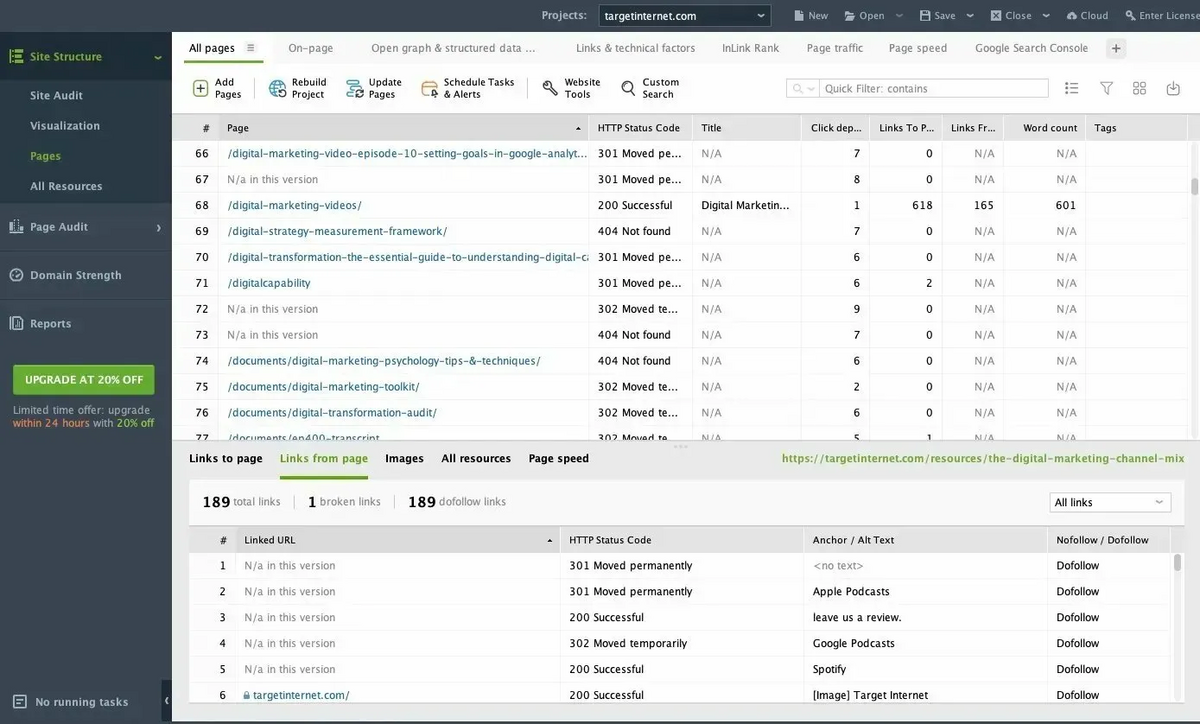
Pages is the main control panel that you'll use within the WebSite Auditor.
When you select a page, the lower panel loads everything at once - inbound links, outbound links, images, resources, and page speed data. Broken links show up immediately. So does empty anchor text and unnecessary redirects. If you've ever had to combine a crawler export with a separate link checker just to understand why a page is losing crawl equity, this removes that step.
Low traffic on a page that also has weak internal linking tells a different story than low traffic on a well-linked page. When you have both signals in the same view, that distinction becomes easy to spot.
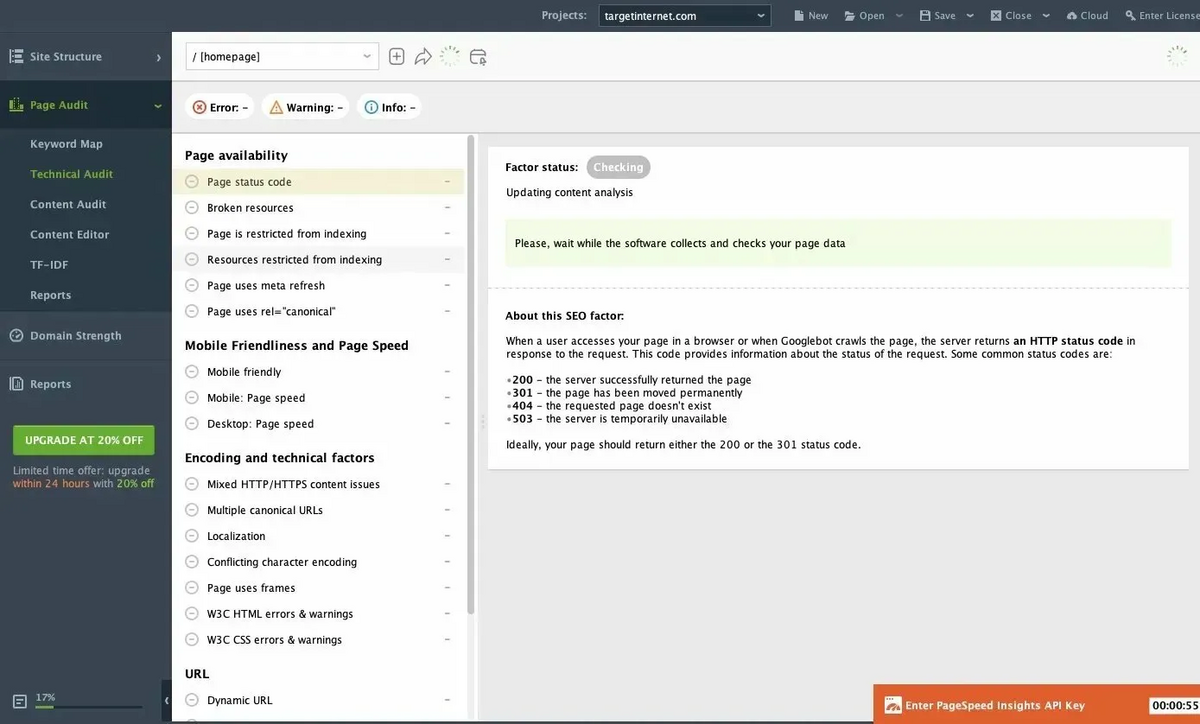
Page Audit
Technical Audit covers page availability, mobile friendliness, page speed, encoding, and URL structure. What we appreciate here is the educational layer. Each factor has an explanation panel that describes what it means, why it matters, and how to fix it.
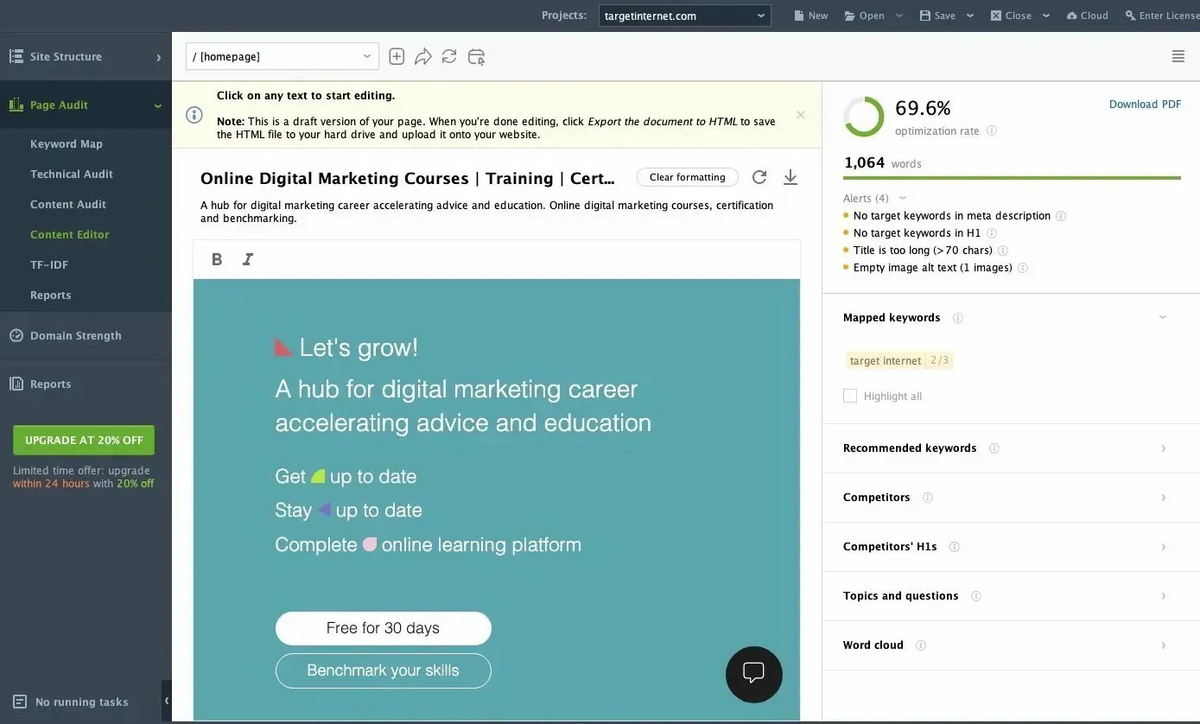
Content Editor
When you're trying to optimise content, you can use the Content Editor tool in this section.
It pulls your live page into an editable preview with a real-time optimisation score, word count, and actionable alerts. It flags specific issues: missing target keywords in your meta description, missing keywords in your H1, title length problems, empty image alt text, etc.
You can edit directly in the preview and watch the score update as you work.
SEO SpyGlass (SEO PowerSuite)
Moving to the 4th application, SEO SpyGlass handles backlink analysis, and it's the second strongest tool in the suite after WebSite Auditor. SEO SpyGlass and LinkAssistant, however, are very closely related and should be consolidated into one tool.
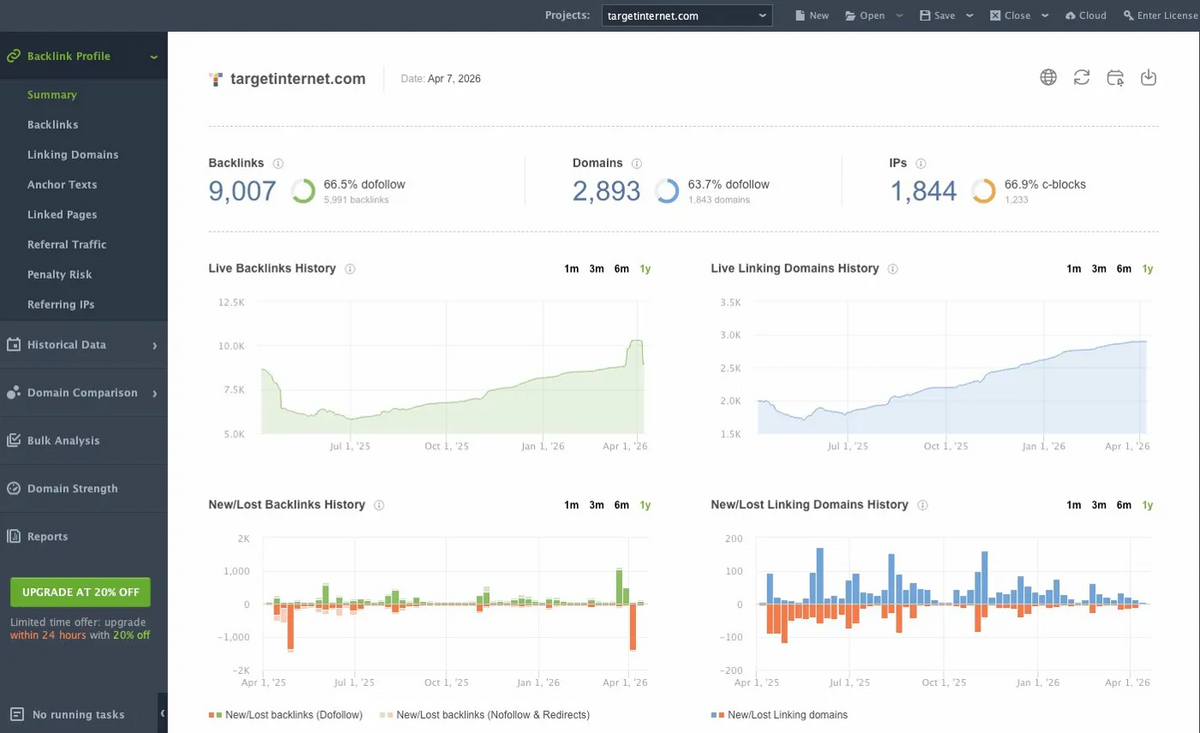
Backlink Profile
The Summary view gives you a clean overview of your entire backlink profile: total backlinks, linking domains, IPs, and dofollow ratios. You also get different graphs that cover metrics like live backlinks history, live linking domains history, and new/lost patterns.
You can toggle and change the date range as well, like a dashboard.
Backlinks and Linking Domains
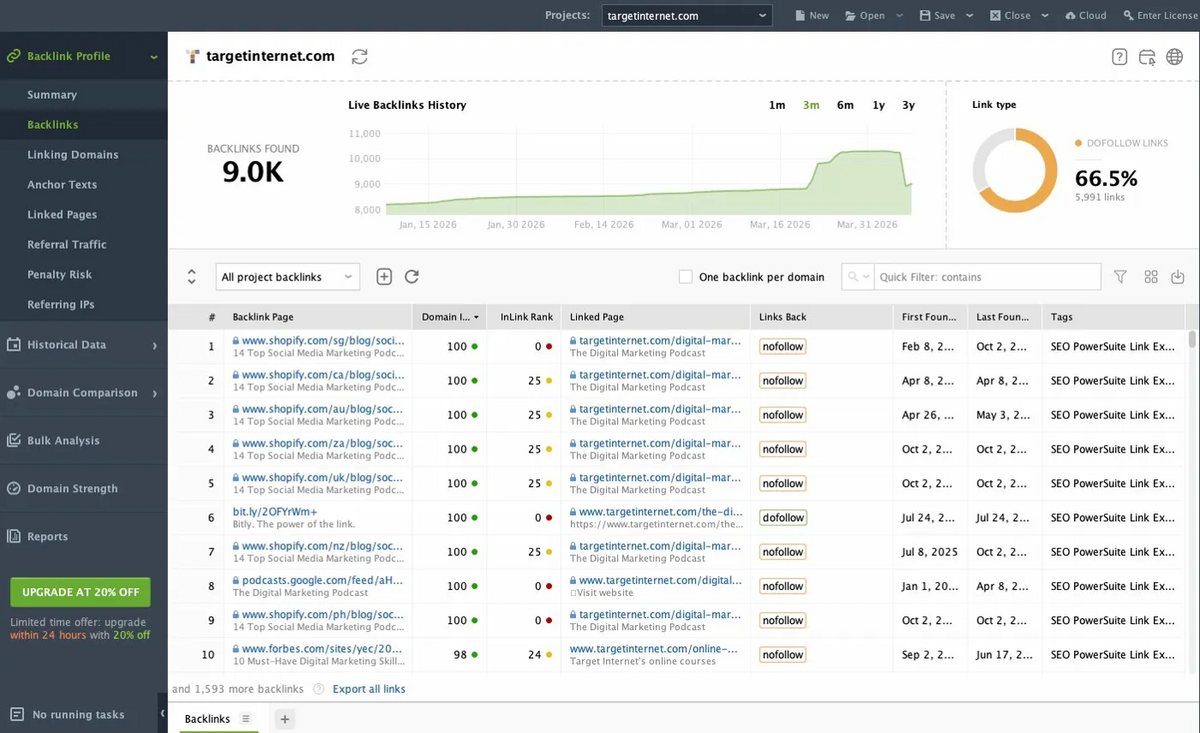
Not all backlinks are equal, and the Backlinks tab makes that easy to assess.
When you open it, you get every link pointing at your site alongside domain authority, dofollow/nofollow status, the destination page, and first/last found dates. When you switch to the Linking Domains view, the data aggregates by domain rather than individual link, which is a more useful lens for judging overall profile quality. You can see quickly whether your links are coming from authoritative, relevant sources or from domains you'd rather disavow.
Linked Pages
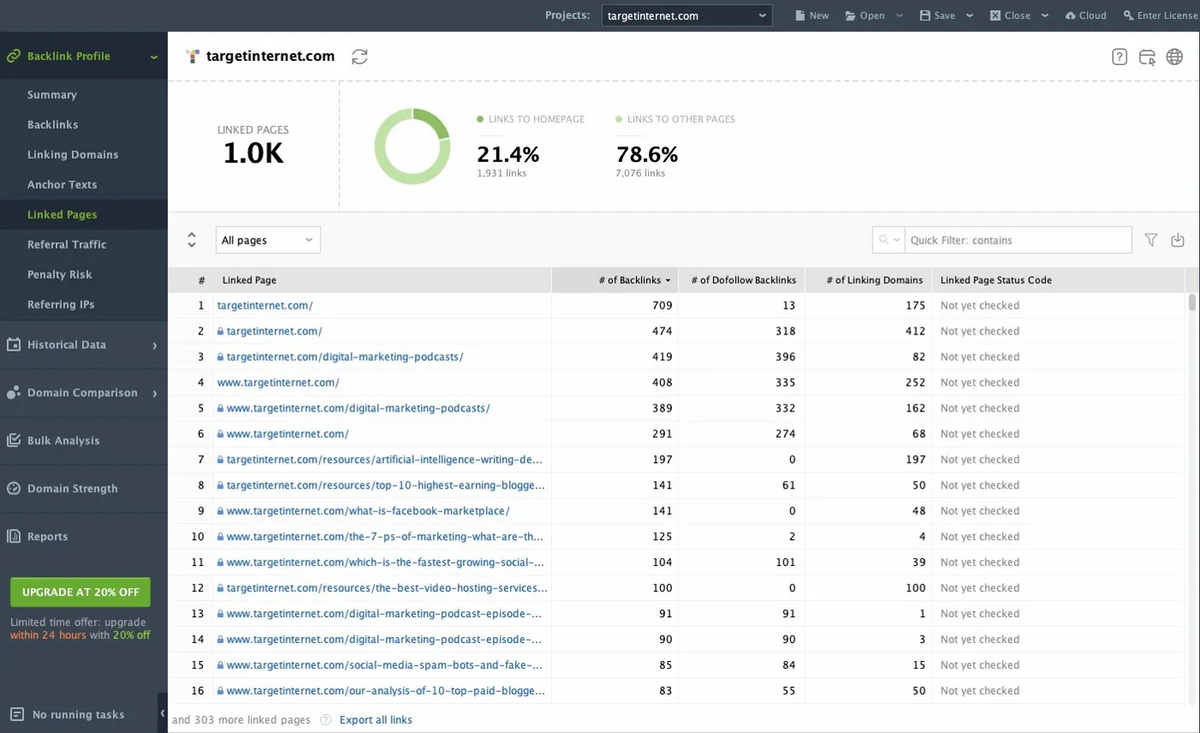
The Linked Pages view shows which pages on your site are attracting the most backlinks, with a split between homepage links and links to other pages. This is useful for understanding where your backlink equity is concentrated. If most of your links point to the homepage and almost nothing reaches your deeper content, that's a distribution problem you can address with internal linking.
Domain Comparison
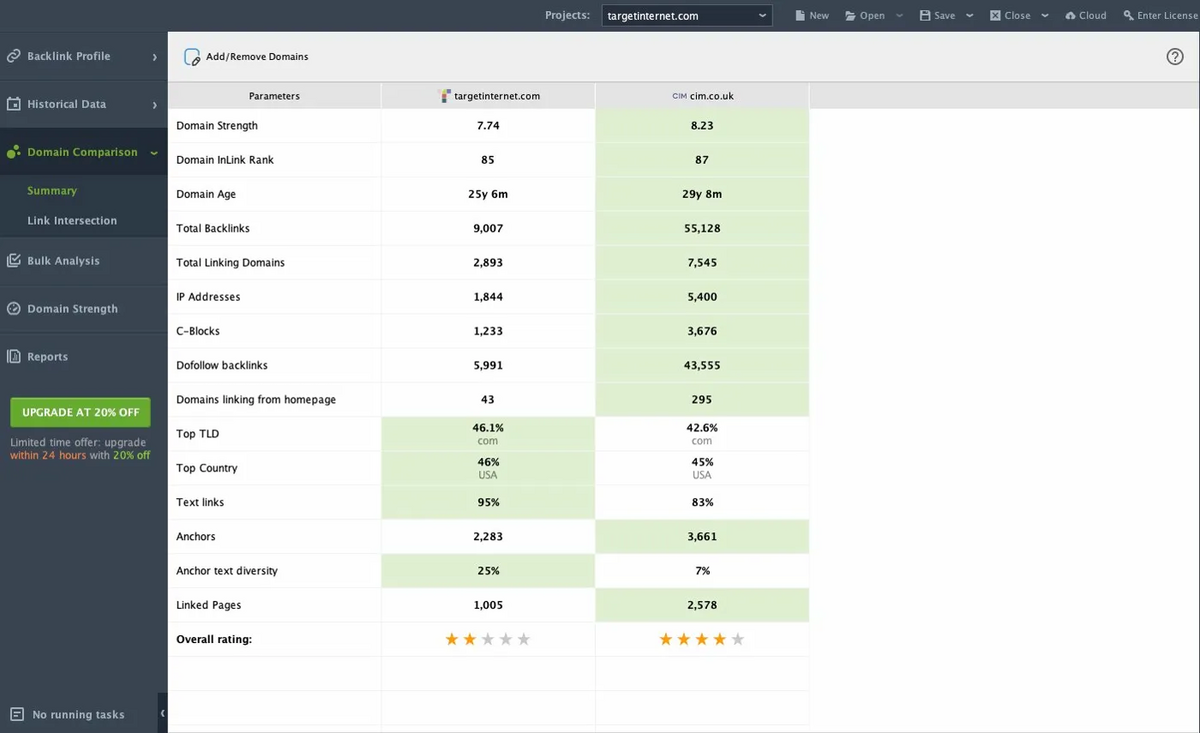
When you use the Domain Comparison view, SEO SpyGlass puts 16 metrics side by side for you to compare in a single table: domain strength, backlinks, linking domains, dofollow ratios, anchor text diversity, and more.
Bulk Analysis
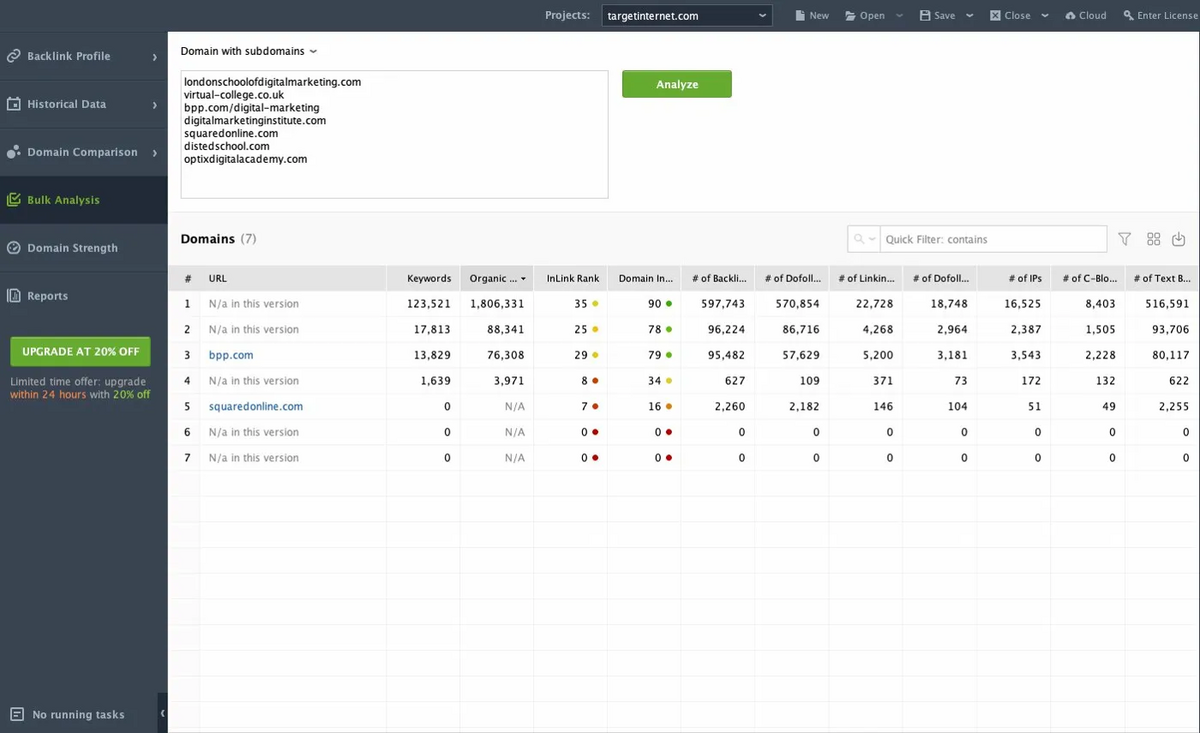
If you want to assess multiple competitors at once, the Bulk Analysis view lets you paste in a list of domains and compare them all across keywords, organic traffic, authority, backlinks, linking domains, and more in a single table. Semrush's Bulk Backlink Analysis handles up to 200 URLs, and Ahrefs has a comparable batch tool, but both carry monthly rates that dwarf SEO PowerSuite's annual cost. For budget-conscious competitive research, this feature pulls its weight.
Pricing
Now that we've finished reviewing all 4 tools in SEO PowerSuite, let's talk pricing.
The pricing is very different from every other tool that we've reviewed. Instead of a monthly SaaS subscription, you pay an annual licence fee for desktop software. That makes the headline price dramatically cheaper than competitors, and it's the platform's primary selling point.
There are four tiers:
- Free: All four tools with significant limitations. One project, no saving, limited crawl and backlink allowances, one competitor per project, with AI Overview tracking. This tier is genuinely useful for a one-off audit or a quick backlink check. You can get real value from it, particularly in SEO SpyGlass, but the inability to save projects makes ongoing work impractical. You will need to set everything up each time you close/open the app.
- Professional ($349/year): Unlimited projects, unlimited keywords, unlimited backlinks. Full site crawls, 5 competitors per project, access to the 216M keyword database and 2.7 trillion backlink index. 550+ search engines for rank tracking, one year of historical data, 20+ keyword research tools, in-app content optimisation, and Dropbox integration.
- Enterprise ($599/year): Everything in Professional, plus white-label reports, PDF/HTML exports, customisable report templates, automated scheduling and delivery, data exports, priority support, and 40 competitors per project.
- Max+ ($899/year): Everything in Enterprise, plus a free Awario Starter plan (first year only; Awario is a social listening tool). Includes an SEO course, personalised onboarding, Partner Agencies directory listing, Certified Partner badge, a guest post on their blog, beta feature access, a dedicated customer success manager, and one custom SEO question per month.
The price comparison against cloud competitors is stark.
Semrush starts at $199/month ($2,388/year). Ahrefs starts at $129/month ($1,548/year). AWR starts at $139/month ($1,668/year). Even WebCEO's Solo plan at $36/month costs more annually than SEO PowerSuite's Professional tier.
At $349/year, SEO PowerSuite is the cheapest full-featured SEO platform available. The question is whether the savings justify the trade-offs. You're giving up cloud convenience, modern UI, faster processing, and the security of not hosting SEO tools on your own machine. For a freelancer or small agency on a tight budget, Professional is hard to argue against on price alone. For agencies needing white-label reporting, Enterprise at $599/year is still less than a single month of Semrush's Business tier.
The Max+ plan is harder to recommend. The only additions are marketing perks, partner badges, blog posts, and course access, instead of giving you more features or higher rate limits. Unless you specifically need the onboarding support and dedicated CSM, the Enterprise plan covers everything functional you'll need.
The Verdict
SEO PowerSuite is the most affordable full-featured SEO platform we've found in our SEO comparison report. That's its strongest argument, and in some cases, it's enough.
The desktop model is the main trade-off.
You're managing four separate applications, each with its own interface and project files, on a machine that will feel the strain - no cloud tool makes you do this. What you save on subscriptions, you lose on setup hassles, slower processing, and a workflow that feels outdated compared to the industry's progress.
WebSite Auditor is the most well-built out of all 4 tools, and SEO SpyGlass holds its own on backlink analysis. If those two tools are your primary need and budget is your primary constraint, the Professional tier at $349/year is a serious offer that's hard to dismiss. But we'd be doing you a disservice if we didn't flag the security concerns clearly.
The permission requests during installation go well beyond what SEO software needs.
The OAuth bypass in Autocomplete Tools, which asks for your Google email and password in plain text inside the application, is a red flag that goes beyond poor UX. Whatever you do, please make sure that you do not enter your credentials there. If you do install this tool, review every permission request carefully, particularly on Windows, where the controls are less granular.
Yes - it is one of the most affordable tools.
But with the lag in UI, high processing times, and lack of 'easy features' that really aren't that hard to build, we'd be lying if we said that SEO PowerSuite provides software that matches up to the competition. In terms of all 3 - UI, features, and workflow - you'd be better off with tools like Semrush or Ahrefs because of the level of sophistication they provide. Tools like those are well thought-out and updated regularly to ensure that they are reflective of the latest search engine updates.
Most importantly, they are differentiated because they regularly add new features to beat each other in value. Also, when it comes to something like SEO, having the bare minimum is never enough.
Example: if you're website A and competing with website B, and both of you start with the same level of Domain Authority, Linking Domains, and Traffic. Website A (you) uses SEO PowerSuite. Website B uses Semrush.
Website B will win against you because they have a much stronger arsenal. With how competitive SEO is, it's sometimes about how much firepower you're bringing to the fight in the first place.
Both of you might be working hard. Both of you might be creative.
But creativity needs something to work with. Website B will find keyword & backlink gaps you can't see, track content opportunities you'd miss, and diagnose technical issues before they cost you rankings. Not to be overdramatic, but you would not lose because you're less talented. You would lose because trying to fight Semrush with SEO PowerSuite is like going in with a knife to a gunfight.
Click here to get back to the 2026 SEO tools comparison report.
Frequently Asked Questions (FAQs)
1. What is SEO PowerSuite?
SEO PowerSuite is a desktop-based SEO platform with four separate applications: Rank Tracker, LinkAssistant, WebSite Auditor, and SEO SpyGlass.
2. How much does SEO PowerSuite cost?
The free tier includes all four tools with limitations (no project saving). Professional is $349/year, Enterprise is $599/year, and Max+ is $899/year. Annual desktop licences, not monthly subscriptions.
3. Does SEO PowerSuite track AI search?
Yes. Rank Tracker includes Google AI Overview tracking on all tiers, including the free tier.
4. Is SEO PowerSuite better than Semrush or Ahrefs?
No. Both are stronger in almost every category. SEO PowerSuite's advantage is price. If budget is your primary constraint, it covers the basics at a fraction of the cost.