Who is the highest paid YouTuber in 2026? The short answer: MrBeast (Jimmy Donaldson), by an enormous margin. Forbes estimates he earned $300 million in the year to March 2026, roughly 4.6 times more than second-placed Dhar Mann and about the same as the next eight creators combined. Across the wider creator economy, the top 50 creators earned a combined $1.02 billion this year, the first time the list has passed the billion-dollar mark.
In this guide we rank the ten highest earning YouTube creators of 2026 and, more usefully, break down what each one can teach you about content strategy, audience building and monetisation. Because the interesting story this year is not just who earns the most: it is how completely the top earners have outgrown YouTube ad revenue.
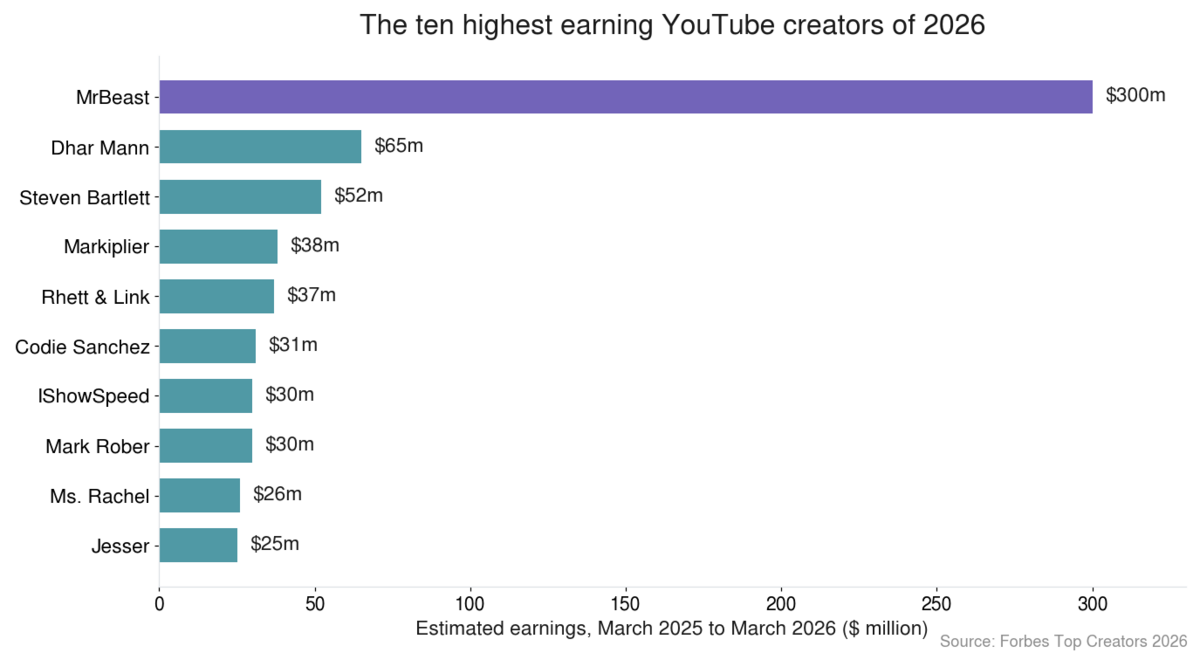
1. MrBeast (Jimmy Donaldson): estimated $300 million
Followers: 873 million across platforms
MrBeast is no longer best understood as a YouTuber. Beast Industries spans viral entertainment, consumer products (the Feastables chocolate brand), games and large-scale productions such as Amazon's Beast Games, with a reported valuation around $5 billion. Only a minority of his income now comes from YouTube advertising; the majority comes from brands, products and media deals built on the audience YouTube gave him.
The content itself still follows the formula our earlier analysis identified: fast cuts, escalating stakes, huge budgets, a recurring cast of friends, and displays of generosity that make the videos feel like event television. The difference now is scale: each video is effectively a marketing engine for a diversified business. His interview on the Diary of a CEO podcast below gives a revealing look at the mentality behind it.
Key takeaway: the platform builds the audience; the business is built off-platform. Ad revenue is the smallest prize.
2. Dhar Mann: estimated $65 million
Followers: 171 million
The biggest riser of recent years, Dhar Mann produces short moral-dilemma dramas at industrial scale, in dozens of languages, across YouTube and every short-form platform. His studio employs hundreds of people and behaves like a modern television production company that happens to distribute for free.
Two lessons stand out. First, repeatable formats scale: every video follows the same narrative arc, which makes production fast and audience expectations reliable. Second, translation and localisation multiply reach at low marginal cost, something most brands still underuse.
Key takeaway: a tightly repeatable format plus systematic localisation is a growth machine.
3. Steven Bartlett: estimated $52 million
Followers: 38.7 million
The smallest audience in the top five, and that is precisely the lesson. The Diary of a CEO host earns from podcast sponsorship, live events, books, speaking and investments, all flowing from a video-first interview show whose hour-long watch times the YouTube algorithm rewards.
Long-form trust-building content can be worth more per viewer than viral entertainment, because the audience arrives with high intent and stays. Bartlett monetises depth, not reach.
Key takeaway: an hour of attention sells premium products in a way 60 seconds never will. Revenue per follower beats followers.
4. Markiplier (Mark Fischbach): estimated $38 million
Followers: 76.8 million
The gaming and comedy stalwart remains near the top through relentless consistency, a film deal, and subscription ventures beyond YouTube. His convivial, tongue-in-cheek tone and reciprocal guest appearances with other creators keep the audience compounding year after year.
Key takeaway: longevity is a strategy. Consistent output and cross-channel collaboration compound like interest.

5. Rhett & Link: estimated $37 million
Followers: 45.6 million
Good Mythical Morning still releases an episode every weekday, making the show part of its audience's daily routine, and the pair have built Mythical Entertainment into a studio with multiple shows, merchandise and a creator accelerator.
Key takeaway: find your place in your audience's daily routine; habit beats virality.
6. Codie Sanchez: estimated $31 million
Followers: 10 million
The smallest audience in the entire top ten. Sanchez built her Contrarian Thinking brand on "boring business" content: buying laundromats and car washes rather than chasing startups. Her income comes from newsletters, courses and an investment arm, with YouTube as the discovery channel.
She is the clearest proof on this list that a tightly defined niche with high commercial intent out-earns a big general audience.
Key takeaway: ten million followers with buying intent beat a hundred million passive viewers. Niche plus product is the formula.
7. IShowSpeed: estimated $30 million
Followers: 184 million
The live-streaming phenomenon turned global tours into massive audience growth: his marathon streams from China became cultural events watched by tens of millions. Earnings flow from streaming, sponsorship and appearances. His unscripted, high-energy style shows the commercial power of authenticity at scale, and of taking content to where new audiences are.
Key takeaway: live, unscripted content builds connection faster than polished production, and travelling to your audience grows it.
8. Mark Rober: estimated $30 million
Followers: 90.7 million
The former NASA engineer's science and engineering spectaculars feed CrunchLabs, his subscription toy box business that turns viewers into monthly subscribers. It is one of the cleanest creator-to-product funnels in existence: every video demonstrates the exact kind of engineering joy the product delivers.
Key takeaway: the best creator products are the content, productised. Align what you sell with what you show.
9. Ms. Rachel: estimated $26 million
Followers: 34.2 million
Rachel Accurso's toddler-education content has succeeded the kid-channel generation: Nastya and Ryan's World, fixtures of our previous lists, have both fallen down the rankings while Ms. Rachel captured the pre-school market. Her background as an educator gives the content credibility with the people who actually control the screen, the parents, while licensing, streaming deals and toys carry the business model past YouTube's limits on advertising to children.
Key takeaway: for children's content, the parent is the customer; credibility and trust are the product.
10. Jesser: estimated $25 million
Followers: 54.9 million
Basketball creator Jesser represents the sports-content generation that grew up on Dude Perfect: challenges, trick shots and collaborations, monetised through merchandise (his Bucketsquad brand) and deals with sports labels.
Key takeaway: own the merchandise brand, not just the channel. Superfans want to wear the community.
Who dropped out, and what it tells us
Compare this list with our previous edition and the churn is striking. Jake Paul and Logan Paul have moved their earnings into boxing, drinks and media ventures counted outside creator income. The kid-channel giants Nastya, Unspeakable and Preston Arsement have slipped as their audiences aged. Dude Perfect sits just outside the top tier while it invests in its own platform. The lesson: creator earnings are now business earnings, and the top of the list belongs to those who converted attention into companies.
What this means for your own channel or brand
You do not need a $300 million business to apply these lessons. Pick a repeatable format your audience can rely on, publish consistently enough to become a habit, treat ad revenue as the floor rather than the ceiling, and think early about what you can own: an email list, a product, a community. Every creator above did exactly that before the money arrived.
If you want to build these skills systematically, Target Internet members get structured courses in content strategy, social media and video marketing, with skills benchmarking to show exactly where to focus. See our membership options and start building your own audience engine.
Sources
Forbes Top Creators 2026 (June 2026), estimated earnings March 2025 to March 2026, as visualised by Visual Capitalist. All figures are estimates.