By Daniel Rowles, lead trainer at Target Internet and author of Digital Branding (Kogan Page). Last updated: November 2026.
Pokemon Go makes money from a free app through in-app purchases of PokeCoins, a web store, ticketed live events, sponsored real-world locations and accessories. Ten years after launch it has passed $9 billion in player spending, making it one of the most successful free-to-play mobile games ever.
How successful has Pokemon Go been?
When Pokemon Go launched in July 2016, it became a global phenomenon within weeks, with crowds gathering in parks and city centres to catch virtual creatures on their phones. Many expected it to fade as quickly as it arrived. Instead it has lasted a decade.
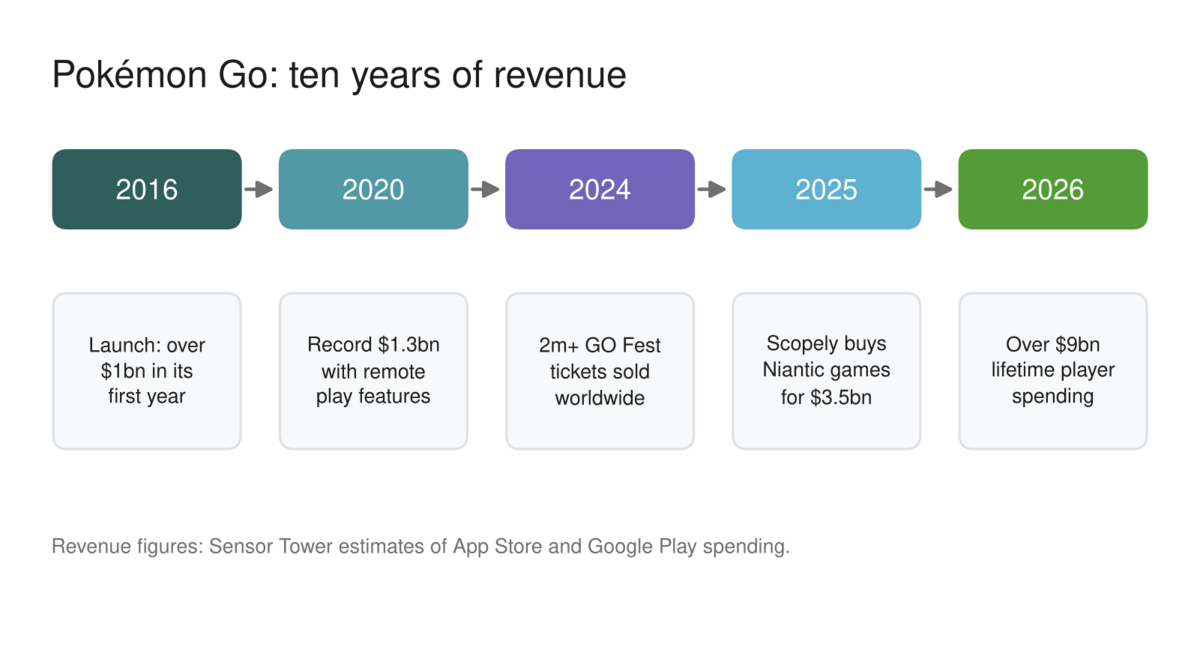
According to Sensor Tower estimates reported by PocketGamer.biz, Pokemon Go had generated more than $9 billion in gross player spending by its tenth anniversary in July 2026. Only a handful of mobile games launched since 2016 have earned more. It made over $1 billion in its first year, and spending peaked during the pandemic, when new features allowed players to take part remotely.
The business behind it has also changed hands. In 2025, Scopely, the publisher of MONOPOLY GO!, agreed to buy Niantic's games business, including Pokemon Go, for $3.5 billion, as PocketGamer.biz reported. At the time, Pokemon Go was still attracting more than 20 million weekly active players.
How does Pokemon Go make money?
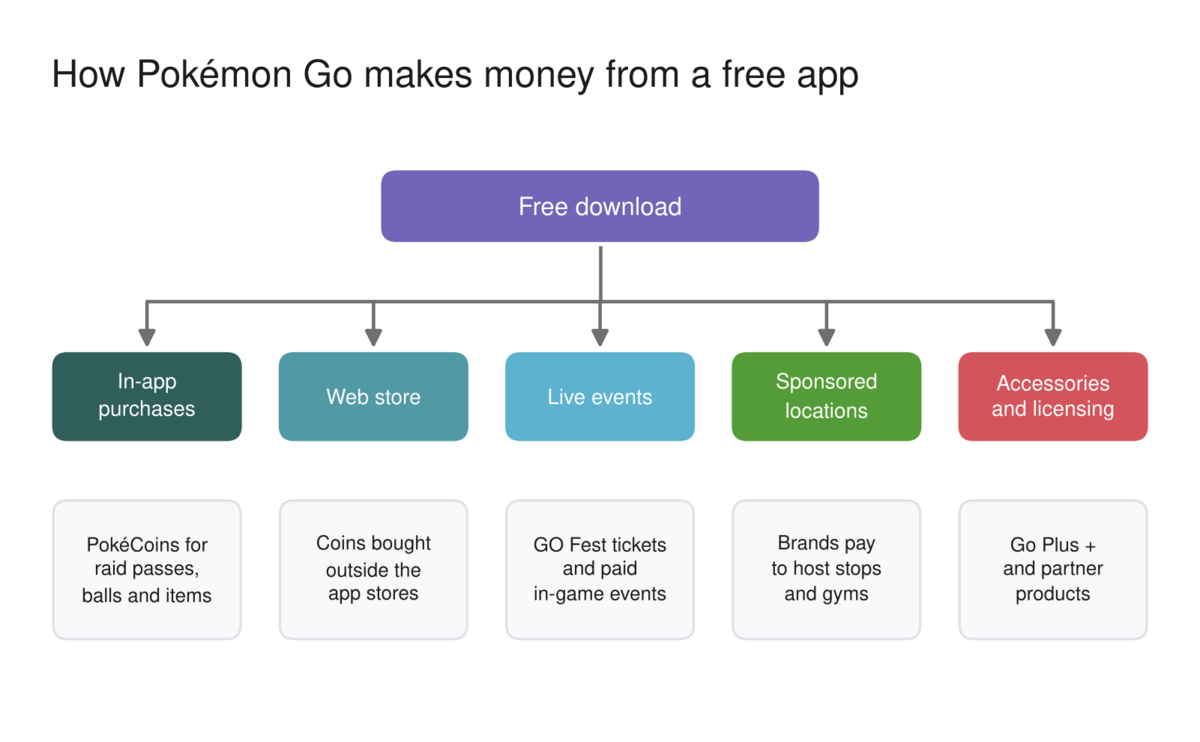
Pokemon Go is free to download, so every penny of revenue comes from players who choose to pay, or from partners who want to reach them. Its income comes from five main sources:
- In-app purchases: players buy PokeCoins and spend them on raid passes, extra Poke Balls, lures, incubators, storage upgrades and cosmetic items.
- Web store: coins and bundles can also be bought through an official web store, outside the app stores, which lets the publisher avoid some app store fees.
- Live events: ticketed events, both in-game and in person, give players exclusive content and experiences.
- Sponsored locations: brands pay to turn their stores into in-game PokeStops and Gyms, driving footfall.
- Accessories and licensing: devices such as the Pokemon Go Plus + and partnerships across the wider Pokemon brand.
In-app purchases
In-app purchases are the core of the model. As in most top-grossing mobile games, the majority of players never pay, while a smaller group spends regularly to progress faster, take part in more raids or collect rarer Pokemon. Because the items are digital, the margin on each sale is very high once the game is built.
Moving some sales to a web store matters too. App stores typically take up to 30% of in-app purchases, so selling coins directly can significantly improve margins. Since court rulings in the US in 2025, many mobile game publishers have moved in the same direction.
Live events
Live events have become one of Pokemon Go's most distinctive strengths. Pokemon GO Fest sold more than two million tickets across its events in 2024, according to Kidscreen. In-person festivals attract tens of thousands of players to host cities, and a Statista study commissioned by Niantic found the three 2024 GO Fest events generated more than $200 million for their host cities, as Dexerto reported. That gives cities and tourism bodies a strong reason to partner with the game.
Sponsored locations
Sponsored locations were one of the first new revenue streams. When Pokemon Go launched in Japan in July 2016, around 3,000 McDonald's restaurants became in-game Gyms, and other brands followed in later years. For a retailer, an in-game location is a way to bring players through the door, and for the game it is advertising that adds to the experience rather than interrupting it.
The balancing act is restraint. Too many sponsored locations would feel commercial and make stops less special, so they have been used selectively rather than everywhere.
What are the risks of the free-to-play model?
Pokemon Go's success hides some of the risks that come with monetising a free app, and they are worth understanding before copying the model:
- Player backlash: price rises or changes that make free play harder can anger loyal players. Pokemon Go has faced criticism over changes to remote raid passes, for example, showing how quickly goodwill can be tested.
- Dependence on a small group of spenders: when most revenue comes from a minority of players, losing them hits income hard.
- Safety and privacy: a game that sends people into the real world and uses their location carries responsibilities around safety, children and data. Players increasingly care about the app permissions they grant.
- Regulation: in-app purchases aimed at younger players, and mechanics such as paid random rewards, attract growing scrutiny from regulators.
The brands that sustain free-to-play models over many years treat these risks as part of the product, communicating changes clearly and protecting the experience for players who never pay.
What can marketers learn from Pokemon Go?
Pokemon Go offers lessons that apply far beyond gaming:
- Nostalgia is powerful: the game reconnected adults who grew up with Pokemon in the 1990s with the brand, and gave them something to share with their children.
- Give value first: a genuinely good free experience builds the audience that a small paying minority then funds.
- Run it as a live service: constant events, seasons and community days keep players returning, years after launch. A well-planned content calendar does the same for any brand.
- Bridge digital and physical: by sending people into the real world, the game created footfall, partnerships and local economic impact that a purely digital product cannot.
- Community drives longevity: raids and live events reward playing with others, which makes leaving the game more costly.
Not every brand has a Pokemon-sized franchise, but the principles of offering real value, building community and blending online and offline experiences apply to any business. Our case study on crowd source funding shows the same community dynamic at work in a very different context.
Understanding models like this, and applying them to your own marketing, depends on broad digital skills. The Target Internet platform helps you build them, with interactive courses across digital marketing and AI, skills benchmarking to show where your gaps are, accredited certification, over 400 episodes of the Digital Marketing Podcast, and monthly live masterclasses.
Copy and paste prompt: "Using Pokemon Go as inspiration, suggest five ways [brand or business] could connect digital engagement with real-world visits or experiences for [audience]. For each idea, describe the customer benefit, how we would promote it, a possible partner, the metric we would track, and one risk to manage. Keep ideas realistic for a budget of [budget]."
If you are ready to take a structured approach to building your digital marketing skills, explore Target Internet membership options and discover how the platform's interactive courses, benchmarking tools, podcast, accredited certification and live masterclasses can help you turn ideas like these into campaigns.
Frequently asked questions
How much money has Pokemon Go made?
According to Sensor Tower estimates, Pokemon Go had generated more than $9 billion in gross player spending on the App Store and Google Play by its tenth anniversary in July 2026. That excludes revenue from its web store, live event tickets and partnerships.
Is Pokemon Go still popular?
Yes. When Scopely agreed to buy Niantic's games business in 2025, Pokemon Go still had more than 20 million weekly active players, and its live events continue to sell out in cities around the world.
Who owns Pokemon Go now?
Pokemon Go was developed by Niantic in partnership with The Pokemon Company. In 2025, Niantic sold its games business, including Pokemon Go, to Scopely for $3.5 billion, while Niantic's mapping and AR technology became a separate company.
Do businesses pay to be PokeStops?
Some do. Sponsored locations, starting with McDonald's in Japan in 2016, let brands turn their stores into in-game locations. Most PokeStops, however, are landmarks and public places submitted by players rather than paid placements.
Why is Pokemon Go a good marketing case study?
It shows how a free product can earn billions through optional purchases, how live events and real-world partnerships extend a digital brand, and how community and constant content updates keep customers engaged for years.
About the author
Daniel Rowles is lead trainer at Target Internet and the author of Digital Branding (Kogan Page). He co-hosts The Digital Marketing Podcast and delivers digital marketing and AI training for organisations around the world, including digital transformation and future skills. You can find out more on his Target Internet profile.
Bibliography
1. PocketGamer.biz (2026). Pokemon Go celebrates 10th anniversary with over $9bn in revenue. https://www.pocketgamer.biz/pokemon-go-celebrates-10th-anniversary-with-over-9bn-in-revenue/
2. PocketGamer.biz (2025). Scopely acquires Pokemon Go developer Niantic's games business in $3.5bn deal. https://www.pocketgamer.biz/scopely-acquires-pokmon-go-developer-niantics-games-business-in-35bn-deal
3. Kidscreen (2025). Scopely buys Niantic's entire gaming division in a US$3.5-billion deal. https://kidscreen.com/?p=220593
4. Dexerto (2025). Pokemon Go Fest host cities earned mind-blowing amount in 2024. https://dexerto.com/pokemon/pokemon-go-fest-host-cities-earned-mind-blowing-amount-in-2024-3025880
5. Fortune (2017). Pokemon Go tops $1 billion in revenue. https://fortune.com/2017/02/01/pokemon-go-tops-1-billion-in-revenue/